How to Mix Peptides with Bacteriostatic Water: A Safety-First Guide

A familiar-looking vial doesn’t mean a familiar mixing formula. If you’re searching for how to mix peptides with bacteriostatic water, the key point is that there’s no universal volume to use. The applicable information depends on the exact product and its directions.
Conflicting advice can make reconstitution seem like a simple calculation. It isn’t safe to apply a volume from one vial to another. The amount of peptide in a vial and the volume of liquid added are different measurements, and both matter when describing a concentration.
This guide explains the terminology and the checks to make before relying on product information. It covers why directions need to match the exact product, what to do when information is missing or unclear, and when to pause. Peptides and bacteriostatic water in the Quanta Pharma range are supplied for research use only, not for human use. This article isn’t a mixing protocol or medical advice. If you’re considering human use, don’t proceed on the basis of online instructions. Seek guidance from a qualified healthcare professional.
Key Takeaways
- Understand what reconstitution means and why the product’s own information must guide how you interpret it.
- Learn why “how to mix peptides with bacteriostatic water” has no universal answer that applies to every vial.
- Use a pause-and-check list to review the exact product identity, label and applicable information before acting.
- See why a calculator can check arithmetic but cannot confirm that the underlying product information is right.
- Find product-specific information for Quanta Pharma lyophilised vials and 10 ml bacteriostatic water on their product pages.
How to mix peptides with bacteriostatic water: what reconstitution means
Unsure what “mixing” means when a peptide arrives as a dry powder? Start with the term, not a calculator. Reconstitution means preparing a lyophilised product as directed in its own product information. It describes a process, not a standard recipe. This matters because products can differ in their contents, formulation and intended use.
So, how to mix peptides with bacteriostatic water? There isn’t one answer that applies to every vial. Bacteriostatic water is a diluent, meaning a liquid used to prepare a product when its information specifies it. It doesn’t set a volume, dose or method by itself. Those details must come from applicable, product-specific directions, not a general online example.
Products and intended uses can have different requirements. A liquid suitable for one product may not be specified for another. The fact that bacteriostatic water is sold alongside a product doesn’t establish that it is appropriate for every peptide. This explanation is for understanding terminology in a research context. It isn’t a mixing protocol or guidance for human use.
What does lyophilised mean?
Lyophilised means freeze-dried. In plain terms, the product is supplied in a dry form rather than as a ready-made liquid. The dry contents and a prepared liquid are different states of the product. Reconstitution refers to preparing the liquid form according to the relevant directions. Don’t assume the powder’s appearance tells you which liquid, amount or method applies. Those details need to be stated for the exact product.
What is bacteriostatic water used for?
Bacteriostatic water is used as a diluent in some product instructions. “Bacteriostatic” refers to limiting bacterial growth, as described in this overview of the Bacteriostatic Agent concept. The term alone doesn’t mean the water is a universal match, nor does it explain how a particular product should be prepared. Don’t treat it as interchangeable with every sterile liquid. Follow the specific product information, and pause if it doesn’t name the appropriate diluent or leaves the directions unclear.
Keep three ideas separate:
- Lyophilised: the product is in a freeze-dried form.
- Diluent: a liquid used for preparation when specified.
- Reconstitution directions: product-specific information that explains what applies to that vial.
This vocabulary helps you read a label without confusing the dry contents with the liquid used to prepare them. It also helps you spot a gap: knowing what bacteriostatic water is does not tell you whether a particular vial calls for it. If the label and product information don’t clearly match the item in hand, don’t fill in the blanks with another product’s directions. For research use only, not for human consumption.
Why peptide reconstitution instructions must match the exact product
A calculator can make conflicting information look precise. It can’t tell you whether the information entered belongs to the vial in front of you. For a clear interpretation, consider the product identity, vial label and applicable product information together. If one doesn’t match the others, stop rather than filling the gap with an online example.
These terms describe different things. Vial strength refers to the stated amount of product in the vial. Liquid volume is the amount of diluent specified for preparation. Concentration describes the amount of product in a given volume of prepared liquid. Dose refers to an amount intended for use, which is not established by a vial strength or calculator result. Don’t treat one measurement as a substitute for another.
Why there is no reliable universal water-to-peptide ratio
Peptide vials can have different stated strengths, and product directions can differ too. A direction for one product does not automatically apply to a different peptide, even if the packaging or format looks similar. Don’t transfer a ratio, volume or preparation instruction between products. If the exact product’s directions are missing, unclear or inconsistent with its label, pause. An assumed ratio cannot resolve that uncertainty.
What a peptide calculator can and cannot tell you
A calculator can perform arithmetic using values entered into it. It cannot identify the vial, confirm the diluent, assess whether the directions apply or supply missing product information. Its output is only as relevant as its inputs. Values must come from applicable directions for the exact product, not from a different vial or a general online guide.
A calculation does not confirm that a preparation is suitable. It only processes the numbers supplied. If a calculator produces a neat result from guessed or borrowed values, that result doesn’t turn them into valid directions. Don’t use a calculation to create information that hasn’t been provided.
For example, if a label names one product but the figures in an online calculator refer to another, the arithmetic may still work. The result still won’t verify the correct preparation. Check that the product name and stated strength correspond, then read the information for that exact item. If the details don’t align, don’t proceed on the basis of a calculation.
Keep research product information separate from personal medical guidance. A product page can help identify details listed for an item, but it can’t determine whether that product is suitable for an individual or provide a treatment plan. For personal medical decisions, seek advice from a qualified healthcare professional.
For research use only, not for human consumption. You can review Quanta Pharma vial information as part of checking product-specific details. It isn’t a substitute for clear product information or qualified healthcare guidance about human use.
Peptide vial mixing myths: what generic guides cannot establish
The main myth is simple: one online recipe does not fit every vial. A guide may explain a general idea or show how a calculation works. That doesn’t make it an instruction for the product you have. Consider the vial’s identity, label and product-specific information together. If those details don’t line up, don’t guess.
Generic guidance cannot replace information for the exact product. This is the difference between background information and a direction you can apply. A clear-looking liquid doesn’t prove that the right diluent or preparation method was used. Nor does a calculator result confirm that its inputs were suitable. Appearance and arithmetic can’t verify product compatibility.
Does bacteriostatic water make every peptide vial suitable for preparation?
No. The fact that a liquid is bacteriostatic doesn’t establish that it is compatible with every product or intended for every preparation. Suitability depends on the exact product information, not the diluent’s name alone. Read the applicable information for the vial. If you’re considering human use, don’t rely on an online guide. Seek advice from a qualified healthcare professional.
Can an online example be copied to another vial?
No. An example can demonstrate how figures relate, but it can’t account for another vial’s label or directions. A different product identity or stated strength changes what information applies. Don’t transfer an example simply because the containers look alike or the numbers seem familiar. If the label and directions conflict, or key information is absent, pause and seek qualified healthcare advice before proceeding.
Use this distinction to assess what a source can tell you:
- General explanation: helps define terms and describe why product directions matter. It doesn’t establish the preparation for a particular vial.
- Online example: illustrates a calculation using its own assumptions. It doesn’t verify another product’s details.
- Exact product information: relates to the identified product and its stated requirements. It is the relevant reference for interpreting that product.
The phrase “how to mix peptides with bacteriostatic water” can sound as though it has one practical answer. It doesn’t. A generic page can’t establish which directions apply to your vial, and a similar-looking label isn’t enough if the product identity or instructions remain uncertain. Keep the source and product information together as you read. Don’t combine details from unrelated pages to make a complete-looking recipe.
For research use only, not for human consumption. This section explains the limits of generic guidance. It isn’t a mixing protocol, dosing advice or medical guidance. If product information is incomplete or inconsistent, stop rather than trying to resolve the gap with an online example.
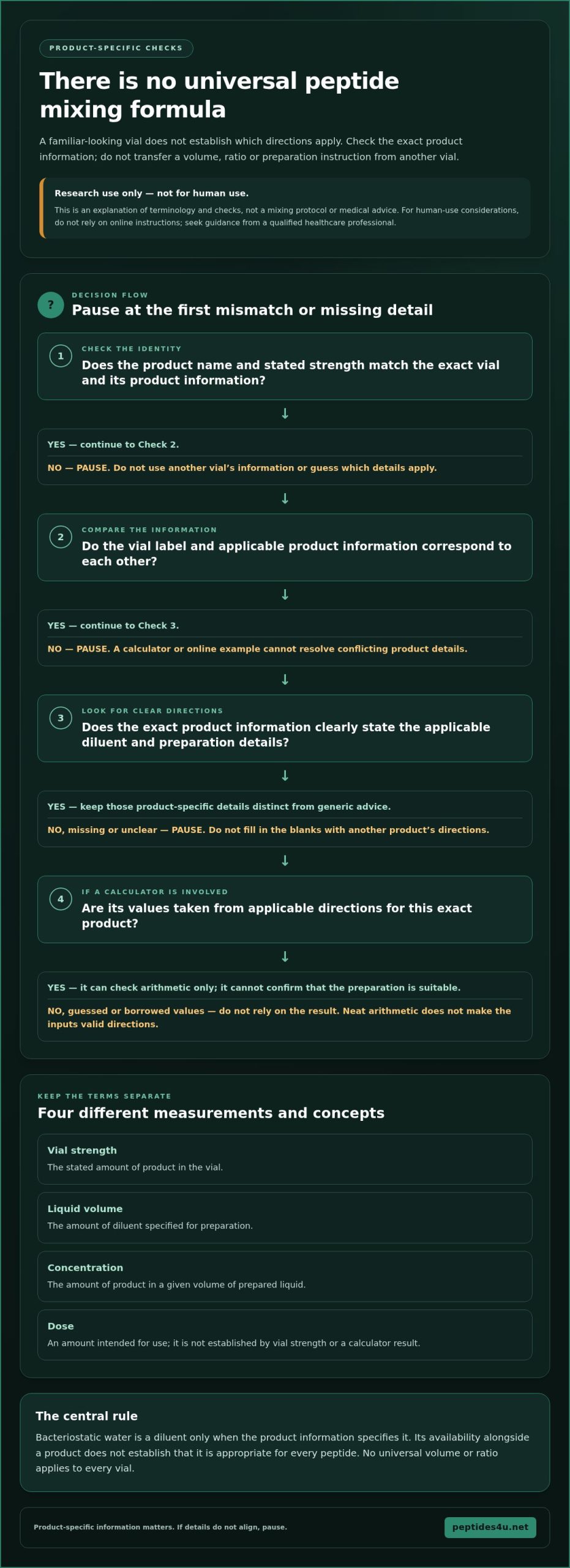
A safety-first checklist before acting on reconstitution information
Before relying on reconstitution information, pause. This checklist helps you assess whether the information is clear and relevant. It isn’t a set of mixing or injection steps. The key question is whether the guidance matches the exact product and its stated intended use. If you can’t establish that, don’t proceed on assumptions.
What to verify before relying on an instruction
Compare the product identity and formulation on the vial with the matching product information. Check that the label is legible and the packaging intact. Then confirm that the directions you’re reading clearly apply to that exact product. Similar names or packaging aren’t enough. A general guide or calculator can’t supply product information that is absent.
- Product identity: Does the name and formulation in the guidance match the vial and its product information?
- Label and packaging: Are the details readable, consistent and undamaged? If the packaging appears damaged or the label can’t be read, stop.
- Applicable directions: Do the instructions clearly relate to this exact product and intended use? Don’t borrow directions from another vial.
- Consistency: Do the label and product information agree? If they conflict, don’t choose the version that seems most plausible.
- Missing details: Are essential directions absent or ambiguous? Don’t use online examples to fill in the gaps.
These checks assess the information, not whether a preparation is approved or suitable. A label can be clear yet still leave an important question unanswered. Likewise, a calculator may display a result without confirming that the source figures belong to the product. Treat unresolved details as a stop point, not a reason to improvise.
When to stop and seek qualified advice
Stop if you can’t identify the exact product, if instructions are unclear or conflicting, or if its intended use is uncertain. Don’t act on a best guess. This article is for research information only, not for human consumption, and can’t determine a treatment or injection plan. For personal medical decisions, speak with a qualified healthcare professional.
Keep the checklist focused. It helps you recognise when information is incomplete; it doesn’t establish that a product is suitable for a particular use. If the question is medical, product-page wording or an online calculation can’t replace individual advice from a qualified professional. If the question is what the product information says, rely on details for the exact item rather than generic instructions.
For a research-use product, review the relevant Quanta Pharma product information alongside its label. Peptides and bacteriostatic water aren’t a universal match simply because they appear in the same range. Keep product information separate from medical guidance, and pause if any detail doesn’t align.
Quanta Pharma vials and bacteriostatic water: where to find product information
General explanations can clarify terminology, but the next step is to look at information for the exact item. Peptides4u stocks lyophilised vials and bacteriostatic water in a 10 ml format. Their presence in the same range doesn’t mean the water is a universal match for every vial. Review the relevant product page for information about that item, and don’t use a general guide to fill gaps.
What Peptides4u product information can help you check
The product page is the place to review the information listed for a particular item. Match its name and formulation with the vial in hand. If a product is awaiting a lab report, this is marked on its product page. That status is separate from preparation directions: a report note doesn’t tell you how to prepare a vial or establish which diluent is suitable.
Quality information also needs to be read in context. Sealed, finished vials undergo independent HPLC and blind-screen testing, with results verified by Janoshik. This information applies to those sealed finished vials. It isn’t a claim about bacteriostatic water, and testing doesn’t replace product-specific instructions or medical advice. Keep each detail in its proper scope.
As you review a product page, check whether it identifies the exact item and whether its details correspond with the label. Don’t assume that similar names, a shared range or the presence of a matching liquid settles the question. If directions are unclear or absent, a calculation can’t supply them. Pause instead of combining details from different products.
A clear next step for readers
Product information comes first. Any calculation comes after, and only if the relevant directions provide the values and context it needs. The phrase “how to mix peptides with bacteriostatic water” may lead to broad online advice, but no general answer can establish the requirements for a specific vial. Keep research information separate from decisions about personal treatment or use.
Products are for research use only, not for human consumption. This article doesn’t provide a preparation protocol, dose or injection plan. For medical questions or decisions about human use, seek guidance from a qualified healthcare professional. Product-page details can help identify what is listed for an item, but they aren’t clinical guidance.
For the next step, browse the Peptides4u range and review the information for the exact product you’re considering. Don’t proceed if its identity or directions remain unclear.
Make your next step a clear one
If you’re still asking how to mix peptides with bacteriostatic water, don’t let a tidy online answer stand in for product-specific information. Identify the exact item and review its product page and label. If those details leave a question unanswered, pause. Uncertainty is a reason to seek clarification, not to improvise.
Keep research information separate from personal health decisions. Product descriptions can help you understand what is listed for an item, but they can’t determine whether it is appropriate for you or guide a treatment plan. For medical questions, speak with a qualified healthcare professional.
Ready to review the product information? Browse Quanta Pharma vials and bacteriostatic water, then consider the details for the exact product before taking any next step. A careful pause is progress too. Move forward only when the information is clear.
Frequently Asked Questions
How much bacteriostatic water should I add to a peptide vial?
There’s no universal volume that applies to every peptide vial. The answer must come from information for the exact product, not a generic guide or another vial’s label. If you’re researching how to mix peptides with bacteriostatic water, use this as a reason to check product-specific information, not as a recipe. Don’t prepare a vial if its applicable directions are missing or unclear. This article isn’t a preparation protocol or medical advice.
Can I use the same reconstitution instructions for different peptide vials?
No. Instructions for one vial shouldn’t be carried over to another, even if the labels or packaging look similar. The product identity and formulation matter. For example, a direction on a page for one item doesn’t become suitable for a different item because both are described as peptide vials. Treat each product separately, and don’t combine details from multiple sources to create instructions.
Is bacteriostatic water interchangeable with sterile water?
No. Don’t assume two liquids are interchangeable because both are described as water or sterile. Their suitability depends on the exact product instructions, and a liquid’s name alone doesn’t establish compatibility. Use only the diluent specified in the applicable product information. If the instructions don’t identify one clearly, pause rather than substituting another liquid. For questions about personal medical use, seek guidance from a qualified healthcare professional.
What should I do if the product instructions are missing or unclear?
Pause and don’t fill in the missing details with an online example, calculator or instructions for another vial. Check that you have information for the exact product and that it matches the label. If the directions remain incomplete or contradictory, don’t proceed on a guess. This guide can’t provide a substitute protocol. For any personal medical question, speak with a qualified healthcare professional.
Can a peptide calculator tell me how to prepare a vial?
No. A calculator can process values, but it can’t identify your product or confirm that the information entered applies to it. For instance, a neat result based on figures copied from a different vial still doesn’t verify the preparation. Don’t use a calculator to invent missing directions. Only consider calculations in the context of applicable product instructions, and pause if those instructions aren’t clear.
How should I store a prepared peptide vial?
Follow the storage directions supplied for the exact product and its prepared form. Don’t assume that unopened-vial guidance also applies after preparation, or infer a storage temperature or usable period from a general online post. If the product information doesn’t explain storage after preparation, don’t guess. Seek appropriate qualified guidance. This article doesn’t provide storage or handling instructions for human use.
What should I do if a vial or its packaging appears damaged?
Don’t use a vial if its packaging is damaged, the label is unreadable or the container appears compromised. Keep it separate from items you intend to use and retain its label and product details so the issue can be identified accurately. Don’t try to repair, transfer or prepare it. If you have a health-related concern, seek advice from a qualified healthcare professional. Peptide products discussed here are for research use only, not human consumption.