Peptide reconstitution in the UK: calculating volume and concentration
The right water volume isn’t a standard amount. It depends on the vial’s peptide mass and the concentration required by its product-specific instructions: for example, adding 2 ml to a 10 mg vial gives a calculated concentration of 5 mg/ml. This peptide reconstitution guide for UK readers shows how to work out the volume and concentration, then label the vial clearly.
It’s easy to focus on how much bacteriostatic water to add. The calculation is straightforward, but the volume must follow the relevant protocol, not guesswork. You’ll learn the concentration formula, how to convert a volume into U-100 syringe units, and how to choose a protocol-based diluent volume. The guide also covers what to record on a vial label, so the contents and preparation details stay clear. Use the product-specific instructions for handling and storage.
Key Takeaways
- Calculate concentration by dividing peptide mass by diluent volume, then convert millilitres to U-100 syringe units if needed.
- Choose a diluent and volume from the product-specific protocol, not a general rule or a preferred syringe amount.
- Keep storage conditions and discard timing tied to the product instructions; these can differ after reconstitution.
- Understand why bacteriostatic and sterile water are not interchangeable, and follow the relevant handling instructions.
- Label each vial with its contents, concentration, preparation details and storage instructions to reduce mix-ups.
Calculating reconstitution volume and concentration
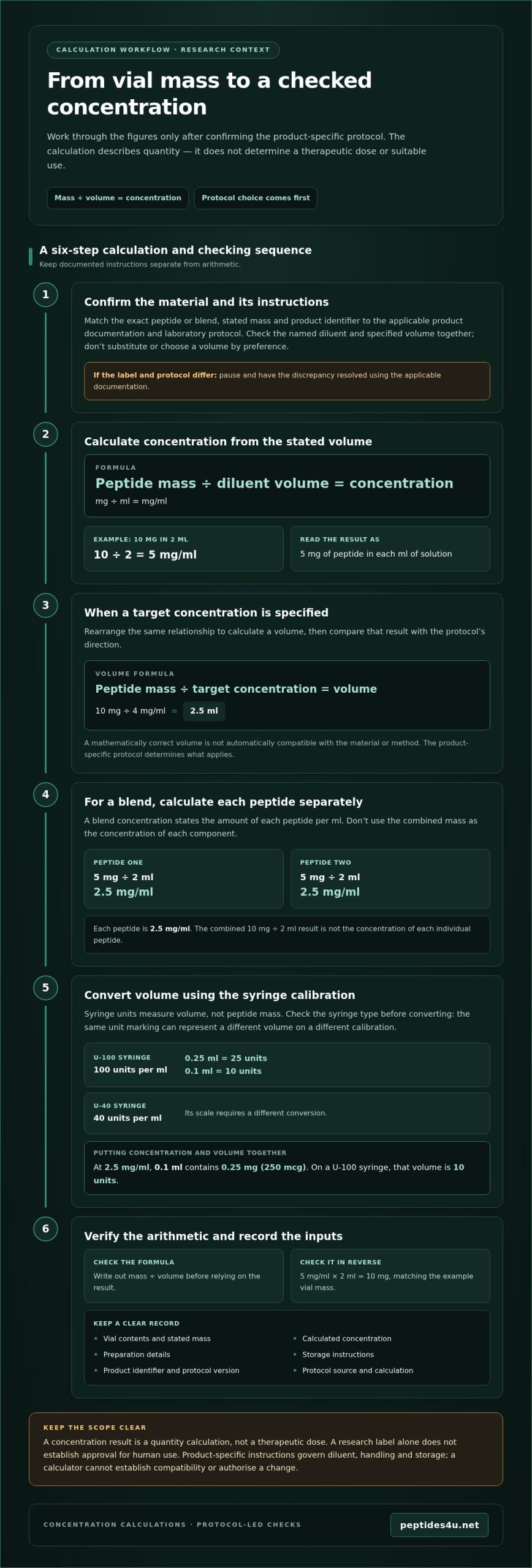
Calculate concentration using peptide mass and diluent volume. The result describes quantity, not a therapeutic dose. This peptide reconstitution guide UK readers can use starts with the product’s stated mass and protocol volume.
A research label alone doesn’t establish approval for human use. UK pharmacies or clinics can explain instructions for an authorised prescribed medicine. Research materials require their own product and protocol instructions.
Peptide concentration calculations
A concentration calculation relates the amount of peptide to the volume of diluent. For a 10 mg vial mixed with 2 ml, calculate 10 ÷ 2 to get 5 mg/ml. To find the volume for a target concentration, divide the peptide mass by that concentration. For 10 mg at 4 mg/ml, 10 ÷ 4 gives 2.5 ml.
Keep the units consistent: milligrams divided by millilitres gives mg/ml. A calculator can check the arithmetic, but it can’t determine a suitable concentration or diluent. Use the product-specific protocol for those decisions.
Blend concentrations and syringe units
A blend concentration states the amount of each peptide per millilitre. For a blend containing 5 mg of each of two peptides in 2 ml, calculate each separately: 5 ÷ 2 gives 2.5 mg/ml of each. Don’t divide the combined 10 mg by 2 ml and treat that as the concentration of each component.
Syringe units measure volume, not peptide mass. A U-100 syringe has 100 units per ml, so multiply millilitres by 100: 0.25 ml is 25 units, and 0.1 ml is 10 units. A U-40 syringe has 40 units per ml, so its scale requires a different conversion.
At 2.5 mg/ml, 0.1 ml contains 0.25 mg, or 250 mcg. On a U-100 syringe, that volume corresponds to 10 units. The same unit marking on another syringe calibration represents a different volume.
Verify each calculation in two ways: write the formula, then check the arithmetic with a calculator. For a 10 mg vial and 2 ml, multiply 5 mg/ml by 2 ml to confirm the result returns 10 mg. Check the syringe type before converting volume into units. A peptide reconstitution guide UK readers can use should keep calculations separate from protocol choices. If the figures disagree, recalculate from the vial mass and specified volume.
Selecting diluent volume from a laboratory protocol
A laboratory protocol specifies the diluent and volume for its intended purpose. For research, don’t treat a concentration example as instructions for human use.
Product directions and diluent checks
Product directions identify the diluent and volume intended for that specific material. Check the product documentation and laboratory protocol together before calculating concentration.
Match the exact peptide or blend, its stated mass and the protocol’s named diluent. A volume that works mathematically may still be incompatible with the material or study method. Don’t substitute a different diluent because it is available or familiar. For prescribed products, follow the product-specific instructions for the diluent and volume.
Record the protocol version and product identifier used in the calculation. If the label and protocol differ, pause rather than choosing one by assumption. The laboratory’s responsible person can resolve discrepancies using the applicable documentation. A calculator can check arithmetic, but it cannot establish compatibility or authorise a change.
Selecting diluent volume
Diluent volume is the protocol-specified amount of liquid used to calculate the resulting concentration. The relevant inputs are the peptide mass, selected volume and concentration required for the research method.
For example, a 10 mg research vial with 2 ml of diluent calculates to 5 mg/ml. This is a concentration calculation, not a universal mixing instruction. If a protocol sets a target concentration, calculate the required volume from the stated peptide mass, then compare it with the protocol’s own direction. Don’t select a volume solely to make syringe measurements easier.
Before laboratory preparation, confirm the vial identity, mass, protocol and diluent name. Use the laboratory’s approved procedure for handling and adding liquid. This section does not provide a sterile preparation method or dosing instructions. Those details must come from the relevant validated protocol, not a general online guide.
Different research materials may specify alternative diluents, but they aren’t automatically interchangeable. Bacteriostatic water and sterile water have distinct properties; the protocol and product instructions determine which applies. Acetic acid water is another named diluent, but its presence in a catalogue does not establish that it is suitable for a particular peptide.
Keep the decision tied to documented inputs:
- Match the peptide name and mass to the protocol.
- Use only the diluent named for that material and method.
- Calculate concentration as mass divided by volume.
- Record the source document and calculation with the laboratory record.
These checks separate arithmetic from protocol choice. A 5 mg/ml result describes the example above; it doesn’t determine a therapeutic use, administration method, or safe dose.
What is the formula for peptide reconstitution?
Peptide reconstitution means adding the specified liquid to lyophilised powder to form a solution. Only products supplied as powder need this step; products already supplied as liquid do not. This section covers storage for laboratory research, not instructions for human use.
Storage conditions describe the temperature and handling used to preserve a material. Lyophilised peptide is typically stored light-protected at −20°C or colder; a reference duration is 24+ months. That duration applies while powder remains unreconstituted. It is not a universal shelf-life promise: product instructions and the certificate of analysis (COA) govern each material.
After reconstitution, the storage state changes. A general reference is 2-8°C for the solution, with 4-6 weeks often given for stable peptides, subject to the COA. Treat that range as context, not a discard date for every vial. Follow the product-specific instructions for storage and disposal. They account for the peptide, diluent and supplied data.
Room-temperature storage after reconstitution is described as suitable for only a few hours when the solution is for immediate use. Don’t extend that into a longer storage window. Avoid assuming refrigeration or freezing preserves every peptide equally; stability depends on the specific product documentation.
Freezing single-use aliquots immediately after reconstitution is sometimes recommended to avoid repeatedly accessing one vial. This approach must match the relevant product instructions and research protocol. Repeated access, temperature changes and handling can affect sample integrity. Don’t apply general aliquoting practices to a product whose instructions specify different handling.
Before storage, label the vial with the peptide identity, concentration, reconstitution date, diluent and storage condition. Include the protocol or batch reference when laboratory records require it. Write these details clearly before storing the vial. Distinguish lyophilised powder from reconstituted solution on the label, as their storage conditions differ.
Keep the vial label readable and attached during storage. Follow the product’s stated discard instructions rather than estimating from another peptide’s reported duration. Don’t mistake a vial containing solution for unreconstituted powder. If a label becomes unclear, separate the vial from identified materials until its identity is resolved through the laboratory record.
Clean handling and storage are separate controls. An alcohol swab may feature in a product’s handling instructions, but it does not determine the vial’s storage temperature or duration. Protect the container as directed and record any departure from storage conditions in the laboratory log. Use the product-specific instructions to determine temperature and discard timing.
How much bacteriostatic water should I add to a vial?
Bacteriostatic water contains a preservative, whereas sterile water has no stated preservative in this comparison. The volume to add comes from the specific product instructions or laboratory protocol, not a universal amount. Treat these calculations as concentration examples, not human-use dosing directions.
Bacteriostatic water contains 0.9% benzyl alcohol. The supplied guidance describes it as allowing a vial to be entered more than once, whereas a vial reconstituted with sterile water is effectively single use. That distinction doesn’t make the diluents interchangeable. Follow the product-specific instructions for the named peptide and its intended use.
For a 10 mg vial, different volumes produce different calculated concentrations: 1 ml gives 10 mg/ml, 2.5 ml gives 4 mg/ml, and 5 ml gives 2 mg/ml. These are arithmetic examples, not recommended volumes for every vial. The appropriate volume depends on the protocol’s target concentration, specified diluent, and vial instructions. Don’t choose a volume merely because it creates an easier syringe measurement.
Vial capacity also matters. The supplied guidance says most 10 mg peptide vials can hold 3-5 ml comfortably, but that range doesn’t establish suitability for a particular product. A protocol requiring more liquid may exceed the vial’s practical capacity. Check the vial and product directions before preparation, and never force a volume into a container that cannot accommodate it.
Sterile preparation means using a clean work area and handling vial closures carefully. Before mixing, wash your hands and prepare a clean surface. Clean both vial stoppers with separate, fresh alcohol swabs, then let them air-dry. Keep the specified diluent and peptide vial identifiable throughout. Follow the product’s handling instructions; this general guide does not replace them.
After adding bacteriostatic water, the supplied guidance recommends gently swirling the vial for 10-20 seconds and says not to shake it. Follow the product instructions if they give a different handling method. If the powder doesn’t dissolve as expected, don’t improvise by changing the diluent or adding extra liquid; return to the relevant product protocol.
Use this check before proceeding:
- Match the peptide identity and vial strength to its instructions.
- Confirm the named diluent and stated volume.
- Keep bacteriostatic and sterile water distinct.
- Calculate the resulting concentration from peptide mass and liquid volume.
- Label and store the vial according to its product-specific directions.
For research materials, these steps support accurate records, not therapeutic use. A correct concentration calculation cannot establish that a product is authorised or appropriate for human administration. If the vial instructions and protocol conflict, stop and resolve the discrepancy before mixing.
Labelling reconstituted vials
A vial label is a concise record of its contents and handling details. Clear labelling helps distinguish a prepared solution from lyophilised powder and supports accurate laboratory records.
Start with the peptide name exactly as printed on its source label. Add the vial’s stated peptide mass and, where applicable, the blend components. For a blend, record the amount of each peptide separately. This avoids treating the combined mass as the concentration of each component.
Next, record the diluent name and volume used. Add the calculated concentration with its units, such as mg/ml. Keep the calculation traceable: a 10 mg vial with 2 ml produces 5 mg/ml. That figure describes concentration only. It does not indicate a therapeutic dose or establish suitability for human consumption.
Include the preparation date and relevant batch or protocol identifier. These details connect the vial to its laboratory record. If the source label uses a specific identifier, copy it accurately. Don’t rely on memory or abbreviations that could make two peptide names look alike.
Storage information belongs on the label when it helps prevent handling errors. Mark the required condition from the product-specific instructions. For example, the supplied guidance distinguishes lyophilised material stored at −20°C from reconstituted solution stored at 2-8°C. These conditions are not interchangeable. Follow the relevant product instructions and discard directions.
Use a consistent layout for every vial in the same laboratory. Put the peptide identity first, followed by mass and concentration, then diluent and preparation details. Keep the text legible and attached to the container. If a label cannot be read, don’t guess from the vial’s shape, colour or storage position.
A practical label checklist includes:
- Peptide name and any blend components.
- Starting mass and added diluent volume.
- Calculated concentration with units.
- Preparation date and batch or protocol reference.
- Storage condition and product-specific discard direction.
Keep the written record aligned with the vial. If a calculation changes, update both records together. Never use a concentration label alone to infer an administration volume. Syringe units depend on syringe calibration, while a label records the solution’s concentration. Keep research labelling factual and avoid wording that implies approval for human consumption.
Before handling a vial, review its product information alongside the laboratory protocol. Review peptide product information as part of keeping product identity and preparation records distinct.
Peptides4u: Plumas SereneQ
Peptides4u offers Plumas SereneQ as a product option for readers exploring its range. The reconstitution calculations above help explain how mass, diluent volume and concentration relate. They don’t replace product-specific instructions or establish suitability for human use.
If you’re looking for Plumas SereneQ, keep product selection separate from preparation decisions. Follow the relevant product directions and protocol for handling or storage. Clear labels and accurate records remain essential for laboratory materials.
To view Plumas SereneQ or learn more about Peptides4u, visit the Peptides4u website.
Take the next step with clear product information
Base any laboratory preparation on a written protocol, and link the calculation to the vial record. If your next step is choosing a product, keep that decision separate from reconstitution or human-use decisions. A concentration calculation explains what a solution contains; it does not establish whether the product is appropriate for you.
Peptides4u offers Plumas SereneQ and related options. Review the product information that applies to your selection, and follow its instructions for handling. For questions about the business’s offerings, contact Peptides4u for help.
A careful next step is a simple one: keep the product identity, intended context and relevant instructions together. That gives you a clearer basis for deciding what to do next. Visit Peptides4u when you are ready to explore its offerings.
Frequently Asked Questions
Does it work for blends like BPC-157 + TB-500 or CJC-1295 + Ipamorelin?
The calculation applies to blends when each component’s mass is known. Work out each peptide’s concentration separately using its stated mass and the total diluent volume. For example, the combined mass doesn’t tell you the concentration of each ingredient. Arithmetic alone can’t establish whether BPC-157 and TB-500, or CJC-1295 and Ipamorelin, are compatible or stable together. Use the product-specific research documentation.
The powder doesn’t fully dissolve. What’s wrong?
Undissolved powder doesn’t reveal a single cause. Check that the vial and diluent match the product instructions, then follow the stated handling method. Don’t shake the vial or add extra liquid unless directed. Some product guidance recommends leaving it at room temperature for 5-10 minutes after gentle swirling, then swirling again. If the solution still looks unexpected, stop and follow the product instructions.
Why not just dissolve in PBS or cell culture media directly?
PBS and cell culture media aren’t universal alternatives to a specified diluent. Their ingredients and intended research uses differ, and substitution may affect compatibility with the peptide or method. Use them only when the applicable protocol specifies them. A clear-looking solution doesn’t establish suitability for an assay. Record the selected medium and protocol with the sample so the preparation can be understood later.
How do I reconstitute a peptide safely using the manufacturer’s instructions?
Follow the manufacturer’s instructions for the specific product and its stated purpose. For research handling, wash your hands, prepare a clean surface, and use separate, fresh alcohol swabs for the vial stoppers. Let them air-dry. Use the specified diluent and volume, then follow the stated mixing method. This peptide reconstitution guide UK readers can use doesn’t replace product directions or establish suitability for human administration.
What supplies are needed to reconstitute peptides, and where can they be bought in the UK?
Supplies depend on the product instructions and may include its specified diluent, measuring equipment, alcohol swabs and a clean work surface. A general kit isn’t automatically suitable for every vial. Peptides4u offers Viales Quanta Pharma. Match preparation supplies to the relevant product instructions, and keep research materials distinct from products intended for other uses.
Which diluents are suitable for peptide reconstitution, and can bacteriostatic water be used?
The suitable diluent is the one specified by the product instructions or research protocol. Bacteriostatic water contains 0.9% benzyl alcohol, but that doesn’t make it suitable for every peptide. Sterile water and bacteriostatic water aren’t interchangeable by default. Don’t substitute PBS, culture media or another liquid simply because it’s available. Use the diluent named for the specific material and method.
How do I calculate peptide concentration and dose after reconstitution?
Divide peptide mass by diluent volume to calculate concentration, keeping units consistent. To find a volume for a stated amount, divide that amount by the concentration. Syringe units represent volume, so the syringe calibration matters: U-100 and U-40 scales differ. This peptide reconstitution guide UK readers follow can explain quantities, but calculations don’t recommend a dose or establish suitability for human use.
How should reconstituted peptides be stored, and how long do they remain usable?
Follow the product’s storage and discard instructions, because stability differs between peptides. General guidance gives 2-8°C for reconstituted solution and 4-6 weeks for stable peptides, subject to the certificate of analysis. That duration isn’t a universal expiry. Lyophilised, unreconstituted material has different storage guidance. Keep the vial label aligned with its identity, preparation details and required storage condition.