How to Calculate Peptide Doses and Syringe Volumes
A correct draw depends on the peptide amount, the volume added and the syringe scale. The peptide dosage calculation formula is: target dose ÷ concentration = volume to draw. For example, a 5 mg vial mixed with 2 mL gives a concentration of 2.5 mg/mL, so a 250 mcg dose is 0.1 mL, or 10 units on a U-100 syringe.
The arithmetic is straightforward, but it does not determine the dose you should take. Follow your prescribed instructions. Peptide University says dosing decisions should reflect individual factors and current evidence, and should be made by a qualified healthcare professional.
This guide explains how to convert milligrams to micrograms, calculate concentration, read syringe volume and estimate how many doses a vial contains. Follow the vial’s instructions for preparation. Use the calculations to understand measurements, not to choose or change a dose.
Key Takeaways
- Find the solution’s concentration by dividing the peptide amount by the water volume used.
- Convert milligrams to micrograms before calculating a target dose to avoid mixing units.
- Use the syringe’s calibration to translate the required volume into the correct line.
- Estimate doses per vial by dividing the total peptide amount by the amount in each dose, then round down.
- Use the prescribed instructions for the dose and vial preparation; calculations help measure a dose, not choose one.
Converting target peptide doses into syringe volumes
Prescribed doses vary by medication and indication, so use the target dose in your instructions. Convert that target into a liquid volume using the vial concentration, then match the volume to the syringe scale.
To understand the calculation in practice, watch this video:
-
Match the target dose to a syringe volume
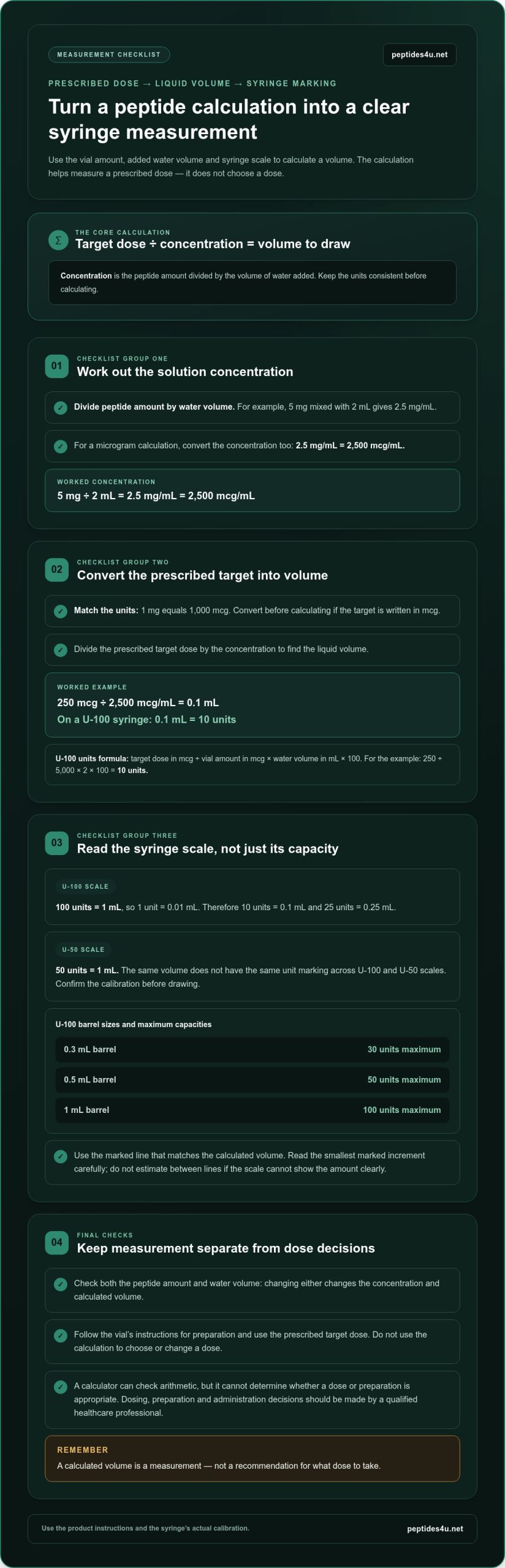
Calculate the concentration first, then divide the prescribed target dose by that concentration to find the volume. For a 5 mg vial mixed with 2 mL of bacteriostatic water, concentration is 2.5 mg/mL, or 2,500 mcg/mL. A 250 mcg target therefore requires 0.1 mL. Check both the vial amount and water volume before drawing. Changing either changes the result.
For a U-100 syringe, 0.1 mL aligns with 10 units. The same dose can produce a different volume if the concentration changes. Use the preparation instructions supplied with the vial. The calculated volume is a measurement, not a recommendation for what dose to take.
-
Convert between dose and volume units
Convert milligrams to micrograms before calculating when the target uses micrograms. One milligram equals 1,000 micrograms. Keep the vial amount, target and concentration in matching units; otherwise, the calculation can be wrong by a factor of 1,000. The peptide dosage calculation formula is target dose in mcg ÷ vial amount in mcg × water volume in mL × 100 for U-100 units.
For example, 250 ÷ 5,000 × 2 × 100 gives 10 units. On U-100, 100 units equal 1 mL, each unit equals 0.01 mL, and 10 units equal 0.1 mL. A 0.25 mL volume aligns with 25 units. Read the barrel markings, not just the syringe capacity.
- Identify the syringe calibration before drawing. U-100 means 100 units per 1 mL. U-50 reads 50 units per 1 mL, so the same volume does not have the same unit marking across these scales. A 20-unit measurement is 0.2 mL on the insulin syringes described, but only when the scale is U-100. A U-50 half-millilitre syringe holds 0.5 mL.
- Use the marked line that matches the calculated volume. Syringes are available in 0.3 mL, 0.5 mL and 1 mL barrel sizes, with maximum capacities of 30, 50 and 100 units respectively on U-100. For fractional volumes, read the smallest marked increment carefully. Don’t estimate between lines if the scale cannot show the amount clearly. Bacteriostatic water contains about 0.9% benzyl alcohol; it does not determine the prescribed dose. Peptide University says dosing, preparation and administration decisions must be made by a qualified healthcare professional under applicable laws and regulations.
How do you calculate peptides dose?
Follow the vial’s instructions for reconstitution, handling and storage. An online calculator can check the arithmetic, but it cannot choose a dose or establish that a preparation is safe.
For UK product guidance, follow the instructions supplied with the vial. Peptide Calculator describes its tool as informational, not medical advice; Peptide University says dosing and preparation decisions belong with a qualified healthcare professional.
-
Reconstitute the peptide with bacteriostatic water
Read the vial instructions before preparing anything. Use the specified diluent and volume rather than applying a general recipe to every peptide. The amount of bacteriostatic water changes the final concentration: more water makes the solution less concentrated, while less makes it more concentrated. Do not substitute another liquid or preparation method based on a calculator result.
Bacteriostatic water contains about 0.9% benzyl alcohol. That figure describes the water, not the peptide dose or the amount to add. Follow the product instructions for the correct volume and preparation steps.
-
Set the vial size and reconstitution volume
Enter the peptide amount printed on the vial and the volume specified in its instructions. Common vial strengths include 5 mg and 10 mg; example water volumes range from 1 to 3 mL. These are calculation examples, not universal preparation directions. Keep the vial amount and added volume separate when recording the inputs.
A 10 mg vial with 2 mL added gives a different concentration from the same vial with 3 mL. The vial strength stays constant, but changing the water volume changes how much peptide each millilitre contains.
-
Calculate the reconstitution concentration
Divide the peptide amount by the volume of water added. A 10 mg vial reconstituted in 2 mL has a concentration of 5 mg/mL. To work in micrograms, convert milligrams first: 1 mg equals 1,000 mcg, so that concentration is also 5,000 mcg/mL.
Check the units before using the result. A 5 mg vial mixed with 2 mL gives 2.5 mg/mL, or 2,500 mcg/mL. Entering 5 instead of 5,000 for a microgram calculation changes the scale and produces a misleading output.
-
Enter the calculator inputs
Enter the vial amount, water volume, target dose and syringe scale only after matching each field to the label or instructions. Some calculators allow dose inputs such as 50 mcg, 100 mcg, 250 mcg and 500 mcg, with water-volume options including 1 mL, 2 mL and 3 mL. Choose the actual values, not the nearest convenient option.
Compare the displayed concentration with your own calculation. A calculator’s output depends on accurate entries and correct units. Peptide Calculator is for informational and organisational use; it does not provide diagnosis or treatment.
- Store the prepared solution as the product instructions direct. General information describes refrigeration at 2-8 °C and roughly 28 days for most reconstituted peptides, but the vial’s instructions should guide its storage. Don’t assume every peptide has the same stability or storage period.
- Keep dose selection separate from the maths. A calculator can convert a stated target into a volume, but it cannot account for individual factors or determine whether that target is appropriate. Peptide University says dosing, preparation and administration decisions should be made by a qualified healthcare professional in accordance with applicable laws and regulations.
How many doses are in a peptide vial?
Calculate the concentration first, then divide the vial’s total peptide amount by the prescribed amount per dose. The result estimates the number of complete doses available.
The peptide amount in each syringe unit depends on both concentration and syringe calibration. A calculation error can produce a draw volume that differs from the intended dose, so never inject based on an unchecked result.
-
Work out the peptide concentration
Divide the total peptide amount by the volume used for mixing. A 5 mg vial mixed with 2 mL has a concentration of 2.5 mg/mL, equivalent to 2,500 mcg/mL. Keep the units consistent throughout the calculation. One milligram equals 1,000 micrograms, so convert before dividing if the target dose uses micrograms.
Check the water volume as well as the vial strength. A 10 mg vial mixed with 2 mL gives 5 mg/mL, while the same peptide amount in 3 mL gives a lower concentration. The total amount in the vial stays the same; the amount in each millilitre changes.
-
Calculate the doses available per vial
Divide the vial’s total peptide amount by the amount in each target dose. Convert both figures to the same unit first. A 5 mg vial contains 5,000 mcg; at 250 mcg per dose, that gives 20 complete doses. A 10 mg vial at the same target dose gives 40 complete doses.
Round down when counting complete doses. The calculation estimates quantity, not how often to use a dose or whether it is appropriate. The vial’s usable contents can also depend on preparation and handling instructions, so follow the product guidance when planning.
-
Convert concentration into draw volume
Divide the target dose by the concentration to find the volume. At 2,500 mcg/mL, a 250 mcg target requires 0.1 mL. On a U-100 syringe, that volume corresponds to 10 units, because 100 units equal 1 mL. Keep the syringe scale in the calculation; units are not interchangeable across different calibrations.
Use the result to interpret the syringe marking, not to set a dose. If the target is written in milligrams and concentration in micrograms per millilitre, convert one value first. Mixing units can make an otherwise correct calculation wrong by a factor of 1,000.
-
Identify peptide amount per syringe unit
Multiply the concentration per millilitre by the volume represented by one syringe unit. For a U-100 syringe, one unit equals 0.01 mL. At 2.5 mg/mL, that means 0.025 mg, or 25 mcg, per unit. At 5 mg/mL, one U-100 unit represents 50 mcg.
Read the syringe label before using these figures. A unit count describes volume on a particular calibration; it does not indicate a universal peptide amount. Peptide University says dosing decisions should account for individual factors and current evidence, and be made by a qualified healthcare professional.
Calculating doses per vial
Count complete doses by dividing the vial’s total peptide amount by the prescribed amount per dose. Adding solvent changes the concentration, not the total peptide in the vial.
-
Identify the vial quantity and strength
Read the total peptide quantity printed on the vial, then note its unit. Common strengths include 1 mg, 5 mg, 10 mg, 15 mg, 20 mg and 50 mg. Convert milligrams to micrograms when the prescribed dose uses micrograms: 1 mg equals 1,000 mcg. Don’t confuse total vial content with concentration per millilitre.
For example, a 10 mg vial contains 10,000 mcg in total. That amount remains the basis for the dose count, whatever solvent volume is added.
-
Determine the doses contained in the vial
Divide the total peptide amount by the target amount in each dose, using matching units. A 5 mg vial contains 5,000 mcg; divided by 250 mcg per dose, it gives 20 theoretical doses. A 10 mg vial at the same target gives 40 doses. Round down to count complete doses, not partial remainders.
This calculation estimates quantity only. It does not set the prescribed dose or frequency. The intended dose must come from the product guidance and qualified clinical advice.
- Record the solvent volume separately from the vial strength. For example, a 10 mg vial mixed with 2 mL gives 5 mg/mL. Adding 3 mL instead gives about 3.3 mg/mL, but the vial still contains 10 mg total. Use the preparation instructions supplied with the vial, rather than choosing a volume to reach a preferred dose count.
More solvent makes a solution less concentrated and increases the volume associated with a given peptide amount. Less solvent makes it more concentrated and reduces that volume. Neither change creates more peptide or increases the theoretical number of doses.
- Separate the dose count from the draw-volume calculation. If a 5 mg vial is mixed with 2 mL, it contains 20 doses of 250 mcg by arithmetic. Each 250 mcg amount corresponds to 0.1 mL at that concentration, or 10 units on a U-100 syringe. Keep the syringe scale and units consistent when calculating.
Follow the product instructions for preparation and storage. Stability depends on the peptide and how it is handled, so a dose-count calculation cannot establish how long a prepared compound remains usable. Do not treat the estimated number of doses as permission to use a vial beyond its stated guidance.
Peptide dosage calculation formula
Calculate concentration, draw volume and doses per vial separately. Keep the prescribed target, vial amount, solvent volume and syringe calibration distinct.
- Convert the vial amount into the target’s units. One milligram equals 1,000 micrograms. A 5 mg vial therefore contains 5,000 mcg; a 10 mg vial contains 10,000 mcg. Convert before dividing whenever the prescribed target is written in micrograms. This avoids mixing milligrams and micrograms in one calculation, which changes the numerical scale.
- Calculate the concentration after reconstitution. Divide the total peptide amount by the volume of water added. For example, 5 mg in 2 mL gives 2.5 mg/mL, or 2,500 mcg/mL. Record the result with its units. The same vial amount mixed with a different volume produces a different concentration, so use the actual preparation volume from the vial instructions.
- Find the volume for the prescribed target. Divide the target dose by the concentration, keeping both in matching units. At 2,500 mcg/mL, a 250 mcg target requires 0.1 mL. For U-100 insulin syringes, multiply millilitres by 100 to convert the volume into units: 0.1 mL equals 10 units. The syringe unit is a volume marking, not a universal peptide quantity.
- Estimate the complete doses in the vial. Divide the total peptide amount by the target amount per dose, then round down. A 5 mg vial contains 5,000 mcg; at 250 mcg per dose, the calculation gives 20 doses. A 10 mg vial at the same target gives 40 doses. This estimates quantity only. It does not establish a suitable dose or administration schedule.
- Check the result before using it. Recalculate using the original vial amount, water volume, target and syringe scale. For a 5 mg vial with 2 mL added, a 250 mcg target equals 0.1 mL, or 10 U-100 units. A mismatch between these equivalent values signals an input or conversion error. Follow the product instructions, and keep dose selection separate from the arithmetic. Peptide University says dosing decisions should reflect patient-specific factors and current evidence, and be made by a qualified healthcare professional.
For the next step, browse peptide vial options and use the supplied product instructions for preparation.
Peptides4u: Plumas SereneQ
Peptides4u offers Plumas SereneQ for readers exploring its available peptide products. Use the calculation steps above to understand vial concentration and syringe volume, but keep product selection separate from dose decisions. The calculations help interpret a prescribed dose; they don’t establish whether a product or dose is suitable for you.
If you are considering Plumas SereneQ, read its product information and follow the instructions supplied with it. For decisions about dose, preparation or administration, rely on qualified healthcare guidance rather than an online calculation alone.
Visit Peptides4u online to view Plumas SereneQ.
Make your next step a considered one
Base dose decisions on the instructions for the specific product and guidance from a qualified healthcare professional. The peptide dosage calculation formula translates an established target into a measurement; it does not determine what to take. That distinction matters when product information, preparation details or syringe markings differ.
If you’re exploring product options, Peptides4u offers a range of high-quality research compounds. Keep your product choice separate from clinical decisions, and use the relevant product instructions for handling and preparation. For product-related questions, contact Peptides4u with your questions.
Make sure each step is clear before proceeding. A careful, informed approach helps you move forward with confidence.
Frequently Asked Questions
How do I calculate MOTS-C dosage?
Use the prescribed target and the concentration shown by the vial’s preparation details; don’t infer a dose from the compound name. For example, a 10 mg MOTS-C vial reconstituted with 2 mL has a concentration of 5,000 mcg/mL. Divide the prescribed amount in micrograms by that concentration to find the volume. Peptide University says dosing decisions should be made by a qualified healthcare professional.
How do I convert between mcg and mg?
Multiply milligrams by 1,000 to convert to micrograms; divide micrograms by 1,000 to convert to milligrams. For example, 0.4 mg equals 400 mcg, and 750 mcg equals 0.75 mg. Convert before calculating if the dose and concentration use different units. Write the unit beside each figure, so a value such as 400 remains clear as either mcg or mg.
What is the formula for calculating peptide dosage from concentration and volume?
Multiply concentration by volume to find the peptide amount in that draw: amount = concentration × volume. For example, 2.5 mg/mL multiplied by 0.2 mL gives 0.5 mg. Keep the units visible, and use the same units throughout. This calculation tells you how much peptide a volume contains; it doesn’t determine whether that amount is an appropriate dose or administration plan.
How do you calculate peptide concentration after reconstituting a vial?
Divide the vial’s total peptide quantity by the volume of solvent added. For example, 15 mg in 3 mL gives 5 mg/mL. If you need micrograms per millilitre, convert the peptide amount before dividing: 15 mg is 15,000 mcg, giving 5,000 mcg/mL. Use the actual amount and volume from the product instructions, not a calculator’s preset example.
What information is needed to calculate a peptide dose safely?
Use the prescribed target dose, the vial’s total peptide amount, the preparation volume and the syringe calibration. Follow the product’s reconstitution and handling instructions, too. Check that the units match before calculating, then compare the result with the intended measurement. These details support the arithmetic, but they do not establish that a dose or preparation is suitable. Peptide University says dosing and administration decisions should be made by a qualified healthcare professional.
What are the risks of calculating or administering peptide doses incorrectly?
A calculation or syringe-scale error can make the drawn volume differ from the intended dose. Mixing units can make a calculation wrong by a factor of 1,000, so check the result and syringe calibration before drawing.