Order Research Peptides Online in the UK

Orders placed before 12pm Monday to Friday are dispatched the same day. Dispatch is not the same as delivery, so check the delivery terms before you order peptides online. In the UK, research peptides can be purchased for in-vitro laboratory research, but they aren’t approved for human consumption.
Choosing a supplier takes more than comparing a product name or delivery estimate. You’ll want to understand what a certificate of analysis can tell you, what age requirements apply and how to assess the catalogue and shipping details.
This guide covers the checks to make before ordering, how to compare products and prices, and what to look for in product documentation. It also explains the difference between dispatch and delivery, helping you make a more informed choice.
Key Takeaways
- Research peptides in the UK can be purchased for in-vitro laboratory research, but they aren’t approved for human consumption.
- Compare listings on a like-for-like basis, including the product, quantity and supporting documentation.
- Review a certificate of analysis for details such as the product and batch it covers. A certificate isn’t the same as approval for human use.
- Check the seller’s age requirements and shipping terms before checkout. Dispatch and delivery are separate steps.
- Assess whether the seller provides clear business details, product information and a straightforward ordering process.
What are research peptides?
Research peptides are compounds offered for laboratory research, including in-vitro work. In the UK, they are legal to purchase for in-vitro laboratory research, but they are not approved for human consumption. That distinction matters: a product labelled “research use only” is not a treatment, and a purity claim does not make it suitable for personal use.
A research-peptide catalogue can include different compounds, formats and research-use descriptions. Compare each listing by its exact compound name, stated quantity, format, batch details and accompanying documentation. Don’t assume that similar names mean identical products. For research and development, match the listing to the laboratory protocol and record the product identity alongside the batch and certificate information. A certificate of analysis may help identify what was tested, but it does not establish approval for human use.
Prices can vary with the compound, quantity, format and documentation provided. Compare like with like: check that listings describe the same compound and quantity before treating their prices as comparable. The number of listings can also change. This week, 573 suppliers were compared for Retatrutide and 300 for Tirzepatide. Those counts describe supplier comparisons, not product quality or clinical approval.
For anyone asking about safer, legal alternatives to buying peptides online in the UK, speak to a GP about the health goal and appropriate treatment options. Don’t use a research product for self-treatment; research peptides are not approved for human consumption.
A UK doctor can assess your symptoms and discuss suitable care. Research peptides sold for laboratory research are not approved for human consumption, so don’t treat an online listing as a prescription or a medical recommendation.
Before ordering for laboratory work, read the product’s storage instructions and check the seller’s information about temperature during transit. Cold-chain shipping means temperature is controlled during transport, so compare the stated delivery method with the product’s storage requirements. Check dispatch and delivery terms separately, and plan to receive and handle the package as directed.
Use a practical catalogue check before placing an order:
- Match the compound name and format to the intended laboratory work.
- Review purity claims and batch-specific documentation together.
- Compare equivalent quantities, rather than headline prices alone.
- Read storage and shipping instructions before checkout.
Comparing prices across UK peptide suppliers
A useful comparison starts with the exact peptide name, not the headline figure. Listings for different compounds, formats or quantities aren’t like-for-like. For example, compare the same named compound and stated amount before judging which supplier offers better value. Worldwide listings may use different product descriptions, so check the details rather than relying on a matching label alone.
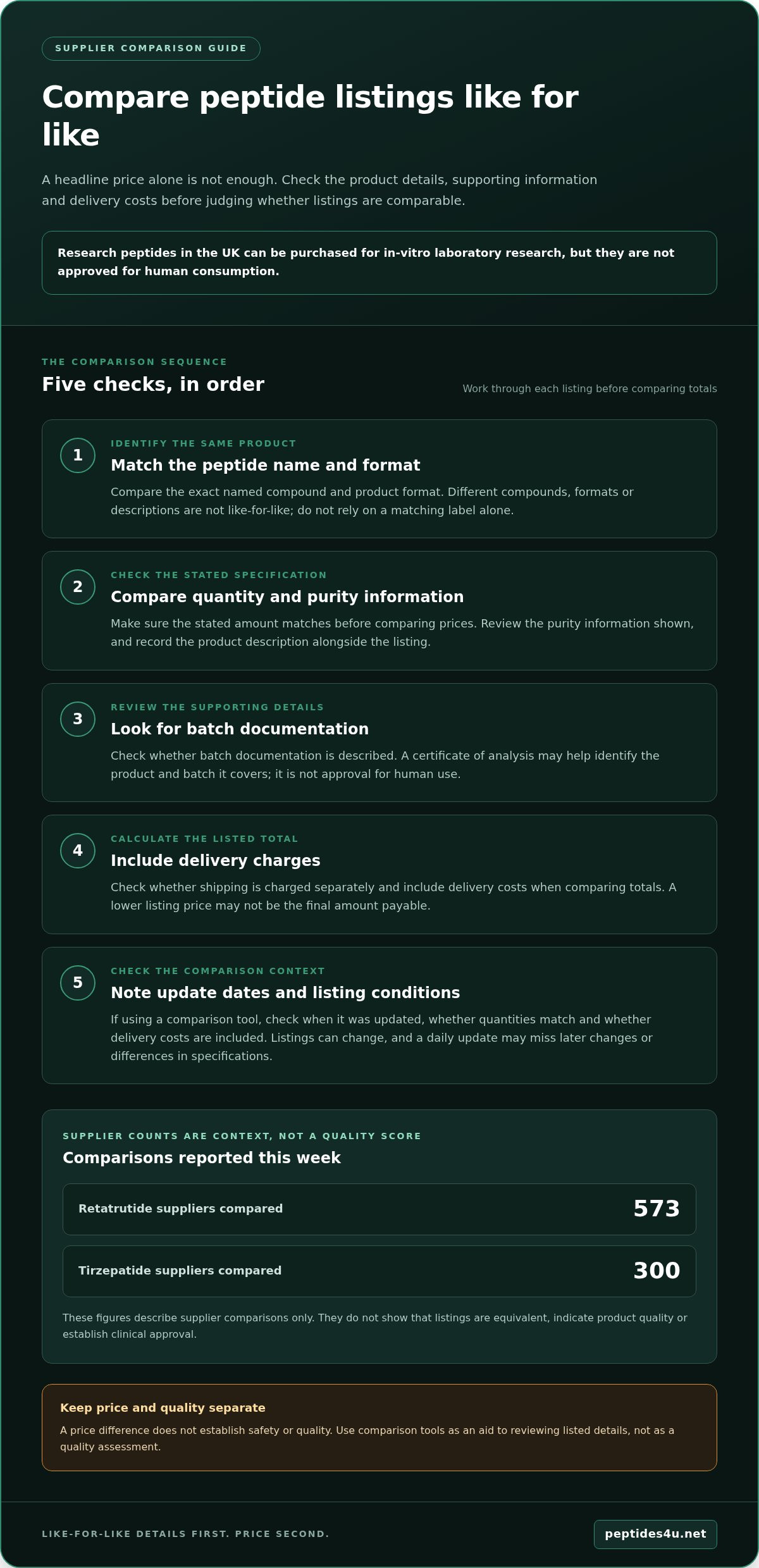
Price comparisons can also be misleading if listings include different items or charges. Check the quantity, format, purity information, batch documentation and delivery costs shown at checkout. A lower listing price may not reflect the final total if shipping is charged separately. Record each product description and total payable amount to make a clearer comparison, without assuming a higher price proves better quality.
Online product listings can change over time. A price comparison tool typically collects listings for a chosen peptide, displays supplier offers and sorts them by price or other listed details. Before relying on a result, check when it was updated, whether quantities match and whether delivery costs appear. A daily update can still miss later changes or differences between product specifications. If you order peptides online for laboratory research, use the tool as a comparison aid, not a quality assessment.
Use this practical check for each listing:
- Match the peptide name and product format.
- Compare the stated quantity and purity information.
- Check whether batch documentation is described.
- Include delivery charges when comparing totals.
- Note the update date and any listing conditions.
Supplier counts provide context, not a quality score. This week, 573 suppliers were compared for Retatrutide, and 300 for Tirzepatide. Those figures show the number of suppliers compared for each peptide, not whether every listing is equivalent or suitable for laboratory research. Before you order peptides online, assess the product details against your research purpose. Research peptides aren’t approved for human consumption.
Online price differences don’t establish safety. Using a research product for personal consumption may involve uncertainty about identity, purity or handling. Don’t use research products for self-treatment; discuss health concerns with a qualified healthcare professional.
When you’re ready to compare an actual catalogue, review its product descriptions alongside your research requirements. Browse peptide product listings and assess each item by its stated details, not by price alone.
Age requirement for purchase
Before buying research compounds, read the seller’s purchase terms and age requirements. Don’t assume a product listing explains who can place an order. Any applicable age condition should be clear before checkout. Follow the stated terms and don’t try to bypass restrictions.
Keep three questions separate: the seller’s checkout rules, the product’s intended use and legal approval. Research peptides may be purchased in the UK for in-vitro laboratory research, but they aren’t approved for human consumption. That research-use status does not, by itself, tell you the seller’s minimum purchasing age. Nor should an age check be taken as evidence that a product is suitable for personal use.
Use this short check before entering payment details:
- Read the age condition in the seller’s terms and checkout flow.
- Check whether the condition applies to account creation, purchase, or both.
- Enter accurate details that match the person placing the order.
- Stop if you don’t meet the stated requirement.
An age declaration during account creation may be separate from the terms shown at payment, so read both carefully. Passing one step doesn’t remove other purchase conditions. If the age wording conflicts, don’t guess which condition applies. Pause before submitting your order and use the seller’s stated support route to clarify the terms.
Age checks don’t verify a compound’s identity, purity or research documentation. Those require separate checks. Before ordering, match the product name and format to your laboratory requirements, then review the batch information and certificate details. Keep the purchase record with the product information for your research files. An age declaration is not a certificate of analysis and does not establish suitability for human or veterinary use.
For laboratory purchasing, the person responsible for the order should review the seller’s terms alongside the intended research purpose. If a research team member handles checkout, they should enter accurate purchaser details and follow the organisation’s purchasing process. Don’t share another person’s account or submit a false age declaration to complete an order.
Age eligibility is one part of a careful purchase. The checkout terms tell you whether you meet the seller’s stated condition; the product documentation tells you what the listing describes. Keep those decisions distinct. A seller’s age gate does not change the UK research-use restriction, and it doesn’t make a research peptide a medicine for personal consumption.
Are peptides sold online licensed medicines or research chemicals?
The product’s stated purpose matters. In the UK, research peptides are legal to purchase for in-vitro laboratory research, but they aren’t approved for human consumption. A listing described as “research use only” should therefore be understood as a research product, not as a medicine for personal treatment. The wording on a seller’s page doesn’t itself prove that a product is a licensed medicine.
Read the full listing, not just the product name. Check the stated intended use, compound identity, format and batch information. A vial described for laboratory research should not be treated as a medicine for personal use. A purity figure or certificate of analysis may describe testing, but it does not change the product’s stated purpose or make it suitable for human or veterinary use.
“Research chemical” commonly describes products sold for laboratory work, but the phrase is not itself a formal approval category. Check what the seller says about the product and its intended use. If a page presents a product both as a research chemical and for personal treatment, those claims conflict. Don’t rely on treatment wording to override the research-use restriction.
Use these checks to interpret a listing:
- Find the exact product name and stated purpose.
- Separate research-use wording from claims about treatment or consumption.
- Read the certificate details alongside the product and batch information.
- Keep the listing and documentation with the relevant laboratory records.
A certificate of analysis is not a medicine licence. It may report test results for a particular sample or batch, so match its details to the product offered. A document without a clear connection to the product or batch is harder to assess. Even a matching certificate does not make a research chemical suitable for human or veterinary use.
Before ordering for laboratory work, make sure the product description fits your research purpose. Record the seller’s wording, product name and any batch documentation. Terms such as “laboratory grade” or “high purity” are not substitutes for a clear intended use. On their own, they don’t demonstrate suitability for human or veterinary use.
For personal health concerns, treat an online research listing as separate from medical care. Research peptides are not approved for human consumption in the UK. Don’t use a seller’s description, certificate or checkout process as evidence that a product is a licensed medicine or appropriate treatment.
How can I check whether an online peptide seller is legitimate and reputable?
Start by checking the seller’s identity and product information. Look for a business name, clear contact details, purchase terms and a consistent catalogue. Compare the name shown at checkout with the name in the terms. Resolve any mismatch before submitting payment.
Where a company registration number is provided, compare it with the business name on the official register. For example, Pure Progress Ltd is registered in England and Wales under company number 10512948. A registration record can help identify a company, but it doesn’t prove product quality, medicine approval or suitability for laboratory work.
Next, assess the product documentation. Match the peptide name and batch details on any certificate of analysis to the listing. Check what the document says was tested and whether the results relate to the product offered. A certificate may support product identification, but it does not establish suitability for human or veterinary use.
Look for clear research-use wording. UK research peptides can be purchased for in-vitro laboratory research, but they aren’t approved for human consumption. Treat a listing that presents a research product as a treatment with caution. Product descriptions, purity claims and testimonials don’t replace regulatory approval or medical advice.
Review the checkout before paying. Confirm the item, quantity, total cost, delivery terms and cancellation or returns information shown. Keep the order confirmation and a copy of the product details. These records help you compare what you ordered with what arrives.
Use a short seller review before proceeding:
- Match the business name across the website, terms and checkout.
- Check the product identity and batch information against its documentation.
- Read delivery, payment and returns terms before submitting an order.
- Separate research-use claims from claims about treatment or consumption.
- Keep the listing and confirmation for your records.
Be wary of pressure to pay quickly, vague product descriptions or claims that a research peptide is suitable for personal use. None of these establishes that a seller or product is trustworthy. Assess company identity, documentation, product purpose and order terms separately.
For a straightforward next step, review peptide product information and compare the listed details with your laboratory requirements before ordering.
Peptides4u: Plumas SereneQ
Peptides4u offers Plumas SereneQ for readers reviewing peptide product options. Use the checks in this guide to assess whether a listing matches your intended purpose. Read the product description and terms carefully. Keep research-use products separate from medicines and personal treatment decisions.
Before placing an order, compare the listed product details with your requirements and review the relevant ordering information. Make sure you understand the product’s stated purpose. Research peptides are for in-vitro laboratory research and are not approved for human consumption in the UK.
If Plumas SereneQ is relevant to your product search, visit Peptides4u to review the offering.
Make your next step a considered one
Before you order peptides online, define the purpose of your purchase and what information your records need. A clear process helps keep product selection separate from medical decisions. It also gives you a practical basis for reviewing product details and ordering terms without relying on promotional claims.
Peptides4u offers Plumas SereneQ and high-purity research vials. Review the relevant product information against your requirements, and keep your decision focused on the stated offering and its intended context. Research products are not a substitute for medical advice or treatment.
If you have questions about the offerings, contact Peptides4u with your questions. Take the next step when you’re ready, with your requirements clear.
Frequently Asked Questions
How quickly do orders ship?
Orders placed before 12pm Monday to Friday are dispatched the same day. Dispatch means the parcel leaves the seller; it doesn’t state when it reaches you. Delivery timing depends on the shipping option and carrier route, so read those terms before checkout. Check your order confirmation for dispatch information, then use any tracking details provided to follow the parcel’s progress.
Is it legal to order peptides online in the UK?
Research peptides can be purchased in the UK for in-vitro laboratory research, but they aren’t for human consumption. The intended purpose matters: a research listing does not make a compound a medicine or make it suitable for personal use. Treat product descriptions and research-use labels as information about the listing, not as a basis for using a compound outside laboratory research.
Which UK rules apply to buying, importing and possessing peptides?
Buying, importing and possessing peptides are separate questions. The stated UK position covers purchasing research peptides for in-vitro laboratory research, not human consumption. For an import, identify the exact compound, product description and country of origin before arranging shipment. Assess the relevant import and possession requirements for that specific item; an online seller’s willingness to accept an order doesn’t settle those separate questions.
What are typical UK prices for popular peptides, including delivery and VAT?
There isn’t one useful total for every peptide listing. The amount depends on the named compound, format, quantity, delivery option and any taxes shown at checkout. Compare matching products and quantities, then compare final checkout totals rather than headline prices. Check whether delivery is included or added separately. This gives you a clearer like-for-like comparison without treating different products as equivalent.
How can I verify peptide purity, identity and batch testing?
Match the product name and batch details to its testing documentation. For SereneQ, each batch is sent to Analiza Białek for independent HPLC purity and identity testing; certificates are published on the product page and can be verified using the pen’s QR code. Products are supplied strictly as a laboratory research chemical and not for human or veterinary use.
Can peptides be prescribed by a UK doctor, and how do I obtain them safely?
A UK doctor can assess your symptoms and discuss suitable treatment options. Research peptides sold for laboratory research are not approved for human consumption, so don’t use them for self-treatment.
What are the risks and side effects of using peptides bought online?
Research peptides bought online are not approved for human consumption. Using them for self-treatment may involve uncertainty about their identity, purity or handling.