Where to Find Peptide Products in the UK

When comparing a peptide shop in the UK, look beyond the product list. Check how products are described, whether research-use restrictions are clear, and what evidence the shop provides about product identity and testing. These are separate questions, not a single assurance.
It’s reasonable to want clear product names, pack sizes and prices before making a decision. This guide explains how to compare the information a shop presents, what research-use restrictions to pay attention to, and how to read claims about legality without treating a product description as legal advice. You’ll get a practical overview of what is listed and how to assess the details that matter. The aim is simple: help you make sense of the catalogue and its claims before deciding what to do next.
Key Takeaways
- Read research-use-only wording carefully and distinguish a product label from permission to use a product as a medicine.
- Compare catalogue entries by peptide name, stated pack size and listed price, rather than assuming products are like for like.
- Assess UK legality claims on their own terms; a shop’s wording is not the same as legal advice.
- Understand what lab testing and a certificate of analysis can tell you, and what they do not establish by themselves.
- Explore Plumas SereneQ at Peptides4u if it fits what you are looking for.
Research-use-only restrictions
“For research use only” describes the seller’s stated purpose for a peptide product. It is not proof that the product is suitable for people, authorised as a medicine or lawful for every intended use. The wording alone does not establish safety, quality or regulatory status.
Start with the exact wording on the product page and packaging. Check whether the product is described strictly as a laboratory research chemical, then compare that statement with the rest of the listing. Claims about human effects alongside a research-only label send mixed messages. Promotional language is not a substitute for clear intended-use information.
Keep research chemicals distinct from medicines. A product sold for research is not a substitute for prescribed care, and its label or description cannot establish authorisation to treat a condition. If you are considering a product for personal health, do not treat research-use wording as medical guidance or assurance of suitability.
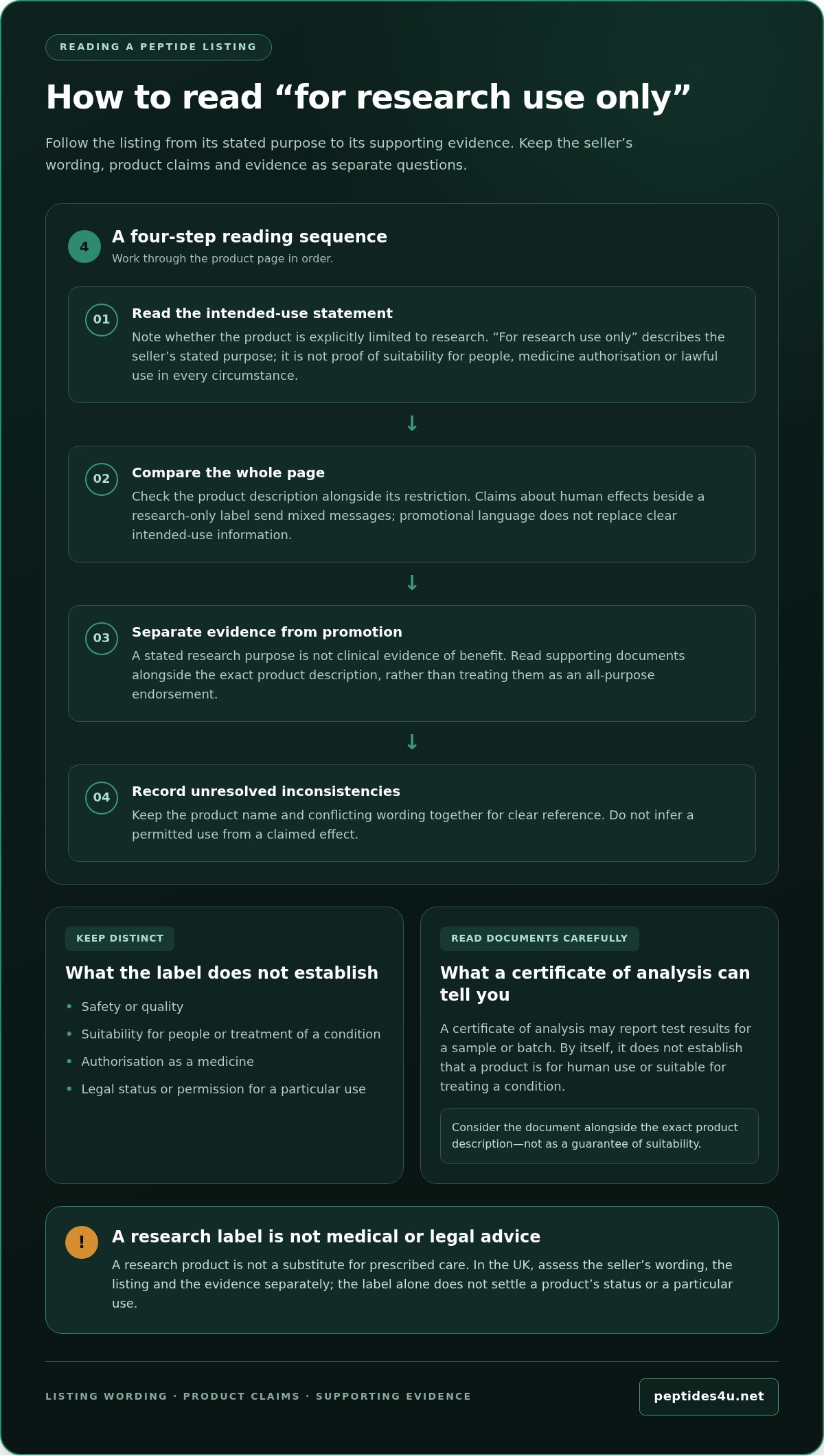
Use this practical reading sequence when comparing listings:
- Read the intended-use statement. Note whether it explicitly limits the product to research.
- Compare the whole page. Check whether claims about human use conflict with that restriction.
- Separate evidence from promotion. A stated research purpose is not clinical evidence of benefit.
- Record unresolved inconsistencies. Keep the product name and the conflicting wording together for clear reference.
A listing might describe a vial as research-only while also referring to body-composition or recovery research. Those statements do not make the product an authorised medicine or establish an effect in people. Read the restriction as written, and do not infer a permitted use from a claimed effect.
Research-use positioning also matters when you assess supporting documents. A certificate of analysis may report test results for a sample or batch, but it does not establish that the product is for human use or suitable for treating a condition. Read the document alongside the exact product description, rather than treating it as an all-purpose endorsement.
In the UK, distinguish a seller’s wording from a claim about legality. “Research use only” does not settle every question about a product’s status or a particular use. Do not treat the label as legal advice, a compliance guarantee or permission for personal use. Assess the restriction, listing and evidence separately.
For a peptide shop in the UK, clear research-use wording tells you how a listing is positioned, but not whether a product is suitable for people or lawful for a particular use. Keep these questions separate, and do not rely on a label alone to answer them.
UK research peptide catalogue and prices
UK peptide catalogues vary in naming, formats and listing detail. Compare products using the exact name, stated format, pack details and price. A price for a vial cannot be compared fairly with another listing until you know whether both describe the same product and quantity. Keep each detail with its listing.
How do UK peptide shops compare on delivery, returns and customer service? Check each shop’s published dispatch and delivery terms, returns information and support channels. These details affect the buying process, but they do not establish a product’s quality or intended use.
What are the health risks of buying or using research peptides? Contents, purity and effects may be uncertain, and research-use products aren’t a substitute for authorised medical treatment. Treat health claims on a product page as claims, not evidence that personal use is safe.
How should peptides be stored and handled safely? Follow the product’s own handling and storage instructions, keep it in its original labelled packaging, and prevent access by children. Don’t guess storage conditions or use a product when its label is missing or unclear.
Catalogue structure can help narrow your comparison. Some shops group products by name or format, while others require you to check each product page. Read the full listing, not just the category label. Check that it identifies the product, states the pack details and gives handling information. A category heading alone does not tell you what a particular pack contains.
- Product identity: Record the exact name as printed on the listing.
- Presentation: Note whether the entry describes a vial, pen or another format.
- Pack quantity: Compare the stated amount, not just the pack’s appearance.
- Listing detail: Keep any batch or testing information separate from marketing claims.
Prices need context. A listed price may apply to a specific pack size or format, so check the stated quantity before judging value. Different forms and amounts can make two prices poor comparisons. Do not rely on a low headline figure without checking what the listing says is included.
For a practical comparison, make a table with columns for product name, format, pack details, price, delivery terms and returns. Fill each column using the relevant listing. Note missing details in your own records rather than assuming they match across shops. This keeps product, price and service comparisons distinct.
Peptide prices and pack sizes
A price is useful only when you know what the pack contains. Compare it with the stated quantity, format and product name. A vial and a pre-filled pen, for example, are different formats; their prices alone do not show whether they contain equivalent quantities or can be compared directly.
Record each listing’s exact product name and pack description. Note whether the quantity refers to one item, a multi-item pack or an amount stated on the page. Do not infer pack contents from a photograph. Images show presentation, but the written listing should explain what the price covers.
Use a consistent comparison method. If a listing gives a price and a clear quantity, divide the price by that quantity to calculate a unit figure. Compare it with another listing only when the unit and product format match. A pack count and an amount are not directly interchangeable.
- Record the name: Copy the peptide name exactly, including any stated variant.
- Record the format: Note whether the listing describes a vial, pen or another form.
- Record the quantity: Use the stated pack count or amount, not an estimate.
- Compare like with like: Calculate a unit figure only where both listings use comparable units.
Two listings may use the same product name but describe different pack quantities. One may show a single item and another a multi-item pack. Check the quantity attached to each price before judging value. A lower pack price does not necessarily mean a lower cost for an equivalent quantity.
Check any charges that affect the checkout total. Delivery costs can make the final amount different from the product-page price. Record the product price and delivery charge separately, then compare totals on the same basis. Read the checkout details rather than assuming the displayed product price is the full order cost.
Price differences do not prove differences in quality, purity or suitability. A higher price is not proof of more extensive testing, and a lower price does not prove poor quality. Assess those claims separately from pack size and cost. If a listing describes testing or batch information, record it as separate evidence.
Build a simple comparison table before deciding. Include product name, format, stated quantity, listed price, delivery charge and relevant documentation. Exclude entries whose units cannot be compared fairly. This helps explain price differences and prevents pack size from being mistaken for a measure of quality.
UK legality claims
A product page’s legality claim is not a legal ruling. Treat phrases such as “legal in the UK” as claims to examine, not proof that every sale, import or intended use is permitted. A research-only description alone does not settle a product’s status or the rules that apply to a particular transaction.
Separate three questions when reading a listing: what the product is, what it is intended for, and what activity the claim covers. A statement about selling a product may not address personal use or import. Research-use wording describes the seller’s stated positioning; it does not establish that a product is authorised as a medicine or suitable for people.
Can peptides be imported into the UK, and what customs rules apply? There is no single answer for every peptide. The substance, intended use and applicable classification matter. A research-only label does not establish that a specific import is permitted or explain the customs requirements that apply.
Read the wording carefully. Check whether the page names the product and explains the scope of its legality claim. Compare that statement with the intended-use label and any claims about human effects. If a page says “legal for research” while promoting personal effects, those are separate claims, not proof of lawful personal use.
Use this reading sequence to assess a claim:
- Identify the claim: Note whether it concerns sale, possession, import or use.
- Match the product: Record the exact name and form shown on the listing.
- Read the qualification: Keep research-use wording distinct from claims about human use.
- Assess the scope: Avoid extending a narrow statement to other activities.
A product page may say that a vial is sold for research. That does not answer whether another intended use is lawful, and a broad statement about a product category does not settle the status of every item in it. Product identity and intended use matter when interpreting general wording.
Be cautious with absolute phrases such as “fully legal” or “customs approved” when the page gives no scope or explanation. A shipping statement is not necessarily a legal assessment of the substance or intended use. A research label is not permission to use a product as treatment. Keep the seller’s claim separate from your conclusion.
For a UK legality claim, record the exact wording, named product and activity it covers. This can reveal gaps between a sales statement and a claim about import or use. Assess each question separately instead of relying on one phrase to answer them all.
Whether an import is permitted depends on the specific substance, its intended use and its applicable classification. A research-only label or shipping statement alone cannot establish permission or the customs requirements.
Which UK peptide suppliers provide lab testing and certificates of analysis?
When assessing a supplier, look for a certificate of analysis (CoA) linked to the product and its batch. A useful report identifies the tested material, gives a batch reference and records results. A generic certificate with no clear link to the listed product cannot show that the batch for sale matches the tested sample.
Read the product page and linked documents together. Match the peptide name and batch details across both. If a listing names one peptide but its certificate names another, the document does not support that listing. Keep the product description, batch reference and CoA together when assessing the information.
A CoA can report test results, but its value depends on what it identifies and measures. Read the method and results rather than relying on a “tested” badge. That word alone does not explain what material was tested, what the analysis covered or whether the report applies to the current batch.
- Product match: Confirm the certificate names the same peptide as the listing.
- Batch match: Compare the batch reference on the document with the product information.
- Test detail: Read the stated method, sample identity and results.
- Document scope: Note what the analysis covers and what it does not claim to establish.
For example, a report may describe identity or purity testing. Those results relate to the stated sample and test. They do not, by themselves, establish that a product is a licensed medicine, safe for personal use or suitable for treating a condition. Keep laboratory findings separate from claims about human effects.
Distinguish a batch-specific report from a general quality statement. A supplier may describe its testing process without showing results for the batch listed for sale. A certificate with a different batch reference may relate to another sample. These are separate pieces of information, not interchangeable evidence.
For each listing, record the product name, batch reference, certificate date if shown, test method and reported results. If a document gives no batch reference, note that limitation rather than assuming it covers every pack. This makes comparisons clearer and prevents broad marketing language from being mistaken for a specific laboratory result.
Assess supplier claims against the evidence provided. A named laboratory, test method and matching batch reference make a report easier to interpret, but the report cannot answer questions beyond its stated scope. Read the document, listing and intended-use wording as separate parts of your assessment.
Peptides4u: Plumas SereneQ
Peptides4u offers Plumas SereneQ for readers comparing peptide product listings. Turn to this option if you want to view the named offering after reviewing research-use wording, product information and the limits of legality claims. Keep those considerations separate from the decision to browse a product.
Use the details on the Plumas SereneQ listing to understand how it is presented. Consider its stated purpose alongside the questions raised in this guide. Research-use descriptions do not establish suitability for personal use, and a product listing is not medical advice. Make your decision with those distinctions in mind.
To view Plumas SereneQ, visit the Peptides4u website.
Make your next step a considered one
Choose a peptide shop in the UK with a clear purpose in mind. Decide which product details matter to you, then keep product information distinct from claims about use, testing or legal status. That gives you a practical basis for deciding whether to continue browsing or pause.
Peptides4u offers Plumas SereneQ and specialised laboratory research vials. If either option is relevant to what you are looking for, review its product information with the same care you would apply to any listing. A product name alone does not answer questions about intended use or suitability.
For questions about the products, contact Peptides4u with your questions. Take the next step at your own pace, with the information that matters to your decision in view.
Frequently Asked Questions
Which UK retailers sell peptides, and what types do they offer?
Peptides4u is a UK online retailer listing Plumas SereneQ and Viales Quanta Pharma. The shop organises its catalogue by categories, including recovery, cognitive and energy, and body composition. Its products are supplied strictly as laboratory research chemicals, not for human or veterinary use. Compare the exact product name and format on the listing, rather than assuming products within one category are interchangeable.
How much do peptides cost from UK shops?
Prices depend on the product and the format or pack size shown on its listing. Compare products only when their stated quantities and presentations match. Peptides4u displays prices on individual product listings, so use the relevant listing for its current figure. Don’t treat a price for one format or pack as a reliable guide to another, and separate any delivery charge from the product price when comparing the total.
Are peptides legal to buy and possess in the UK?
No single answer covers every peptide and intended use. A retailer’s “research use only” wording does not, by itself, settle the legal status of a product or its purchase, possession, import or use. Assess the exact substance and claim. A product listing is not legal advice, and a statement about sale does not necessarily answer questions about personal use.
Which peptides require a prescription or are classified as medicines in the UK?
Prescription status cannot be determined from the broad term “peptide”; it depends on the specific product and its classification. A retailer’s research-use label does not establish whether a named product falls into a prescription category. Identify the exact substance and formulation, then consult an official UK classification source. Do not infer prescription status from a product name, category label or seller description alone.
How do UK peptide shops compare on delivery, returns, and customer service?
Compare each shop’s published dispatch and delivery terms, return conditions, and customer support channels. These affect the buying process but do not establish a product’s quality or intended use.