Peptide pens compared: how to assess the options in 2026

A listing with more technical detail isn’t automatically easier to compare. When peptide pens compared side by side use different terms, it’s easy to mistake a device specification for information about the peptide product or its intended use. Start by separating what the pen is from what the listing says it contains, then compare only details that are documented.
This guide gives you a practical way to assess the options in 2026. You’ll learn how to distinguish reusable and pre-filled designs, compare mechanisms and cartridge details where stated, and record what each listing says is supplied. The aim is to clarify product information, not to make claims about medical suitability. You can apply the same criteria to the SereneQ Pens shop listing, so you know which details to look for and how to compare them consistently.
Key Takeaways
- When peptide pens compared listings use different terms, focus on documented specifications rather than names, photos or broad labels.
- Build a like-for-like comparison around reuse, cartridge capacity, increments and supplied components. Treat any MY PEPTIDES figures as details of that listing, not universal benchmarks.
- Don’t assume pens, cartridges or peptide products are interchangeable. Look for compatibility stated in the listing, and keep device details separate from product claims.
- Use a simple method: identify the format, record the specifications, note the stated contents and separate page facts from assumptions.
- Once you’ve set your comparison criteria, explore the SereneQ Pens category in the Peptides4u shop for its current product information.
Peptide pens compared: what are you actually comparing?
A peptide pen listing describes a device and its stated specifications, not automatically the peptide product associated with it. Keep the parts distinct: the pen is the device, a cartridge or other container may be a separate component, and a peptide product may be listed separately or described alongside the device. A product name, photograph or broad label doesn’t establish how those parts relate.
This distinction matters because What are Peptides? is a different question from what a particular pen listing documents. A peptide is a type of molecule; a pen is a device. A listing may mention both, but that doesn’t make the peptide’s properties a device specification or the device’s features a claim about the peptide.
For a useful comparison, focus on written details you can check against each listing. Treat stated specifications as facts about that listing only. Don’t fill gaps with assumptions based on a product title, a familiar-looking image or what another pen appears to include. This is product-information guidance, not medical advice or instructions for human use.
How a reusable pen differs from a peptide product
A reusable pen is a device described as being used with a separate cartridge. The cartridge is not the pen itself, and neither term identifies the contents. A peptide product may be presented separately, or a listing may discuss it alongside a device. Read each item as a distinct part unless the listing clearly explains their relationship. Similar names or formats don’t establish that a cartridge, device or product will work with another one.
Why listings can be difficult to compare
Specifications answer different questions. Capacity describes one attribute; increments describe another; supplied components tell you what the listing says comes with the item. One detail can’t stand in for the others. A shared label such as “reusable” also doesn’t prove that two pens have the same construction or specifications. Record each detail separately, and mark unclear fields as unanswered rather than guessing.
That gives you a fair basis for peptide pens compared: compare like with like, using evidence from the product information itself. If one page states a capacity and another does not, you haven’t established a match or a difference on that point. You’ve identified a gap in the information. Use this simple distinction as you read:
- Stated: a specification or included component written in the listing.
- Inferred: a conclusion drawn from a name, image or category label.
- Unanswered: a detail the listing doesn’t explain clearly.
Use stated details in your comparison. Keep inferences out of your conclusions, and carry unanswered points forward. This makes the next step more precise: compare individual specifications without treating a device description as evidence about the peptide product or its intended use.
Which peptide pen specifications matter in a like-for-like comparison?
Compare the same fields for each listing. This makes differences visible without treating one device’s figures as a category standard. Like-for-like specifications show what each listing actually documents, not what a name or image might suggest.
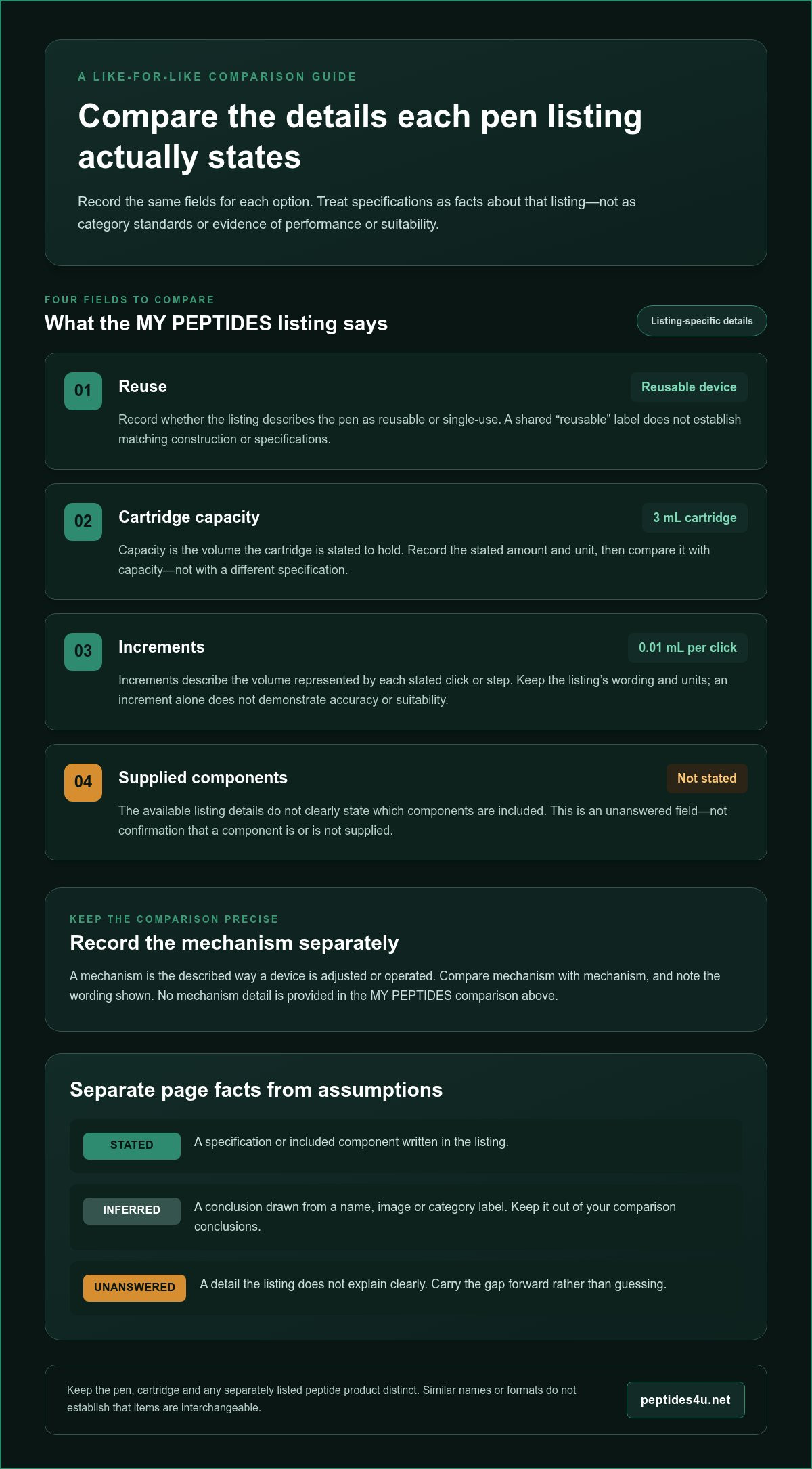
Use a table as a working record. The MY PEPTIDES figures below apply to that product listing alone. They aren’t universal benchmarks, and they don’t establish performance, accuracy or suitability.
| Comparison field | What to record | MY PEPTIDES listing |
|---|---|---|
| Reuse | Whether the listing describes the pen as reusable or single-use | Reusable device |
| Cartridge capacity | The stated capacity and unit | 3 mL cartridge |
| Increments | The stated volume represented by each click or step | 0.01 mL per click |
| Supplied components | Each item the listing says is included, such as the pen body or cartridge | Not stated in the available listing details |
Capacity, increments and mechanism
Capacity is the volume a cartridge is stated to hold. Increments describe the change represented by each marked step or click. A mechanism is the described way the device is adjusted or operated. Record the wording and units as shown. The MY PEPTIDES listing states a 3 mL cartridge and 0.01 mL per click; those figures describe that listing only. They don’t, by themselves, demonstrate accuracy or indicate suitability.
Keep each figure in its original context. Don’t convert it into dosing guidance or treat a stated increment as proof of how a pen performs. For a fair comparison, match field to field: capacity against capacity, increment against increment, and mechanism against mechanism. If a listing uses different wording, note it rather than forcing a false equivalence.
What comes with the pen listing?
Separate the pen body from the cartridge and from any other component named on the page. A listing may describe a device without stating that a cartridge, accessories or consumables are supplied. Record an item as included only when the page says so. Keep packaging and any separately listed peptide product distinct from the device contents.
In the table, “not stated in the available listing details” means the source information gives no clear answer for that field. It doesn’t mean the item is or isn’t included. Apply the same standard to every option. For the SereneQ range, use the SereneQ Pens shop listing as the product-information reference, and record only specifications shown there.
Are peptide pens interchangeable? Separate device details from product claims
No. Don’t assume that pens, cartridges or peptide products are interchangeable. Similar names, appearances or category labels don’t establish compatibility. A listing needs to state which components are designed to work together. If it doesn’t, the comparison can’t establish that relationship. Don’t use an unfamiliar specification as a reason to guess, or try to resolve uncertainty through fitting or operating steps.
Keep three kinds of information separate as you read: the device’s specifications, the peptide product’s description and the listing’s promotional language. A capacity or mechanism is a device detail. A product name or description relates to the product. A phrase such as “easy to use” is a claim made by that listing. One type of information doesn’t prove another. Wording about a device doesn’t establish medical suitability, likely outcomes or regulatory status.
When two listings are not directly comparable
Start by noting differences in format, stated capacity, increments and included components. If one page describes a reusable device and another describes a different format, they aren’t a direct match just because both use the word “pen”. Even when a specification appears to match, that single point doesn’t establish full compatibility. The pages would need to identify the relevant device, cartridge or product relationship clearly.
For example, one listing might state a cartridge capacity while another gives an increment but says nothing about its cartridge. Record each stated fact in its own field. Don’t assume the devices share a cartridge type, or that a product described beside one pen can be paired with the other. The result may be a partial comparison, not proof that the options are compatible or equivalent.
How to read claims without over-interpreting them
Separate measurable details from broad descriptions. You can record a stated capacity, increment or list of supplied components as written. Terms such as “precision” or “convenience” need context: attribute them to the listing that uses them, rather than presenting them as independently verified findings. They don’t tell you how another device performs or whether a product suits a particular person.
Use a simple evidence check before drawing a conclusion:
- Device specification: record the exact detail and unit stated on the page.
- Compatibility: note only relationships the listing explicitly describes.
- Product claim: attribute promotional wording to that listing.
- Unanswered point: leave it unresolved rather than filling the gap with an assumption.
This keeps peptide pens compared on documented information, not implied promises. If a specification feels unfamiliar, preserve the wording and mark the point as unclear. Don’t turn it into a compatibility conclusion or human-use guidance. A careful comparison shows what each listing says, where its claims differ and which points the product information leaves open.
How to compare peptide pen listings without relying on guesswork
A consistent method turns separate product pages into a clear record. Use the same fields for each option, keep the listing’s wording intact and leave gaps visible. That way, peptide pens compared means comparing documented details, not filling in missing information or declaring a winner without evidence.
- Identify the format. Record whether the listing describes a reusable pen or another format. Don’t infer the format from a photograph alone.
- Record specifications. Note stated capacity and increments exactly as written, including the unit. If a field is absent or unclear, enter “not stated in the listing”.
- Check stated contents. Record the components the page says are supplied. Keep the device, cartridge, peptide product and packaging distinct.
- Compare claims. Separate measurable specifications from general wording. Note what evidence the listing provides, and don’t treat promotional language as proof of quality, safety or performance.
A simple comparison table readers can reuse
Copy this template for each listing. Keep it descriptive. A blank or “not stated” entry shows where the information stops, rather than inviting a guess. Don’t rank options unless the evidence supports a clear, relevant comparison.
| Listing | Reusable format | Capacity | Increments | Stated components | Claims and evidence provided | Details not stated |
|---|---|---|---|---|---|---|
| Listing A | As stated / not stated | As stated / not stated | As stated / not stated | List stated items | Quote claim; note evidence cited | Record missing or unclear fields |
| Listing B | As stated / not stated | As stated / not stated | As stated / not stated | List stated items | Quote claim; note evidence cited | Record missing or unclear fields |
Keep product claims in their own column. For instance, if a page uses a broad term such as “precision”, record the wording as a claim and note what evidence the listing gives. Don’t turn it into a conclusion about device performance. Leave price comparisons out of this method; they don’t answer whether specifications or components match. For a separate approach to comparing peptide bundle prices and value, assess bundle contents and comparable item counts rather than device specifications.
Questions a comparison can answer, and those it cannot
Your table can show which device details each page states, where descriptions differ and which fields remain unanswered. It can’t establish personal medical suitability or replace qualified advice. Keep decisions about use, treatment and dosing outside this comparison. Product listings also don’t, on their own, settle UK regulatory questions; those require qualified review. This section makes no legal determination.
To apply the same checklist to a shop option, view the SereneQ Pens listing and record only the product information it states.
Explore SereneQ Pens after comparing the details
Once you’ve set your comparison fields, apply them to the SereneQ Pens category in the Peptides4u shop. Use the current product listing as the source for its product information. Record only details the page states. This gives you a practical next step: compare the available information against your notes without borrowing specifications from another pen or assuming that a familiar category label guarantees the same design.
What to review on the SereneQ Pens listing
Read the product description and specifications as separate pieces of information. Keep device details, such as the format or any stated components, distinct from descriptions of a peptide product. If a detail matters to your comparison, note the wording used on the listing. Don’t fill gaps with features found on other products, or turn a product claim into a device specification.
Use your comparison table to capture details consistently. For example, put a stated format in the format field and a named component in the contents field. Keep claims in their own notes. If a field doesn’t have a clear answer on the page, leave it unanswered. This isn’t a judgement about the product; it keeps peptide pens compared on information you can actually read and record.
From comparison to the shop
The SereneQ Pens category is the direct place to review the shop’s current product information. Read the listing for the item you’re considering, then use the same comparison fields rather than relying on details from another product page. A separate peptide calculator is also available through the shop. It’s a separately listed tool, not medical guidance, and it doesn’t add specifications to a pen listing.
Keep order information separate from product information. The shop states that orders placed before 12pm, Monday to Friday, are dispatched the same day. Plain packaging is also advertised. These are ordering details, not pen features or evidence about a product’s specifications.
Ready to apply your checklist? Explore SereneQ Pens in the Peptides4u shop and use the current listing to review the details provided. Stick to what the page states. This keeps the comparison clear, avoids unsupported assumptions and leaves questions of medical suitability outside product-listing research.
Turn your comparison into a clear next step
Use your notes as a practical reference when you review a product listing. A simple record of the details that matter to you makes it easier to assess new information without relying on memory or assumptions. Keep the comparison focused on documented product information. Leave medical suitability and decisions about use to qualified advice.
If you’re ready to continue, the Peptides4u shop lists SereneQ Pens as a product category. Plain packaging is advertised, and qualifying weekday orders placed before 12pm are stated to be dispatched the same day. These are ordering details, separate from the pen’s specifications. The shop also lists a peptide calculator as a separate tool, not as medical guidance.
Use your peptide pens compared checklist to review the current listing on its own terms. Explore SereneQ Pens and take the next step with a clear view of the information provided. A careful comparison helps you browse with confidence.
Frequently Asked Questions
How do peptide pens differ?
Peptide pen listings can differ in reusable design, stated capacity, increments and included components. These details describe the device or what the listing says is supplied. They don’t prove that a pen is compatible with a peptide product or suitable for a particular person. For a clear comparison, open the exact product pages and record each detail in the same order. Don’t treat one format as universally better.
Are peptide pens interchangeable?
No. Don’t assume pens, cartridges or peptide products are interchangeable. Compatibility needs to be established by the product information for the relevant items. A matching capacity or similar-looking design isn’t enough to show that components fit or work together. For example, two listings may state the same capacity but describe different devices. Compare explicit compatibility statements, and leave the relationship unresolved if the pages don’t establish it.
What does a pen click mean on a product listing?
A click increment describes a stated step in a device’s mechanism. It doesn’t, by itself, tell you a peptide amount, a dose or how anyone should use a product. If a listing gives a volume per click, record it as a specification of that listing only. Keep the unit alongside the figure, and don’t treat it as a standard that applies to every pen.
What should I compare when choosing between peptide pen listings?
Compare the reusable format, stated capacity, increments, mechanism and listed components. Check that figures use comparable units before drawing a distinction, and keep marketing phrases separate from measurable specifications. If a page leaves a field blank, mark it as not stated rather than completing it from another page. This gives peptide pens compared a practical, factual basis without assessing medical suitability or advising on product use.
Does a reusable peptide pen include a cartridge?
Not necessarily. Inclusion depends on what the individual product description says. A device designed around a cartridge doesn’t automatically mean a cartridge comes with it. Read the stated contents carefully and distinguish an item shown in a picture from one explicitly listed as supplied. For SereneQ Pens, use the current product listing for its own details; don’t transfer component information from another pen or assume what is included.
Can a peptide pen comparison tell me which product is right for me?
No. A comparison can help you understand how listings describe their devices, but it can’t decide personal medical suitability or treatment choices. Finding a specification that matches a preference is not a health recommendation. Use the comparison to organise product information and identify what a page says. Don’t use device details to infer how a peptide product may affect you or whether it is appropriate.
Are peptide pen listings medical advice?
No. A product listing describes an item and the details presented with it; it isn’t a substitute for medical advice. Product wording alone also doesn’t establish prescription status, regulatory standing or personal suitability. Read each statement in context: a device specification concerns the device, while a product description concerns the product. Avoid drawing health or legal conclusions from promotional language or a product title alone.
1 comment