Peptide Pens Online: What to Check Before You Buy in 2026

Check a product’s status before weighing convenience when considering a peptide pen. A compact format and confident product description can make a listing look straightforward, but neither tells you whether the product is authorised for human use, suitable for you or supported by evidence for its claimed results. If you’re comparing peptide pens online, start with the details of the specific product.
In the UK, “research use only” wording does not authorise a product for human use, and selling research peptides for human consumption is illegal. Some peptide medicines, including semaglutide and tirzepatide, are prescription-only. A product name or seller description is not a substitute for checking the relevant regulatory status.
This guide explains what a pen listing describes, how pen formats differ from vials, and what to review in product details and order information. It also distinguishes catalogue information from medical or performance claims. Peptides4u’s catalogue includes SereneQ Pens and Quanta Pharma Vials, so it helps to understand what an individual listing does, and does not, establish before you buy.
Key Takeaways
- Read a peptide pen listing for specific product details, not as proof of suitability or approval.
- Compare pen and vial descriptions without assuming their contents or directions are the same.
- When reviewing peptide pens online, distinguish product information from seller claims and checkout terms.
- Check current MHRA guidance and the specific product’s regulatory status before deciding.
- Peptides4u states that weekday orders placed before noon are dispatched the same day. Dispatch timing is not a delivery date.
Peptide pens online: what does a product listing actually tell you?
A peptide pen product is a product presented in a pen-style format. The term describes how an item is packaged or presented, not whether it is authorised for human use, medically suitable or supported by evidence of effectiveness. A listing tells you what the seller says about that item, but cannot verify those claims by itself.
That distinction matters when browsing peptide pens online. A product name may identify a range or ingredient, while the description may state contents, format or seller-provided directions. These details can vary between listings. Do not assume that every product called a “pen” has the same composition or use.
What information should a peptide pen listing show?
Start with the exact product name and read the full listing, rather than relying on a category heading. For example, “GLP-1 & Weight Loss” organises products in a catalogue, but does not identify the contents or establish the status of each item in that category. Peptides4u’s catalogue includes SereneQ Pens; the range name alone does not replace the details on an individual listing.
Look for specific statements, such as a named ingredient or quantity, if provided. Note whether directions appear, but do not treat seller wording as medical advice. Separate factual product descriptions from promotional language about convenience or expected results.
- Product information: the exact name and any stated contents or format.
- Seller wording: descriptions and claims, which remain claims unless independently substantiated.
- Order information: payment and checkout terms, which answer purchasing questions rather than questions about safety.
If a detail is missing or unclear, do not fill the gap with assumptions based on a category, product name or another listing.
What a pen format does not tell you
The format alone does not establish a product’s contents, intended use or authorisation for human use. A polished page, specific product name or confident seller language does not independently verify quality, safety or effectiveness. These are separate questions from how an item is presented.
Convenience language also needs context. Calling a format simple or ready to use does not demonstrate that it is safe or effective for a particular person. Online availability is not proof of regulatory authorisation, and a seller’s description is not independent evidence.
For UK listings, check current Medicines and Healthcare products Regulatory Agency (MHRA) guidance and the regulatory status of the specific product. Keep that check separate from the catalogue description: product details describe what the seller states, while regulatory information addresses a different question. The word “pen” answers neither one.
Pre-mixed pens and vials: compare the format without assuming more
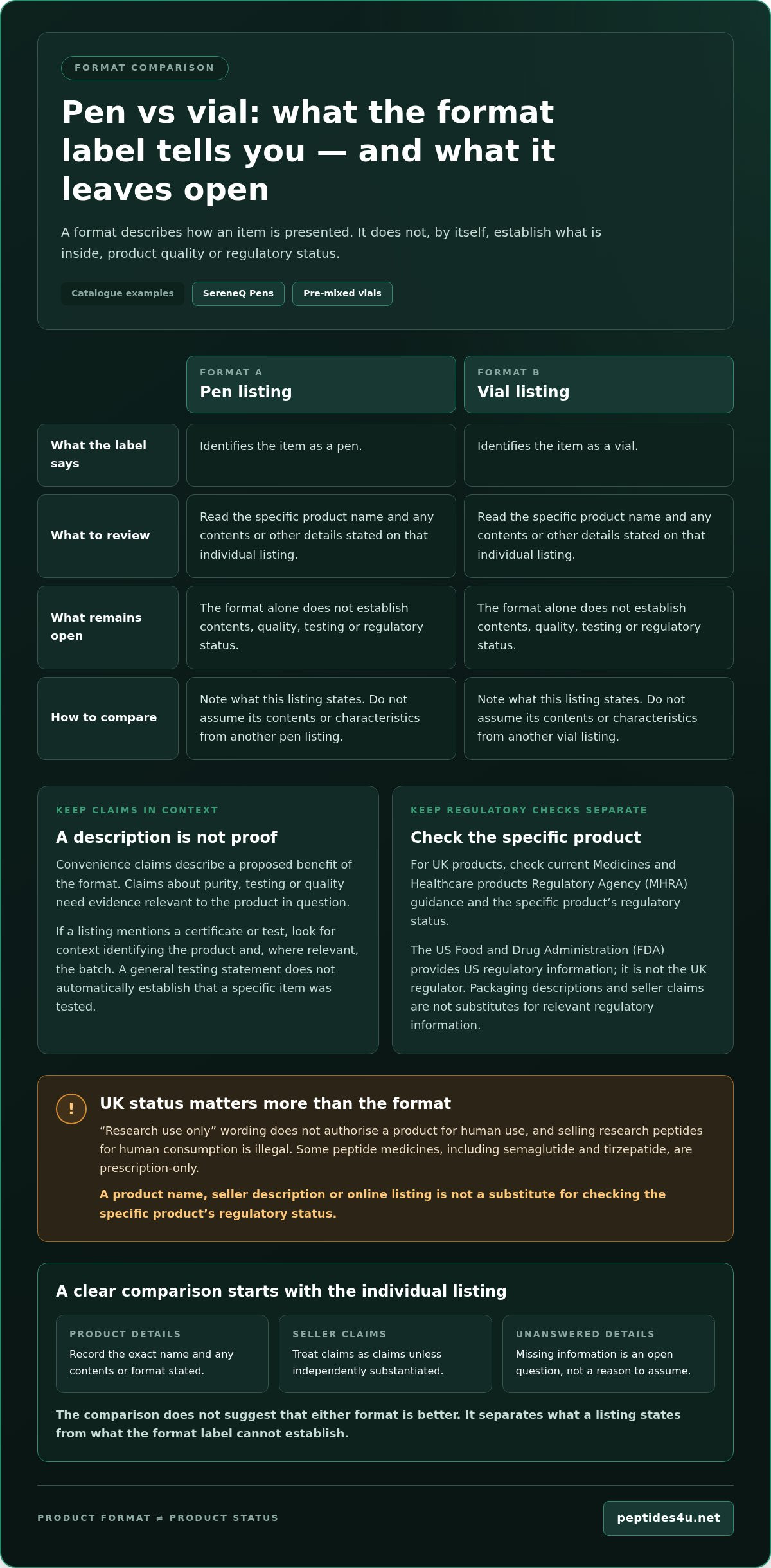
A pen and a vial describe different product formats, but those labels do not tell you everything about the item inside. Peptides4u’s catalogue includes SereneQ Pens and pre-mixed vials. Compare bundle prices by checking each listing’s contents and quantities rather than assuming all pens or all vials have the same contents, design or characteristics.
Use the comparison below to separate stated information from unanswered questions. It does not suggest that either format is better. It shows what the format label alone can and cannot establish.
| Comparison point | Pen listing | Vial listing |
|---|---|---|
| Format description | Identifies the item as a pen. | Identifies the item as a vial. |
| Listing details | Review the specific product name and any contents or other details stated. | Review the specific product name and any contents or other details stated. |
| Questions left open | What does the listing establish about quality, testing and regulatory status? | What does the listing establish about quality, testing and regulatory status? |
How to read a pen-versus-vial comparison
Compare like with like. If one listing states a product name and contents while another only gives a format label, note the difference rather than treating them as equivalent. Missing information is an unanswered question, not proof that a product is faulty. Do not infer details from packaging or from claims about another seller’s products.
Which claims need evidence beyond a format description?
Convenience claims describe a proposed benefit of the format. Claims about purity, testing or quality need evidence relevant to the product in question. If a listing mentions a certificate or test, look for context identifying the product and, where relevant, the batch. A general testing statement does not automatically establish that a specific item was tested.
A format description is not proof of product quality.
Keep regulatory checks separate from format comparisons. For UK products, consult current MHRA guidance and check the specific product’s status. The U.S. Food and Drug Administration (FDA) provides US regulatory information, but it is not the UK regulator. Packaging descriptions, convenience claims and testing statements are not substitutes for relevant regulatory information.
For a direct comparison of the shop’s named formats, review the SereneQ Pens and vial listings side by side. Focus on what each page states, and keep unanswered questions separate from confirmed details.
UK peptide pen listings: check product status and claims
A product appearing in an online shop does not establish that it is authorised for human use. A product name, category or checkout option shows how a seller presents an item, not its regulatory status. When considering peptide pens online, assess the exact product and the claims made about it rather than relying on its availability to buy.
In the UK, regulatory treatment can depend on a product’s ingredients, intended use and claims. Some peptide ingredients are active in licensed medicines and are prescription-only. Research-use wording does not turn a product into a medicine authorised for people, and laboratory claims do not show that it is medically suitable. Check current MHRA guidance and the status of the specific product. A general category description is not a product-specific answer.
Regulatory descriptions can also change as UK requirements change, and differences in claims or intended use may matter. Have legal and regulatory statements reviewed against current UK requirements by a suitably qualified UK reviewer before publication. Avoid presenting a broad summary as a definitive ruling on an individual listing.
How to assess claims about testing and certificates
Check the scope of testing statements. Does the claim identify the product, batch and testing method? Does a certificate relate to the item being described? If those details are unclear, treat the claim as limited rather than proof of a wider standard. Testing information may relate to particular product characteristics, but it does not establish clinical effectiveness or regulatory authorisation. Do not transfer testing claims made by another seller to a Peptides4u listing.
What does research-use wording mean?
Read phrases such as “research use only” in context. A label is the seller’s wording, not an MHRA decision or permission for personal or medical use. On its own, it does not establish whether a product may legally be supplied for a particular purpose. Laboratory references also do not establish medical suitability or authorisation without relevant evidence and regulatory status.
Keep the questions separate: what does the listing say, what evidence supports any testing claim, and what is the product’s UK regulatory status for its stated purpose? An answer to one does not settle the others. Check current MHRA guidance and product-specific information before drawing conclusions. Have any legal explanation reviewed before publication.
A practical checklist for reviewing peptide pens online
Use the same review sequence for each listing. Keep four kinds of information separate: product details, seller statements, checkout terms and regulatory questions. A gap or unclear claim is a reason to pause, not proof that a seller or product is unsafe.
- Identify the listing. Note the exact product name and compare the description with the item shown at checkout. If the name or details change, pause and establish what the order refers to.
- Review the claims. Separate stated product information from promotional language. Look for supporting information for claims about testing or quality. Do not infer specifications from a product name or format.
- Check the order terms. Read the payment, packaging and dispatch details before placing an order. Treat dispatch and delivery as separate timings.
- Consider regulatory status. Check current MHRA guidance and the specific product’s status. An online listing or research-use label does not establish authorisation for human use.
Review the product and seller information
Compare the product name and description on the listing with the details at checkout. Check whether the seller explains the basis for claims instead of relying on confident wording alone. Note what is stated and what remains unanswered. Do not assume contents, testing or specifications, and do not treat an unclear detail as proof of a defect.
Product information describes what the listing says; seller statements explain how the seller presents the product. Neither answers every question about testing or regulatory status. If a claim matters to your decision, look for specific supporting information and check the product’s status separately.
Review order terms before checkout
Read the checkout details carefully. Peptides4u states that weekday orders placed before noon are dispatched the same day. This is a dispatch statement, not a promised delivery date. The shop also advertises plain packaging and lists bank transfer and cryptocurrency as payment methods. Review the current terms shown during your order.
Before deciding, note any point that remains unresolved, such as a mismatch between the listing and checkout, an unclear product statement or an unanswered regulatory question. This keeps your decision grounded in what is actually stated, rather than convenience language or assumptions.
To review the shop’s current listings, browse the Peptides4u SereneQ Pens range. Apply the same checklist to each product page, and keep catalogue information separate from medical advice or claims about results.
Ordering SereneQ Pens from Peptides4u: the shop details
Peptides4u’s online shop includes a SereneQ Pens range. Before ordering, read the individual product listing alongside the checkout details. The listing describes the item, while checkout sets out order information. Keep those practical details separate from medical or performance claims.
Peptides4u advertises plain packaging, accepts bank transfer and cryptocurrency, and confirms orders on WhatsApp. These details explain the stated purchase process; they do not describe a product’s contents or regulatory status. Review those questions separately when comparing peptide pens online.
What to expect from the Peptides4u order process
Check the payment method shown for your order and read the checkout steps before proceeding. Orders are confirmed on WhatsApp, so review the order information and keep the confirmation details for reference. Plain packaging is advertised by the shop. It is a packaging detail, not a statement about a product’s contents or suitability.
The shop states that weekday orders placed before noon are dispatched the same day. This applies to qualifying weekday orders and refers to dispatch, not arrival. Dispatch means an order has been sent out; it is not a guaranteed delivery date. Check the current order terms at checkout for the information that applies to your purchase.
Before submitting your order, compare the product name and selection in your basket with the listing you read. Review the payment and order details too. If checkout information differs from the product page, pause and resolve the discrepancy before proceeding.
Find the SereneQ Pens range
Use the shop range to view current SereneQ Pens listings. Details can differ between individual items, so rely on the information on the relevant page rather than assuming one listing describes the full range. Treat stated contents and other product details as listing information, not medical advice or evidence of results.
Payment, packaging, confirmation and dispatch information answers practical ordering questions. It does not establish whether a product is suitable for a person or authorised for human use. Keep these issues distinct, and review current UK guidance and the status of the specific product before deciding.
Ready to view the current listings? View SereneQ Pens.
Make your next step an informed one
Before choosing, identify the question that matters most: product information, regulatory status or the order process. Keep those questions separate, and do not let a convenient format or persuasive wording answer them for you. A careful decision starts with what the specific listing states and what you can verify.
Peptides4u’s shop includes SereneQ Pens. The shop advertises plain packaging and states that weekday orders placed before noon are dispatched the same day. Dispatch is not a delivery date. Review the listing and current order details, then decide whether you have the information you need.
Ready to view the range? Explore SereneQ Pens. Take the same measured approach to peptide pens online: review the details, consider the relevant UK regulatory information and make your next move with care.
Frequently Asked Questions
What is a peptide pen?
A peptide pen is a seller-described product format, not a statement of approval or suitability. A listing may use “pen” in its product name, but that word does not tell you the ingredients, intended use or regulatory status. Read the details for the specific item, and treat claims about ease or convenience as claims rather than evidence of safety or effectiveness.
Are peptide pens legal to buy in the UK?
There is not one answer for every product. Legal status may depend on ingredients, intended use and how the product is supplied or promoted. Do not use a shop listing or “research use” label as a legal ruling. Check current UK guidance, including relevant Medicines and Healthcare products Regulatory Agency information. If the position remains unclear, seek qualified legal or regulatory advice before relying on a claim.
Are peptide pens the same as peptide vials?
No. They are different formats, but the name alone does not establish what either specific product contains. Sellers may describe their own pens as pre-mixed or provide separate details for vials; those descriptions apply to those listings only. Compare equivalent stated details when assessing bundle prices, such as product name and declared contents. Do not assume that a pen and vial contain the same item or have matching specifications.
Can I tell whether an online peptide pen is safe from its product page?
No. A product page can help you review seller-provided details, but it cannot establish whether the product is safe or suitable for you. Treat claims about purity or testing as claims, and look for relevant product and batch context. A certificate, research-use label, customer rating or presence in a shop does not by itself establish medical suitability or regulatory approval.
What should I check before ordering peptide pens online?
Check the exact product name and compare the listing with the item shown at checkout. Review claims alongside their supporting information, then read the payment and dispatch terms. If the name or stated details change between pages, pause before ordering. Check current UK regulatory information for the specific product too. Do not let convenience wording or customer ratings replace these checks.
Does same-day dispatch mean next-day delivery?
No. Dispatch means the seller has sent the order; it does not guarantee when it will arrive. Peptides4u states that orders placed before noon, Monday to Friday, are dispatched the same day. That statement is not a next-day delivery promise. Check the current order information for applicable dispatch terms, and keep dispatch timing separate from any estimate of arrival.