Plain packaged peptide products for UK research orders

Plain outer packaging says little about how to store the peptide inside. Plain packaged peptide products still need to be handled according to their product-specific instructions, which may call for refrigeration, freezing or protection from light. Check the label before deciding where to keep them.
That distinction matters. Discreet packaging affects the parcel’s appearance, not the storage needs of its contents. Research-only status and the quantity ordered are separate considerations.
This guide explains what plain packaging does and does not tell you, how to consider order quantities, and what research-only conditions mean for peptide orders in the UK. It also covers packaging for lyophilised peptides and practical steps for handling and storing products according to their instructions.
Key Takeaways
- Read the product label for identifiers, batch details and storage instructions; outer packaging does not tell you how to store the contents.
- Plain outer packaging keeps the parcel discreet, while product labelling serves a separate identification and handling role.
- Research-only wording matters. Keep intended use within laboratory research and follow the product’s stated conditions.
- Order quantities can depend on the packaging format and supplier’s minimums, so distinguish packaging specifications from peptide order sizes.
- For lyophilised peptides, secure vial positioning helps limit movement and knocks during transit.
What Makes Peptide Packaging Different from Standard Supplement Packaging?
Peptide packaging should support clear identification, storage and research-only handling. The product label provides practical details, while the outer parcel can remain plain.
For an overview of supply-chain transparency and quality checks, watch this video from Dr Kevin Joseph, DO:
UK labelling and compliance
Research chemical packaging should make its intended status clear. According to Packaging Bee, research chemicals typically need prominent “not for human consumption” wording on the primary packaging. Look for this wording on the product container, not only on the shipping carton. Plain packaged peptide products can arrive in discreet outer parcels while retaining clear identification and research-only wording inside.
White-label and private-label packaging changes the branding, not the need for accurate product details. A printed label should match the contents and avoid implying an unintended use. Keep the appearance of the outer parcel separate from the information on the primary container.
Peptide label information
Read the product name, peptide identifier, lot number, concentration, storage instructions, expiry date and manufacturer information. These details help distinguish one vial from another and guide storage after delivery. Concentration may be shown as mg/ml or mg/vial, so note the unit before comparing products.
Storage instructions can specify refrigeration, freezing or protection from light. Treat the label as the handling reference for that product. A temperature instruction is not interchangeable with another product’s directions. Printed inserts can also provide instructions and supporting information for a peptide kit.
Product identity, purity and quality
Compare the peptide name and identifier on the label with the batch documentation. A lot number connects the container to its batch record. A Certificate of Analysis can provide batch-specific test information, but check what the report measures rather than treating it as proof of every quality or handling feature.
When assessing a UK peptide supplier, look for clear product identification, batch information and accessible supporting documentation. Check that the label and accompanying records refer to the same peptide and lot. Packaging alone cannot establish identity, purity or sterility.
What are the health risks of using unverified peptide products? Unverified identity, purity or sterility can create health risks, including exposure to contaminants or an incorrectly identified substance. Research-only products are not a substitute for medicines or medical advice.
Bespoke peptide labels can organise details for a particular workflow, such as a laboratory’s internal sample references. Keep these references distinct from the product name, lot number and storage instructions. Before packing a product, compare the printed label with the batch record and container. This helps prevent mismatched identifiers during storage and handling.
Plain, discreet outer packaging
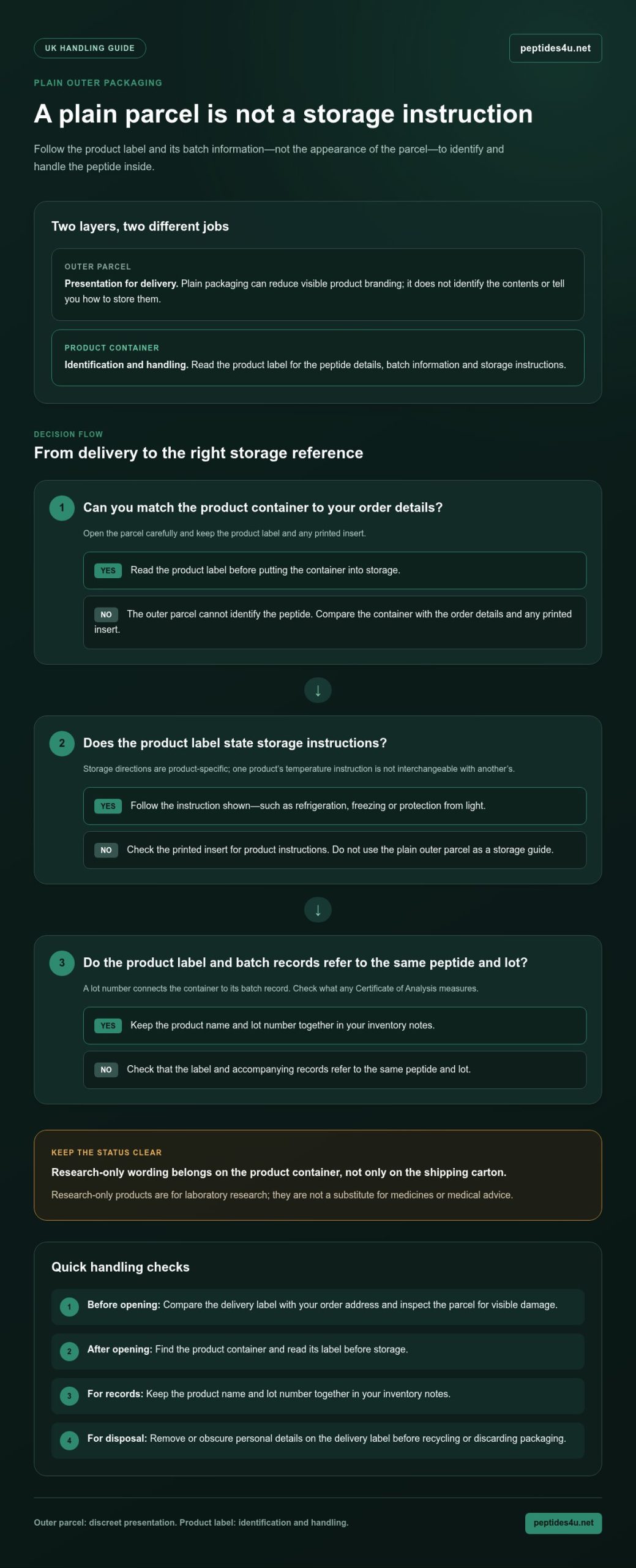
A plain outer parcel keeps product branding off the visible packaging. It does not remove the need for accurate details on the peptide container inside. Think of the parcel and vial as separate layers: one encloses the order for delivery, while the other identifies the contents and handling instructions.
For a UK order, the outer layer might be an unbranded cardboard box or mailing envelope. The delivery label still needs to identify the recipient and include the information required for delivery. Plain packaging does not mean an absent label or missing parcel details. It describes the parcel’s presentation, not whether the contents are correctly identified.
The distinction matters after delivery. A plain parcel will not identify the peptide, its batch or its storage needs. Open it carefully, keep the product label and any printed insert, and match the container to the order details. Do not rely on the outer parcel when recording which vial is stored in a particular location.
- Before opening: Compare the delivery label with your order address and inspect the parcel for visible damage.
- After opening: Find the product container and read its label before putting it into storage.
- For records: Keep the product name and lot number together in your own inventory notes.
- For disposal: Remove or obscure personal details on the delivery label before recycling or discarding packaging.
Discretion also has practical limits. A plain exterior can reduce visible product branding, but it does not make the contents anonymous to everyone handling the parcel. The sender name, recipient label and carrier markings may still be visible. Treat discreet presentation as an outer-packaging choice, not a substitute for careful order records or suitable storage after delivery.
In research settings, keep delivery materials separate from the product’s identification. A useful workflow is to open one parcel at a time, match each vial against its paperwork, then file the paperwork with the relevant batch record. If several products arrive together, this helps prevent assigning a container to the wrong reference. Follow each product’s storage instructions rather than assuming the outer parcel indicates its temperature requirements.
Plain packaged peptide products can make the delivery less conspicuous, while clear inner labelling supports identification after unpacking. Keep the two purposes distinct: use the outer parcel for discreet transport, and the product label for handling and record-keeping. For details about discreet ordering, see the plain packaging information.
Research-only use and UK legality
Plain outer packaging does not change a peptide’s intended use or legal status. Peptides sold for research are supplied strictly as a laboratory research chemical, not for human or veterinary use.
Research-only use and legal considerations
Research-only status sets a clear boundary: these products are intended for laboratory research, not human use. Peptides4u states that its research peptides are legal to purchase and possess in the UK for laboratory research purposes only, and are not licensed medicines. Packaging should make the research context clear. Packaging Bee says research chemicals typically need prominent “not for human consumption” wording on the primary packaging face.
How do plain packaged peptide products compare with licensed medicines? They are supplied strictly as laboratory research chemicals, not for human or veterinary use. A discreet parcel does not change their status or intended research use.
Read the product description and container wording before accepting delivery. A research-only label is not an instruction or recommendation for personal use. If a parcel arrives with a damaged container or illegible label, separate it from other materials. Record the issue through your laboratory’s quality process, and keep the product’s stated purpose clear in inventory records.
Uses of plain packaged peptides
These products are supplied strictly as laboratory research chemicals, not for human or veterinary use. Researchers may study peptide properties in controlled workflows using documented procedures. “Plain” describes the outer parcel, not a different scientific use or a change in composition.
What are plain packaged peptide products used for? They are supplied strictly as laboratory research chemicals, not for human or veterinary use. The outer parcel may lack prominent branding, while the inner container remains identified for record-keeping.
Before a product enters a research workflow, match its label to the order record and planned analysis. Keep the batch identifier with the sample record, then store the container according to its instructions. This links the supply record to the relevant sample and helps distinguish research materials from medicines held elsewhere in a facility.
A simple receiving process can prevent confusion. Record the arrival date, inspect the parcel and container, then compare the product name and batch reference with the paperwork. Read the product instructions before putting it in the designated storage location. If the label says research use only, retain that wording in internal records and do not describe the material as a medicine.
For UK research orders, consider the product description, primary label and laboratory purpose together. Plain outer packaging cannot establish legality, quality or suitability on its own. These questions depend on the product’s stated status, intended activity and handling controls after delivery.
Minimum order quantities and pricing
A minimum order quantity can refer to peptide units or packaging materials. Separate those figures before comparing orders. Peptide pen packaging specifications list quantities from 100 to 200,000+ boxes. That range describes boxes, not a required quantity of peptide vials. It should not be treated as a minimum for every research order.
Packaging quantities depend on the format being produced. A box designed for a peptide pen serves a different purpose from a vial container. A packaging run may therefore have its own order threshold, separate from the number of peptide units ordered. Check the unit beside each quantity: boxes, pens, vials or complete parcels. Plain packaged peptide products can involve packaging requirements distinct from the product order itself.
Pricing depends on what the quoted amount covers. A product price, packaging charge and delivery charge are separate items. For example, a quote for printed boxes does not automatically include the peptide contents. Compare like with like, and record each cost against its matching unit. This avoids mistaking a box price for a per-vial amount.
For UK research orders, make a clear comparison before ordering. Note the product format, stated quantity, packaging specification and order total. If a price is listed per piece, keep that unit in your calculation. If packaging is priced by the box, do not compare it directly with a per-vial amount. This allows a fair comparison between plain packaged peptide products and products supplied in other formats.
- Identify the unit: Check whether the minimum applies to boxes, vials or another item.
- Match the format: Compare vial packaging with vial orders, and pen packaging with pen orders.
- Separate costs: Keep product, packaging and delivery amounts in distinct lines.
- Check the total: Use the quantity and unit shown for that order, not a figure from another format.
For vial orders, consider the vial format when planning storage and handling. A box specification for peptide pens does not establish the minimum quantity for vials. Vial count, packaging arrangement and order total answer different questions, so keep them separate in procurement records.
There is no universal minimum order quantity for plain packaged peptide products. A packaging supplier’s box run may start at 100 boxes, while a peptide order follows its own product and purchasing terms. Treat these as separate decisions. Choose the research product and format, then assess whether the packaging quantity suits your workflow, storage capacity and expected use.
Before confirming an order, read the unit beside each quantity and check how it applies to the parcel. This helps prevent ordering packaging volumes that do not match the intended research stock.
Packaging to protect lyophilised peptides
Lyophilised peptides are supplied in vials, so packaging should limit movement and protect the container during transit. Plain branding concerns the parcel’s appearance. It does not provide cushioning, secure a vial or set storage conditions. Assess these functions separately when reviewing how an order is packed.
A close-fitting insert helps stop a vial shifting inside its box. Packaging Bee notes that a vial moving half a centimetre inside a loosely fitted box can break when the parcel is knocked. The practical check is simple: the vial should be supported, not rattling in empty space. Outer cushioning can then help absorb knocks before they reach the container.
Useful packaging features include:
- Vial support: Inserts or dividers keep containers apart and reduce movement.
- Impact cushioning: Protective material fills gaps between the insert and outer box.
- Secure closure: A closed parcel helps keep its contents together during handling.
- Clear identification: The vial label remains readable after unpacking.
Packaging should also keep the container’s label intact. A damaged label can make it harder to match the product with its batch records and research notes. On arrival, inspect the parcel and vial before storage. Record any visible damage, then compare the label with the order paperwork. Keep the vial’s identity and batch reference together in your records.
Transit protection and storage are different tasks. A padded parcel may reduce knocks, but it does not determine how the peptide should be stored after delivery. Read the product’s own storage instructions before choosing a location. Those instructions may specify protection from light, refrigeration or freezing. Don’t infer a temperature requirement from the parcel’s insulation or from the weather during delivery.
Temperature control depends on the product’s stated conditions and the time between delivery and storage. Packaging alone cannot establish that a vial has remained within a particular temperature range. Avoid leaving a parcel in direct sunlight or beside a heat source while unpacking. Follow the product label when moving it, rather than treating outer packaging as a storage container.
Keep research-only wording and branding in their proper roles. Discreet outer packaging can limit visible product branding, while the inner label identifies the contents and states “not for human consumption” where applicable. That wording does not replace careful handling. Keep the container closed as directed, avoid unnecessary handling and follow laboratory procedures for the research material.
Before ordering, consider whether the vial format, protective insert and outer parcel suit your receiving process. After delivery, inspect, match, record and store the contents using the product instructions. Explore peptide product options for your research-order requirements.
Peptides4u: Plumas SereneQ
Peptides4u offers Plumas SereneQ for readers considering this product alongside their research-order requirements. Its site advertises plain packaging, keeping the parcel’s outer presentation discreet. Orders placed before 12pm, Monday to Friday, are dispatched the same day.
Before ordering, compare the product details with your intended research and planned storage. On arrival, read the product label and follow its handling instructions. Plain packaging concerns the parcel, not the contents’ identity or storage needs.
For a straightforward next step, review Plumas SereneQ and its order details on the site. Visit Peptides4u to view Plumas SereneQ.
Set up your next research order with care
Before choosing plain packaged peptide products, decide how each item fits your laboratory’s workflow. Set out who will receive the parcel, record the batch reference and arrange storage. A clear handover reduces mix-ups between delivery records and research materials.
Peptides4u offers Plumas SereneQ and alternative formulations. Use the product details to decide which option matches your planned research order and handling process. Keep the decision tied to the intended laboratory work, rather than the parcel’s appearance alone.
If discreet presentation is part of your order planning, take the next step with a clear question about plain packaging. Contact Peptides4u about plain packaging and review the available product information. A considered order starts with a defined research purpose and a straightforward receiving process. You can prepare those steps before the parcel arrives, then keep the product record organised from delivery onwards.
Frequently Asked Questions
How should research peptides be stored and handled?
Follow the instructions for the specific product and keep its identity linked to your laboratory records. For SereneQ pens, the stated safety instructions are: “Store refrigerated at 2 °C - 8 °C. Do not freeze.” “Keep out of reach of children and animals.” “Use a fresh sealed tip for each dispense. Dispose of tips in a sharps container.” “Expiry 12/2027 on sealed, correctly stored stock.” Record the batch reference when adding a product to inventory.
What Must Be on a Peptide Product Label?
A useful label identifies the product and connects it to its batch and handling record. Look for the product name, peptide identifier, lot number, concentration, storage directions, expiry date and manufacturer information. Concentration may be shown as mg/ml or mg/vial, so retain the unit in your records. If a label is difficult to read, keep the container separate until you can match its identity with the accompanying paperwork.
What Packaging Formats Do Peptide Brands Use?
Peptide products may arrive in vial cartons, pen boxes or kits with printed inserts. A vial carton protects an individual container, while a kit box can hold several components and supporting information. Pen boxes are shaped to accommodate the device. For a laboratory receiving workflow, unpack one order at a time and match each container to its paperwork before filing it with the relevant records.
What are plain packaged peptide products?
Plain packaged peptide products arrive in an outer parcel with plain, unmarked packaging and no branding or description of the contents on the outside. The phrase refers to the parcel’s exterior, not the label on the inner container. That label still needs to identify the product for research records and handling. Plain packaging alone does not establish quality, intended use or storage conditions; use product information to guide those decisions.
Which peptide products are available in plain or unbranded packaging in the UK?
Peptides4u offers Plumas SereneQ and Viales Quanta Pharma, and advertises plain packaging. The parcel’s exterior is separate from the product format and its identifying label. The available products suit different order formats, so consider whether your research workflow requires a pen or vial. Match the selected product with its product information, then plan how your laboratory will receive and record it.
How much do plain packaged peptide products cost in the UK?
The cost depends on the product and the unit shown in its listing. Plain packaged peptide products do not have one universal price across formats. Compare a per-piece price with another per-piece listing, and keep delivery charges separate from the product amount. For a UK order, check the price in pounds and make sure the selected product and quantity match your intended purchase.
Are plain packaged peptides legal to buy, sell or import in the UK?
Plain packaging does not determine whether buying, selling or importing a peptide is lawful. The products discussed here are supplied strictly as laboratory research chemicals, not for human or veterinary use. Do not treat a discreet parcel as evidence of permission for a particular activity. The product’s stated status and intended activity matter; import requirements also depend on the circumstances of the shipment.
What UK rules apply to peptides sold for research use only?
Research-only wording identifies the intended supply and does not make a product suitable for human or veterinary use. Keep this status clear in purchase records, laboratory inventories and sample documentation. Check that the product description and container label use consistent identification, then store the material according to its instructions. Packaging text alone cannot establish that every product or activity meets all applicable UK requirements.
1 comment