Peptide Product Authenticity: How to Read Chromatograms and COAs

A chromatogram alone can’t establish peptide product authenticity. HPLC shows a sample’s purity profile, but it doesn’t confirm the peptide’s identity or reveal every substance in the vial. Read it alongside mass spectrometry and a COA that can be independently verified.
A high purity figure can look reassuring, but it answers only part of the question. HPLC purity of 95-98% is commonly described as a standard research-use-only grade; it doesn’t prove that the sample contains the labelled peptide or that it’s suitable for human use.
This guide explains what chromatogram peaks can and can’t tell you, how mass spectrometry adds evidence of identity, and what to look for in third-party testing and seller information. You’ll also see where COAs fall short, so you can assess the evidence without treating a single document or number as proof.
Key Takeaways
- Read the chromatogram as a purity profile, not proof of peptide identity or total vial contents.
- Check whether a third-party COA can be verified, and note which tests it actually reports.
- See how mass spectrometry can help assess whether the sample matches the peptide named on its label.
- Spot seller warning signs, including missing testing documents, no verifiable address or cryptocurrency-only payment.
- Understand why a research-use-only COA does not show that a peptide is suitable for human use.
HPLC purity and chromatogram interpretation
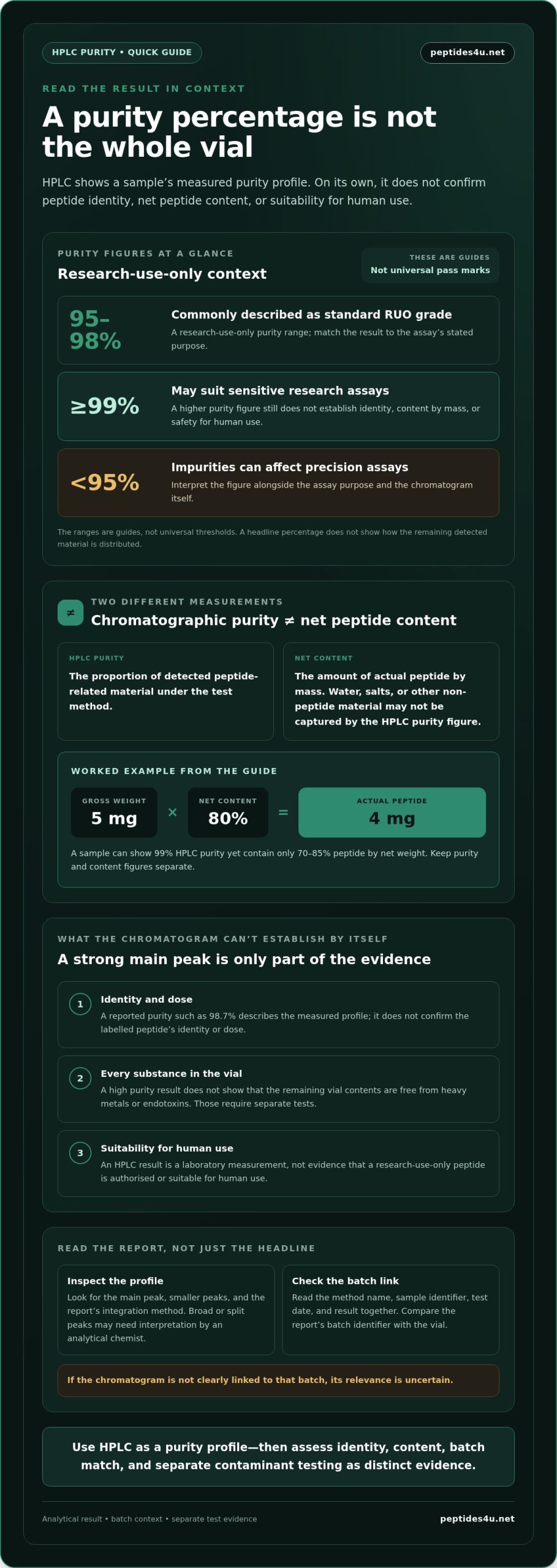
HPLC separates components in a sample as they pass through a column. A detector records their signals over time, creating a chromatogram. Each peak represents material detected at a particular retention time. The largest peak is often used to calculate the peptide’s relative purity. Read the reported percentage with the method and sample details. A stated purity of 98.7% describes the measured profile, not every property of the vial. It does not, by itself, confirm the peptide’s identity, dose or suitability for human use.
HPLC purity of 95-98% is commonly described as standard research-use-only grade for discovery research. A result of at least 99% may suit sensitive research assays. Below 95%, impurities can affect precision assays. These ranges are guides, not universal pass marks. Compare the result with the assay’s stated purpose. Then inspect the chromatogram: look for the main peak, smaller peaks and the report’s integration method. A single headline percentage hides how the remaining material is distributed. A broad or split peak can also need interpretation by an analytical chemist.
Purity is not the same as net peptide content. HPLC calculates the proportion of detected peptide-related material under its method. It may not capture water, salts or other non-peptide material. A sample can therefore show 99% HPLC purity yet contain only 70-85% peptide by net weight. For example, a vial labelled 5 mg by gross weight, at 80% net content, contains 4 mg of actual peptide. Check whether a report distinguishes chromatographic purity from content by mass. Treat those figures as separate measurements.
HPLC purity testing also has limits when it comes to contamination. A peptide’s main peak can dominate the chromatogram even when testing for heavy metals or endotoxins is absent. Those contaminants require separate tests, not a higher purity figure. Read the method name, sample identifier, test date and result together. Compare the report’s batch identifier with the vial. If the chromatogram isn’t clearly linked to that batch, its relevance is uncertain. A high percentage can’t make up for a mismatch.
Research-use-only peptides differ from medicines authorised for human use. An HPLC result describes a laboratory measurement; it doesn’t establish authorisation for treatment. In the UK, product classification and how it is marketed affect which requirements apply. An RUO label alone does not determine legal status. A purity chromatogram is analytical evidence, not legal authorisation.
UK requirements for buying or selling peptide products depend on their classification and intended presentation. A seller’s research-use-only wording does not, by itself, establish that a product is authorised for human use. HPLC results cannot settle that classification or replace applicable requirements.
Counterfeit or unverified peptides can expose users to the wrong substance, variable peptide content or contaminants. A purity figure cannot identify every risk. For example, a 99% HPLC result does not show that the remaining vial contents are free from heavy metals or endotoxins. Nor does it establish that a product is suitable for human use. Match the chromatogram to its batch, then interpret it alongside identity and contaminant testing.
Third-party testing and certificates of analysis
A certificate of analysis (COA) is useful only if it relates to the sample being assessed. Compare its product name and batch identifier with the label. Then check the test date, methods, results and laboratory details. A COA covering purity alone does not establish that heavy metals or endotoxins were tested. Third-party testing adds independent analysis, but the report still needs to match the specific batch. A familiar logo or polished PDF can’t establish that link.
Check the report’s verification key, QR code or database lookup. If none is available, use the Report ID to contact the named testing laboratory. Confirm that the lab issued the report and that its batch identifier matches the product. Read each result alongside its method and unit. For example, an endotoxin result may be reported in EU/ml or EU/vial. A number without a unit or test method offers little practical context.
Different contaminants need separate tests. Heavy metals are commonly assessed using ICP-MS, which detects metals at parts-per-billion levels. Endotoxins are commonly assessed using the LAL test. One test does not cover both categories. Look for a distinct result for each analysis, rather than assuming a general “tested” statement includes them. For example, a COA listing purity and ICP-MS results still needs a separate endotoxin result to show that LAL testing was performed.
Testing costs depend on the scope, methods and number of samples. A purity-only analysis differs from a panel that includes ICP-MS and LAL. Volume discounts also depend on the laboratory’s pricing structure and sample arrangements. Compare quoted test scopes, not just headline totals. Confirm whether each sample receives an individual report or shares a batch-level result. You can’t infer a reliable price from a COA itself.
Turnaround time depends on the selected methods, sample preparation and laboratory workload. Separate assays may follow different schedules, so a combined panel can take longer than one analysis. A report’s issue date can help place the results in context, but does not by itself show how long testing took. Compare the sample receipt date with the report date when both are shown. An old COA may accurately describe its tested batch, but it cannot show that another batch was tested.
A study of semaglutide products bought online without a prescription found endotoxin contamination in every tested sample. That finding highlights the distinction between a purity result and an endotoxin result. A third-party COA provides evidence of specific tests on a stated sample. It does not replace checking the batch match, method, units and report verification together.
Mass spectrometry for peptide identity
Mass spectrometry adds evidence about molecular identity. It measures ions by their mass-to-charge ratio, written as m/z. A peptide produces signals associated with its ionised molecules, which analysts compare with the expected mass for the named peptide. A match supports identity, but does not establish purity, strength or safety. For example, a label naming a peptide should correspond with the expected molecular mass in the report. A signal alone is not a full characterisation.
Liquid chromatography-mass spectrometry, or LC-MS, combines separation with mass analysis. The chromatography stage separates sample components; the mass spectrometer records ions from those components. This can help show whether the main detected component has a mass consistent with the stated peptide. Check the report for the sample identifier, batch reference, method and expected mass. These details connect the result to the material being assessed. Without a clear sample link, a report offers weaker evidence about a particular vial.
Tandem mass spectrometry, often written MS/MS, can add structural detail. The instrument fragments selected peptide ions and records the resulting pattern. Analysts compare that pattern with the expected fragments from the peptide sequence. A set of matching fragments supports the proposed sequence more strongly than a single mass signal. Check whether the document reports only an intact mass or includes fragmentation data. These are different levels of evidence, not interchangeable labels.
Mass interpretation needs care. Peptides can carry different electrical charges, so one molecule may appear at several m/z values. Sodium or other adducts can also shift a signal. A useful report explains how the observed peaks map to the expected peptide mass. A mismatch may reflect an impurity, a modified molecule or a preparation issue, and needs interpretation in the context of the method and sample. Don’t treat every extra peak as proof of a counterfeit product.
Some peptide structures share the same overall mass. Isomers can contain the same building blocks in a different order, so intact mass alone may not distinguish them. MS/MS fragmentation can provide more sequence information, while specialist methods may be needed to answer more complex structural questions. Look for the actual analytical result, not simply “mass spectrometry tested”. The method name and reported interpretation show what the laboratory assessed. A generic claim doesn’t tell you which identity features were compared.
Use mass spectrometry alongside the batch record and other analytical results. Compare the vial’s batch identifier with the tested sample, then check that the report names the expected peptide and explains its mass assignment. HPLC addresses the sample’s chromatographic profile; mass spectrometry supports identity. Neither answers every question alone. For peptide product authenticity, the strongest assessment comes from evidence that agrees across the label, batch record and analytical methods.
Recognising warning signs of counterfeit peptide sellers
Seller behaviour can reveal traceability gaps before a product arrives. Look for clear batch records, accessible testing documents and ordinary payment options.
Warning Signs in Sellers
Warning signs are seller practices that make a product’s origin or testing difficult to verify. Cryptocurrency-only payment, no verifiable physical address, missing COAs and unusually low prices are listed warning signs for illegitimate peptide vendors. Treat these as reasons to pause and assess the available evidence. One sign alone doesn’t establish that a product is counterfeit, but several together leave fewer ways to trace it.
Check whether the seller identifies the product and its batch consistently across the label, listing and COA. Compare the names and batch details instead of relying on a general claim such as “laboratory tested”. A COA should identify the tested sample and its methods. If the seller provides no test documentation, there’s no report to compare with the product details. Clear records make discrepancies easier to spot.
Batch Numbers and QR Codes
A batch number connects a product to a particular production lot and its associated records. A QR code can lead to a COA verification page, database entry or report lookup. Compare the batch number on the product with the number in the report. Then use the verification key, QR code or database lookup to check the document. If needed, contact the testing laboratory using the Report ID. These steps help establish whether the document relates to that batch.
A matching code is useful, but it doesn’t prove every claim about the contents. Check that the verification result identifies the same product and batch, and that the document names the tests performed. A QR code that leads only to a generic homepage provides no batch-specific confirmation. Likewise, a valid report for another batch doesn’t verify the vial in front of you. Compare the label and report details side by side.
Storage matters too. Peptides should be transported refrigerated and in a dark container because heat and light can degrade them. Poor storage conditions can compromise product integrity, but don’t prove counterfeiting by themselves. A seller’s handling information and the product’s condition provide context; neither replaces batch-specific evidence.
Look for practical inconsistencies. A label with a batch number paired with a COA showing a different batch creates a traceability gap. A QR code that fails to show a matching record leaves the document unverified. A seller offering cryptocurrency-only payment while providing no verifiable address or testing paperwork combines several listed warning signs. Assess each detail against the product record, not promotional wording.
Use a simple comparison: product name, batch number, report identifier and verification result. Any mismatch means the documents don’t establish a clear link to the product. Storage evidence adds another part of the picture, especially if heat or light exposure may have affected the peptide. Together, these checks help assess seller credibility and product integrity without treating one code or claim as proof.
COA limitations
A certificate of analysis records results for a tested sample. It doesn’t prove every claim about a product or establish suitability for human use. A research-use-only COA is not evidence that a peptide is suitable for human use. Read it as a record of specific tests, not a complete guarantee of identity, contents, handling or legal status.
Start with the sample link. Compare the COA’s product name and batch identifier with the vial label. A genuine report for a different batch doesn’t verify the vial in your hands. Check the Report ID, issue date and laboratory details. Use its verification key, QR code or database lookup where available. A report that can’t be matched to the product leaves an important gap.
Next, check what the laboratory actually measured. A COA may report HPLC purity without testing peptide identity, heavy metals or endotoxins. These are separate questions. For example, a purity result doesn’t show that ICP-MS testing was carried out, or that an LAL endotoxin test was completed. Read each method and result separately. A broad claim such as “tested” doesn’t explain the test scope.
Even a listed method has limits. Mass spectrometry can support identity by comparing measured ions with the expected peptide mass. It doesn’t, by itself, show that every unit in a batch has the same contents. A laboratory tests a submitted sample, not every vial individually. The report’s value depends on how the sample is connected to the batch and what information was recorded during submission.
A COA also describes a sample at the time of testing. It can’t show later storage or transport conditions. Heat and environmental exposure can break down peptide amino acid bonds. So a valid report doesn’t prove that the tested material remained unchanged after analysis. Batch documentation and handling records provide separate context. Keep these distinctions clear when assessing product integrity.
Watch for the gap between analytical results and intended use. “Research-use-only” identifies a stated use category; it isn’t evidence of medicine authorisation. A COA doesn’t turn a research-use-only peptide into a medicine authorised for human use. Nor does a purity result establish a safe dose, clinical benefit or suitability for an individual. Those conclusions require evidence beyond a laboratory certificate.
Use a practical reading order: match the batch, verify the report, inspect the methods, then note what remains untested. A COA with a matching batch and clear results offers more useful evidence than an untraceable document. But even a well-documented certificate answers only the questions its tests address. Treat it as one part of the evidence, not proof of every aspect of peptide product authenticity.
Peptides4u: Plumas SereneQ
Peptides4u offers Plumas SereneQ for readers considering this product. Use the checks above to assess batch details and testing documents independently. A product name alone doesn’t establish what a COA covers or whether its results match a particular batch. Keep the product label, batch information and any available documentation together when reviewing the evidence. This helps you distinguish product information from analytical proof, without treating either as a substitute for the other.
If Plumas SereneQ is relevant to what you’re looking for, visit Peptides4u to view the product information. Take the same careful approach to any documentation you review.
Make your next decision with clear records
Turn your assessment into a consistent record for future decisions. Note the product name, batch identifier and documents you reviewed. This gives you a clear basis for comparing information if you consider another batch. It also helps distinguish evidence about a specific sample from claims about a product more broadly. Careful records support peptide product authenticity checks without treating one test result as a complete answer.
Peptides4u offers reliable peptide formulations. If you’re considering available options, use the same measured approach: review the product information and assess any supporting documentation on its own terms. Keep your questions focused on the details you need to understand.
Contact Peptides4u with your questions and take your next step with confidence.
Frequently Asked Questions
Chromatogram or No Chromatogram?
A chromatogram is useful evidence, but it can’t verify a peptide by itself. If a seller provides one, check that the report identifies the tested sample and explains the method. A graph without a sample reference or readable result adds little. If there’s no chromatogram, other batch-linked analytical evidence may still be available. Treat its absence as a gap to weigh, not automatic proof of counterfeiting.
How can you verify the authenticity of peptide products?
Compare the product label, batch details and test documentation, then verify the report with the named laboratory. Check that the product name and batch reference agree across records. Save the product page and report together, so you can compare them if details change. These checks help assess peptide product authenticity, but no single code or document proves every claim about the contents.
What do legitimate peptide product certificates of analysis include?
A useful COA identifies the tested product and sample, gives a batch reference, names the laboratory and lists the analytical methods and results. It should also show units, report date and a report identifier or verification route. For example, a purity result alone doesn’t show that identity or contaminant tests were included. Read the document’s scope carefully, and note which questions its results leave unanswered.
How can you check whether a peptide seller and laboratory are reputable in the UK?
Look for consistent seller details, clear product information and batch-specific testing records. A verifiable business address and ordinary payment options support traceability; cryptocurrency-only payment is a warning sign. Verify the laboratory report through its stated verification route or contact details independently, rather than relying only on a seller’s claim. Check that the report identifies the sample and methods. Research-use-only wording does not establish suitability for people or animals.
Can peptide identity and purity be independently tested, and what does testing cost in the UK?
Yes. Laboratories can assess identity and purity using methods such as mass spectrometry and HPLC. Costs depend on the requested analyses, sample preparation, number of samples and whether contaminant testing is included. A quote for purity alone can’t be compared fairly with a wider testing panel. First define the questions the analysis must answer, then compare the methods and deliverables, not just the quoted total.
What are common signs of counterfeit or mislabelled peptide products?
Warning signs include no verifiable physical address, cryptocurrency-only payment, unusually low prices and missing COAs or third-party testing documents. Also compare the product name and batch details across the label, listing and report. For example, a report for a different batch doesn’t verify the item being sold. Treat conflicting details as a reason to question the evidence, rather than relying on polished packaging or confident seller claims.
1 comment