Peptide Vial Products for Research: Prices and Quantities
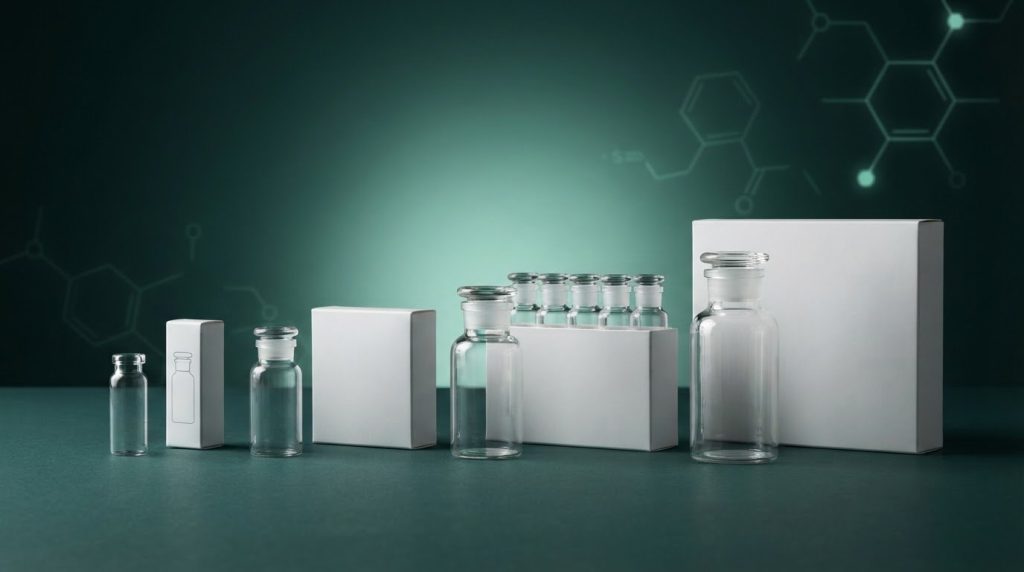
Peptide vial products come in 2 ml, 3 ml, 5 ml and 10 ml capacities, with custom sizes also available. Packaging can be arranged for different vial counts, so the right presentation depends on the quantity and format you need.
Choosing a presentation is only part of the decision. You also need clear information about quantities, packaging and prices, and a practical understanding of research-use restrictions.
This guide covers common vial and box formats, available quantities and the factors that shape packaging costs. It also explains how to read research-use wording and distinguish product presentation from the restrictions that apply to its intended use.
Key Takeaways
- Compare vial capacity and packaging format before choosing a presentation; listed capacities include 2 ml, 3 ml, 5 ml and 10 ml, plus custom sizes.
- Assess unit pricing by order band, as the listed per-item price changes with quantity.
- Match the order size to the project: listed box quantities range from 100 to 200,000 or more.
- Check how many vials each format holds, then compare storage and packaging options against your handling needs.
- Read research-use restrictions separately from product presentation, and make sure the intended use fits the stated limits.
Peptide and research compound presentations
In the UK, peptide vials are offered in several capacities, including 2 ml, 3 ml, 5 ml and 10 ml. Custom sizes are also available. Presentations can vary by vial count, with boxes configured for 2, 5 or 10 vials. The format describes packaging and capacity, not suitability for a particular use. Match the stated vial size and count to the requirements of the research protocol.
Packaging dimensions also vary. Listed peptide vial box sizes include 4″ x 4″ x 4″, 4″ x 4″ x 8″, 4.25″ x 4.25″ x 12.5″, and 5″ x 3″ x 1.5″. A 40×20 mm holographic label is another presentation detail. These dimensions can help distinguish a compact box from one intended to hold a longer arrangement. Compare the outer box measurements with the vial count and storage space available for the project.
To assess a product’s identity and documentation, compare the vial label with its peptide product authenticity evidence and batch information. Check the compound name, stated quantity, batch identifier, seal and packaging for consistency. If a batch identifier or seal is absent, damaged or inconsistent, pause your assessment rather than relying on appearance. Keep the vial, label and documentation together so they can be traced to the same product record. Clear labelling helps identify a product, but cannot establish its contents by itself.
Peptide injections can carry risks such as injection-site reactions, contamination-related infection and unexpected effects from the compound. The risk depends on the substance, its purity, the handling process and the person exposed. A research-use label does not establish that a product is safe for human use. Don’t use research compounds as medicines or inject them outside an appropriately authorised research setting.
For storage and handling, follow the product’s stated instructions rather than assuming every vial needs the same conditions. Keep each vial labelled, closed and protected from unnecessary handling. Use clean handling procedures, avoid mixing up caps or records, and keep the vial separate from food or drink. If a seal is broken or the label becomes unreadable, set the vial aside for identification. Do not assume a storage temperature or shelf life when the product instructions provide those details.
Before selecting a presentation, write down the vial capacity, the number of vials required and the box dimensions that suit the workspace. For example, a 3 ml vial and a 10-vial box describe different decisions: one concerns individual capacity, the other the arrangement. Keep those details separate in inventory records. A clear record helps researchers match each vial to its intended project and handle it according to its own instructions.
Product prices
Listed prices vary by presentation, order quantity and whether the item is a vial box or an accessory. This is a packaging price, not a price for peptide compound contents. Compare the item and its unit carefully before using a figure in a project budget.
When comparing listings, keep the stated price, product and order quantity together. Do not assume that a bulk listing or discount applies to every product.
Other research-related products may have separate listings. These are distinct products with different specifications, so check the description before including one in a budget. Do not interpret the price of one product as the price of a vial or its contents.
Label and reference materials form another category. The stated discount is 20%. Separate physical and digital items in a budget, since they don’t represent the same type of purchase.
For a clear comparison, record the product, unit, order band and listed price in separate columns. For example, compare a single box price with a per-item bulk price only after noting the applicable order quantity. Keep accessories, labels and digital downloads in their own lines. Treat packaging and compound listings as distinct budget items.
Prices for peptide compounds are a separate consideration from the packaging and accessory figures above. The amount depends on the specific product and its stated presentation, so avoid using box or storage-case prices as a proxy. For a separate product decision, view the research peptide product range and assess the product information against your research requirements.
Product quantities
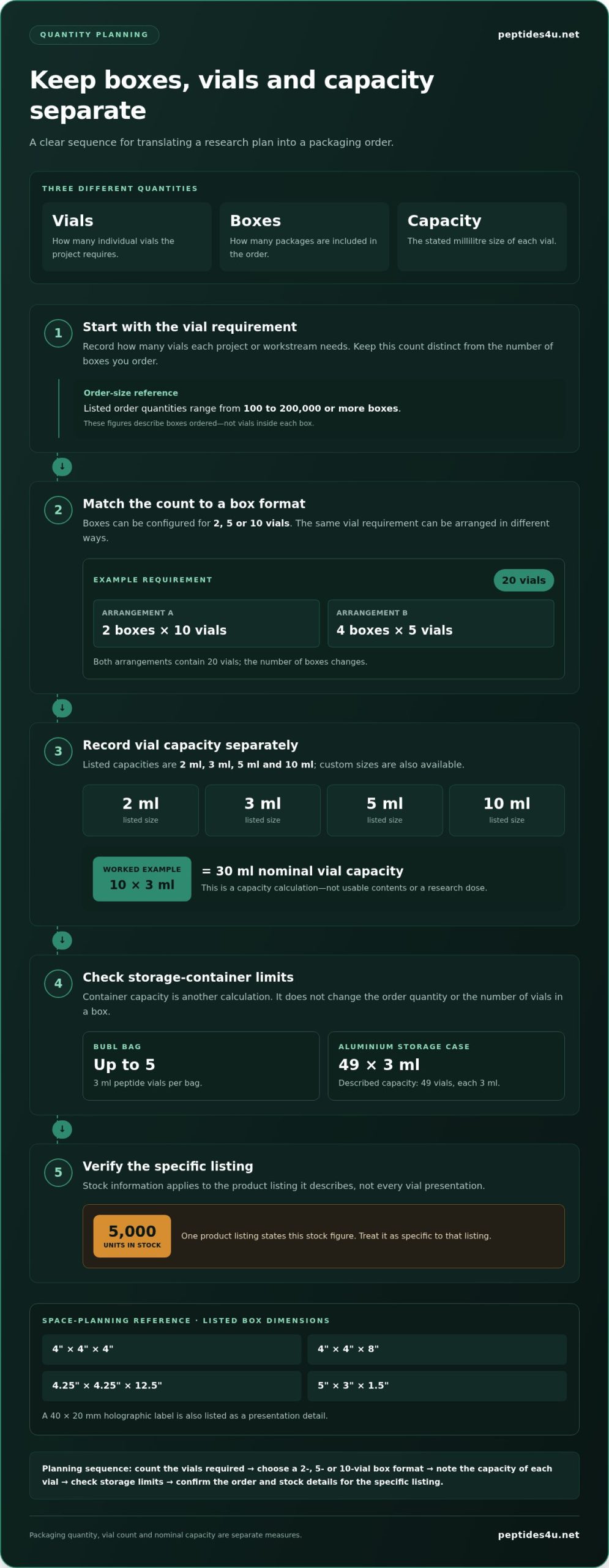
Order quantities describe the number of boxes, not the number of vials inside each box. Listed order sizes range from 100 to 200,000 or more boxes. Keep the packaging quantity separate from vial capacity and vial count. This avoids confusing a bulk box order with the total number of individual vials required.
Start with the research plan. Record how many vials each workstream needs, then group those requirements by presentation. Boxes can be configured for 2, 5 or 10 vials. For example, a requirement for 20 vials could be organised as two 10-vial boxes or four 5-vial boxes. The total vial count stays the same, but the number of boxes changes.
Capacity affects how you calculate total material volume. The listed vial capacities are 2 ml, 3 ml, 5 ml and 10 ml, with custom sizes also available. Multiply the number of vials by the stated capacity to estimate the combined nominal volume. For example, ten 3 ml vials represent 30 ml of nominal vial capacity. This calculation describes capacity, not usable contents or a research dose.
- Count vials: Set the number required for each project.
- Choose a configuration: Match that count to 2-, 5- or 10-vial boxes.
- Check capacity: Record the stated millilitre size separately.
- Plan the order: Convert the required boxes into the relevant order quantity.
Small-format storage also has defined limits. A BUBL Bag is designed to hold up to five 3ml peptide vials. Use that capacity when planning how many bags an arrangement needs. An aluminium peptide vial storage case is described as holding 49 x 3mL vials. These examples show why container capacity and product order quantity belong in separate calculations.
Stock figures apply to a particular listing, not every vial presentation. One product listing states that 5,000 units are in stock. Treat that as a listing-specific quantity, rather than a general measure of supply across all formats. For larger requirements, use the stated order range and selected box configuration to build the order plan.
Before placing a quantity in a research record, note the box count, vials per box and capacity per vial. A plan for 100 boxes of 5-vial presentations represents 500 vials. If those vials are 3 ml, the nominal combined capacity is 1,500 ml. Keep those figures distinct from stock counts and handling-container limits. This simple breakdown makes the requested quantity easier to interpret and reconcile.
Research vial product range
Compare peptide vial products by capacity, vial count, packaging dimensions and intended research workflow. The listed capacities are 2 ml, 3 ml, 5 ml and 10 ml, with custom sizes also available. A suitable comparison starts with the protocol’s required container size, then checks whether the packaging holds the required number of vials. These details describe presentation, not the contents’ suitability for a specific experiment.
Peptide vial boxes can be configured for 2, 5 or 10 vials. That gives researchers a choice between smaller grouped presentations and larger sets. For instance, a 10-vial arrangement suits a different inventory plan from a 2-vial box. Compare the number of vials per box with the number of samples or project units being organised. Keep capacity per vial separate from the number of vials in each package.
Outer dimensions also help distinguish formats. Listed box options include 4″ x 4″ x 4″, 4″ x 4″ x 8″, 4.25″ x 4.25″ x 12.5″, and 5″ x 3″ x 1.5″. A smaller footprint may fit a different storage layout than a longer box. Record the box dimensions alongside vial capacity, rather than relying on a product name or image alone.
For individual identification, holographic peptide vial labels are sized 40×20 mm. Their dimensions matter when checking whether a label can be read and handled alongside the vial’s existing information. Treat a label as an identification aid, not proof of the contents or quality. Preserve the vial’s product record and any associated batch details together.
Storage and transport accessories serve different roles. A BUBL Bag is designed to hold up to five 3ml peptide vials. An aluminium peptide vial storage case is described as holding 49 x 3mL vials. Compare those capacities with the number and size of vials in the planned workflow. A bag designed for five 3ml vials does not represent a general fit for every capacity.
- Capacity: Match 2 ml, 3 ml, 5 ml or 10 ml vials to the required format.
- Configuration: Compare 2-, 5- and 10-vial box arrangements.
- Dimensions: Check the listed outer measurements against storage space.
- Accessories: Compare the BUBL Bag’s five-vial limit with the case’s 49-vial capacity.
For a practical comparison, make one line per format and record vial capacity, units per package, outer dimensions and accessory fit. For example, a 3ml vial could be assessed against a five-vial bag or a 49-vial case, depending on the handling plan. This keeps product format, storage capacity and research requirements distinct.
Research-only use and product restrictions
A vial’s presentation does not establish its legal status or intended use. A research-use label states a restriction; it does not establish medicine authorisation. Consider the product’s classification separately from its label.
Which peptide vial products are licensed medicines in the UK? A product should be treated as a licensed medicine only if it has the relevant UK medicine authorisation. A vial’s name, packaging or research-use label alone does not establish that status.
UK rules for buying, selling and importing peptide vials depend on the product’s classification and intended supply. Research compounds and medicines may be subject to different requirements, so do not assume that rules for one category apply to another. Consider the product description, claims and intended use together.
One packaging rule applies to medicines entering the UK supply chain: from 1 January 2025, they must have a UK-specific outer carton labelled ‘UK only’, according to the UK Government. This requirement concerns medicines entering that supply chain. It should not be applied automatically to every research compound or vial.
What are peptide vial products used for? Products labelled for research use are supplied strictly as laboratory research chemicals, not for human or veterinary use. For example, a research team may record a vial under a project and handle it within the relevant research protocol.
Safe purchasing starts with product classification, clear labelling and consistent documentation. Compare the named compound, stated presentation, batch details and research-use wording. Keep records with the vial, and don’t treat a seller’s description or an attractive label as proof of authorisation, identity or quality. If the stated use is unclear, don’t assume the product is suitable for human use.
Where can UK consumers buy peptide vial products safely? Choose a source that clearly identifies the product and its stated research-use restrictions. For any medicine, verify its status as a medicine rather than relying on vial format or marketing language. A research compound should remain within its stated research context.
- Read the label: Identify the compound and stated intended use.
- Match records: Keep batch information and product documentation together.
- Separate categories: Don’t treat a research compound as a licensed medicine.
- Check the carton: For medicines entering the UK supply chain, note the UK-specific ‘UK only’ outer carton rule.
To review a range presented for research use, view research peptide products and read each item’s stated restrictions before making a product decision.
A peptide vial should be treated as a licensed medicine only if that specific product has the relevant UK medicine authorisation. A research-use product is not a licensed medicine simply because it is sold in vial form.
Peptides4u: Plumas SereneQ
Peptides4u offers Plumas SereneQ as a separate product option from research vial presentations. Consider it when you’re reviewing the available offering, rather than treating it as a vial format or a research compound. Keep product presentation and intended use distinct when making your choice.
For research work, use the vial details and restrictions covered above to assess the format against your project. For a separate product choice, review Plumas SereneQ on its own terms. This keeps the decision clear and avoids assuming that different product types share the same use, storage or handling requirements.
Visit Peptides4u online to view Plumas SereneQ.
Make your next product decision with clarity
Turn your shortlist into a clear product decision. Record the format you need, the research context and the product information relevant to your work. Keep those requirements together when comparing peptide vial products, so you can distinguish packaging needs from the choice of a specific product.
Peptides4u offers specialised research compounds and formulations. Consider each offering on its own terms, and keep research-use restrictions in view when deciding what fits your requirements. A clear question about the product or its presentation can help you take the next step with focus.
Contact Peptides4u about vial products to discuss your product requirements. Move forward with a choice that fits your intended use.
Frequently Asked Questions
How much do peptide vials cost in the UK?
There isn’t one standard UK price for a peptide vial. The total depends on the specific compound and whether the quoted amount covers the compound, the vial packaging or separate storage accessories. Compare like with like: check the product identity and presentation, then distinguish that price from boxes, labels or storage cases. Peptides4u supplies its products strictly as laboratory research chemicals, not for human or veterinary use.
1 comment