Peptide order dispatch: UK delivery times and costs

Dispatch speed and delivery speed are different. For peptide order dispatch, orders placed before 12pm Monday to Friday are dispatched the same day. Standard parcels to most of England and Wales often arrive within two to three working days; deliveries to the Scottish Highlands and islands can take two or more extra days, and Northern Ireland usually needs an extra day.
That gives you a clearer starting point when you’re planning an order. The delivery charge is a separate part of the process, and the option shown at checkout is the figure to use for your parcel. This guide explains how processing time affects arrival, what can influence UK delivery costs, and how batch records and tracking help you follow an order after dispatch. You’ll also find practical steps for dealing with a parcel that’s delayed or arrives damaged. Clear expectations make it easier to tell the difference between a normal pause in transit and a problem that needs attention.
Key Takeaways
- Orders placed before 12pm Monday to Friday are dispatched the same day. Allow for longer journeys to remote areas and Northern Ireland.
- Separate dispatch time from delivery time when estimating arrival. The destination and the parcel’s progress after collection both matter.
- Check the delivery charge and any free-delivery threshold at checkout. The amount can depend on the delivery option and order.
- A tracking status can stay unchanged for 24-48 hours without signalling a problem. Know when to contact the courier and when to contact support.
- Keep your order and batch details handy if a parcel is delayed or damaged, and read how packaging choices affect temperature-sensitive deliveries.
Handling delayed or damaged parcels
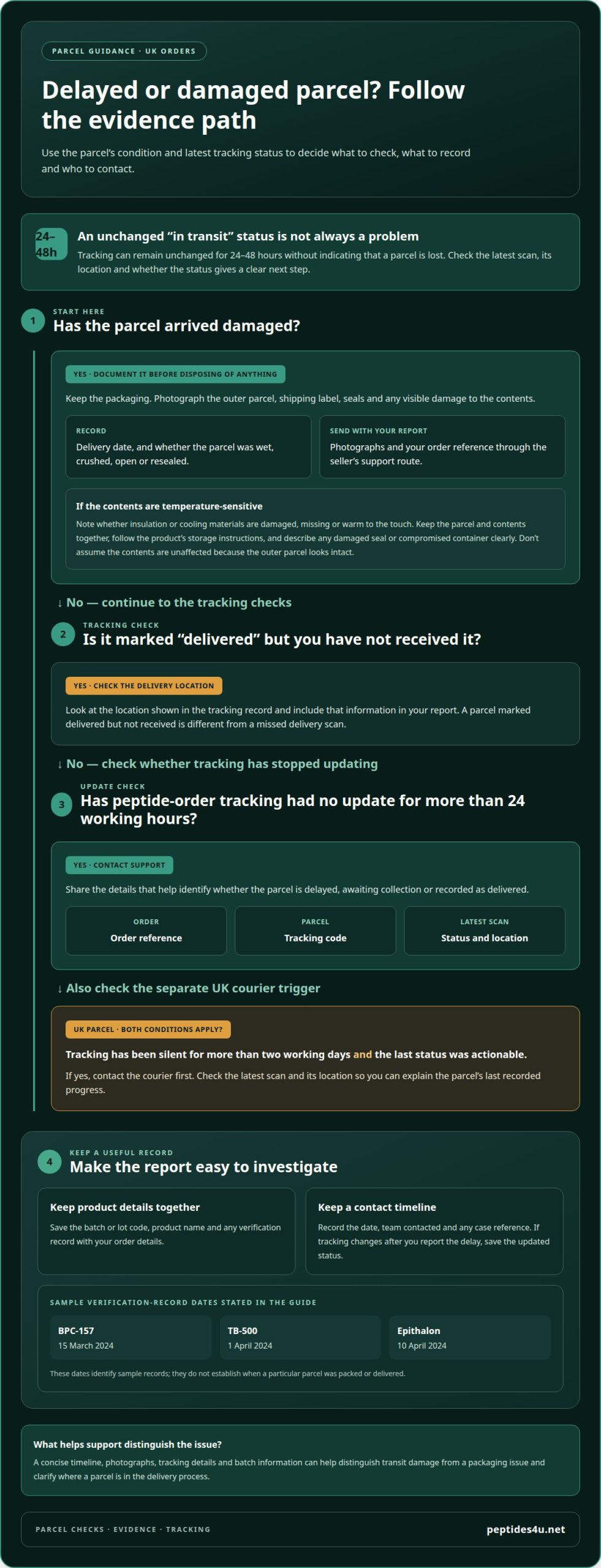
A tracking pause does not always mean a parcel is lost. “In transit” can remain unchanged for 24-48 hours without indicating a problem. Check the latest scan, its location and whether the status gives a clear next step. A missed delivery scan differs from a parcel marked delivered but not received.
For UK parcels, contact the courier first if tracking has been silent for more than two working days and the last status was actionable. If peptide-order tracking has no update for more than 24 working hours, contact support. Share the order reference, tracking code and latest status. These details help identify whether the parcel is delayed, awaiting collection or recorded as delivered.
If the parcel arrives damaged, keep the packaging and document its condition before disposing of anything. Photograph the outer parcel, shipping label, seals and any visible damage to the contents. Record the delivery date and note whether the parcel was wet, crushed, open or resealed. Send these details with your order reference through the seller’s support route. Clear evidence helps distinguish transit damage from a packaging issue.
For temperature-sensitive contents, note whether the insulation or cooling materials are damaged, missing or warm to the touch. Don’t assume the contents are unaffected because the outer parcel looks intact. Keep the parcel and its contents together while you report the problem, and follow the product’s storage instructions. Describe any damaged seal or compromised container clearly, rather than hiding it by repacking.
Batch details can help connect a parcel issue with its product record. Keep the batch or lot code, product name and any verification record with your order details. Sample verification records show test dates of 15 March 2024 for BPC-157, 1 April 2024 for TB-500 and 10 April 2024 for Epithalon. Those dates identify records; they don’t establish when a particular parcel was packed or delivered.
Are there UK rules for importing or receiving peptides by post? A courier accepting a parcel doesn’t establish that its contents meet applicable UK requirements. Before ordering from overseas, check the product’s classification and the rules that apply to its import and intended use.
Keep a simple record of each contact, including the date, the team contacted and any case reference. If tracking changes after you report the delay, save the updated status. For a parcel marked delivered, check the delivery location shown in the tracking record and include that information in your report. A concise timeline, photographs and batch details give the support team useful facts to investigate.
UK delivery prices and free-delivery threshold
There isn’t one UK delivery charge for every peptide parcel. The amount depends on the delivery option, destination and parcel requirements. A standard service and a temperature-controlled service can involve different handling and transport arrangements. Check the delivery options shown before payment, then compare the full charge with the arrival estimate. A lower fee may suit a flexible delivery date; a specialist option may matter more when handling needs are specific.
A free-delivery threshold is an order value set by a seller. If your eligible basket reaches it, the delivery charge may be removed or reduced. The threshold itself doesn’t tell you when the parcel will arrive. Treat the delivery estimate and charge as separate details. For example, an order can qualify for free delivery yet still use a service with its own transit estimate.
Use the checkout total to assess the cost. Review the basket subtotal, delivery line and any adjustment before placing the order. Check whether the free-delivery threshold applies to the items in your basket and whether discounts change the qualifying total. Don’t assume that adding an item will lower your overall spend. Compare the extra item’s cost with the delivery charge it might offset.
Destination can affect which services are available and how much they cost. A parcel going to a mainland city may have different options from one travelling to an island or remote address. The service selected can also affect the estimate. If the address has a flat number, building name or postcode detail, enter it accurately. A corrected address can create extra handling and delay.
For temperature-sensitive contents, consider more than the headline fee. The handling needs of a product may affect the available delivery service and how the parcel is prepared. A lower-cost option is not automatically suitable for every product or journey. Read the service description and product storage instructions alongside the charge, and keep the order confirmation showing the option selected.
- Compare the total. Weigh the delivery fee against the basket value.
- Read the threshold terms. Check how the eligible order total is calculated.
- Match service to need. Consider destination, timing and temperature handling.
- Save the confirmation. Keep the selected service and charge with your order record.
Before paying, compare the delivery choices at checkout with your address and timing needs. If free delivery applies, confirm which service it covers. If you choose a paid option, check its stated estimate too. This makes the cost clear and helps you choose a service that fits the parcel, rather than deciding on price alone.
Order processing and dispatch timelines
Plan around two stages: order processing and delivery after dispatch. For orders placed before 12pm Monday to Friday, same-day dispatch applies. The cutoff identifies which orders qualify for that schedule. It doesn’t give a dispatch time for orders placed later. Nor does dispatch mean the parcel has already reached your address. Keep the order confirmation and dispatch notice separate when estimating arrival.
For example, an order placed before 12pm on a Tuesday can be dispatched that day. The remaining journey depends on its destination and the delivery network. Standard parcels to most of England and Wales often arrive within two to three working days. That estimate concerns delivery, not the time spent preparing an order before dispatch.
Location changes the estimate. For the Scottish Highlands and islands, allow two or more extra days compared with typical regional delivery estimates. Northern Ireland deliveries usually need an extra day. These regional differences matter when planning around a specific date. An address in mainland England and one on a Scottish island do not follow the same typical journey.
A peptide order dispatch timeline is easier to understand when you distinguish each event. An order confirmation records placement. A dispatch notification means the parcel has been sent; courier tracking then shows its recorded movement through the delivery network. These are separate stages, and the time between them affects the overall wait.
Use the destination and order time together. First, note whether placement was before the 12pm weekday cutoff. Next, identify the UK destination. Then use the relevant regional estimate as a guide to arrival. For example, a Scottish Highlands address needs additional time beyond the typical regional estimate. A Northern Ireland address has its own extra-day consideration.
- Order placed before 12pm, Monday to Friday: same-day dispatch applies.
- Most of England and Wales: standard parcels often arrive within two to three working days.
- Scottish Highlands and islands: allow two or more extra days against typical regional estimates.
- Northern Ireland: allow an extra day in the usual delivery estimate.
Keep the delivery date flexible when the destination adds time. A sensitive product may also have handling requirements that influence the available dispatch arrangements. Check the order and delivery information together, rather than reading a dispatch notice as an arrival date. This gives you a more useful estimate for planning receipt.
How can I track a peptide order after dispatch?
Start with the dispatch notification. Use its tracking reference in the courier’s tracking service, then compare the latest scan with your delivery details. Keep the order reference and tracking code together. The order record confirms what was purchased; courier tracking shows the parcel’s recorded movement. If the notification has no tracking reference, contact the supplier’s support team with your order reference.
Read each status as a snapshot, not a live map. “In transit” means the parcel is moving through the network, but the page may not refresh after every handover. That status can remain unchanged for 24-48 hours without necessarily indicating a problem. Check the scan time and location before treating a quiet tracking page as a delay. A timestamp tells you when the update was recorded, not necessarily when the parcel moved.
Use the status wording to decide what to do next. “Out for delivery” signals a different stage from “in transit”. A collection or delivery instruction calls for action, so follow the stated step. If a parcel is marked delivered, check the delivery information and the address used for the order. Keep a screenshot or note of the status and timestamp for any support report.
For UK peptide parcels, contact the courier first if tracking has been silent for more than two working days and the last status was actionable. An actionable status is one that asks you to collect, rearrange or respond. Give the courier the tracking reference and explain the last instruction. If the status offers no action, compare its timestamp with the previous scan before escalating.
Contact support if peptide-order tracking has no update for more than 24 working hours. Include the order reference, tracking code, latest status and time of the last scan. If you have already spoken to the courier, add the case reference and their response. These details help support distinguish a courier query from an order-record issue.
- Keep both references: order number and courier tracking code.
- Record the status: note the wording, scan time and location.
- Follow instructions: act on collection or rearrangement prompts.
- Escalate with context: share previous contact details and case references.
For example, a status unchanged for a day may simply be awaiting another network scan. A collection prompt needs a response, while a parcel shown as delivered calls for a delivery-record check. Keep those situations distinct. A clear timeline of scans and contact attempts makes it easier to explain what happened and where tracking stopped moving.
What shipping methods do UK peptide suppliers use for temperature-sensitive peptides?
There is no single shipping method for every temperature-sensitive peptide. The product’s handling instructions, journey length and expected time in transit shape the choice. Options can include insulated packaging, coolant packs and a faster courier service. These serve different purposes. Insulation slows temperature changes, coolant packs help keep contents cool, and faster transport can reduce time in transit.
Packaging works as a system. An insulated liner alone does not actively cool its contents. A coolant pack without suitable insulation may lose its effect sooner. Suppliers therefore need to match packaging to the product’s stated storage conditions and the route. A parcel travelling across the UK may face different transit conditions from one staying within a local delivery area.
Temperature control can also depend on when a parcel leaves and how it moves through the network. A dispatch before a weekend may follow a different journey from one sent early in the working week. The delivery option, collection schedule and destination all affect time in transit. For a sensitive product, a shorter journey can matter as much as the packaging.
Check the product’s storage instructions before choosing a delivery option. Compare those instructions with the packaging and service details shown during ordering. Look for clear information about insulation, coolant and the intended delivery timeframe. Don’t assume that “express” means temperature-controlled, or that a plain outer box reveals how the contents were packed.
When the parcel arrives, inspect its outer packaging and internal materials before unpacking. Note whether the liner is intact and whether coolant packs are present. Follow the product’s own storage instructions promptly. If packaging is damaged or the contents appear affected by temperature, keep the materials and take photographs. Record the delivery condition alongside the order details.
- Match the method to the product: use its stated storage requirements.
- Review the route: consider transit time and delivery timing.
- Check the packaging: insulation and coolant serve different functions.
- Inspect on arrival: record damage or concerns before disposing of packaging.
Compare the delivery service and product handling information rather than relying on labels alone. A faster service relates to journey time, while packaging details describe how the parcel is prepared. Read the delivery information alongside the product’s storage guidance before placing an order.
For peptide ordering information and available products, view peptide ordering options.
Peptides4u: Plumas SereneQ
Peptides4u offers Plumas SereneQ for readers considering this product after reviewing dispatch and delivery information. It is the natural next step if you want to explore the available offering and assess its product details against your requirements.
Before ordering, read the product information and review the delivery options shown at checkout. Keep the delivery estimate separate from the dispatch schedule. This helps you plan for the parcel’s arrival without treating dispatch as a delivery date.
If you’re ready to explore Plumas SereneQ, contact Peptides4u for further information.
Make your next order easier to manage
Before ordering, decide where the parcel can be received and how you’ll handle it on arrival. Keep the delivery details accessible, and make sure someone can follow any courier instruction if your plans change. A little preparation helps you respond promptly without guessing what to do next.
A clear peptide order dispatch plan also starts with choosing the product that fits your purpose. Peptides4u offers a range of quality research compounds. Review the relevant product information and delivery choices before placing an order. Keep your order details in one place so you can refer to them if you need support.
For a question about your order or the dispatch process, contact Peptides4u with your dispatch question. Take the next step when you’re ready, with the details you need close at hand.
Frequently Asked Questions
How quickly can I receive my order?
Arrival depends on when the order is processed, the delivery service and your UK destination. Standard parcels to most of England and Wales often arrive within two to three working days. The Scottish Highlands and islands can take two or more extra days against typical regional estimates, while Northern Ireland usually needs an extra day. Use the delivery estimate for your address when planning receipt.
What does peptide order dispatch mean?
Dispatch means an order has been prepared and sent for delivery; it doesn’t mean it has arrived. An order confirmation records placement, while a dispatch notification signals the next stage. The courier’s tracking record then follows the parcel’s movement. Keep these events distinct when working out whether you’re waiting for processing, courier collection or delivery.
How long do peptide suppliers take to dispatch orders in the UK?
Dispatch timing varies by supplier and order time. Peptides4u dispatches orders placed before 12pm Monday to Friday on the same day. Orders placed later, or at weekends, ship the next working day. That describes dispatch, not arrival. For planning, check when the order was placed and the supplier’s stated cutoff, then consider the destination and selected delivery service.
Which UK peptide suppliers offer same-day or next-day dispatch?
Peptides4u offers same-day dispatch for orders placed before 12pm Monday to Friday. Orders placed before 3pm qualify for next-day delivery across the UK. These are separate cutoffs: one concerns dispatch, the other eligibility for a delivery service. Read the specific terms before ordering, and don’t treat a next-day option as a promise that every parcel will arrive the following day.
What should I do if a peptide order is delayed, lost, or damaged in transit?
Keep your order reference, tracking code and delivery records together. For a delay, follow any actionable courier instruction and provide the latest scan when reporting it. For a parcel marked delivered but missing, include that status in your report. If it arrives damaged, photograph the outer packaging, label and contents before disposing of anything. Include batch details where available.
How can I check a peptide supplier’s dispatch and delivery policies?
Read the delivery information before checkout, not only the order confirmation. Find the weekday cutoff, dispatch schedule, delivery options, destination coverage and any free-delivery conditions. Check whether stated timing refers to dispatch or arrival. Save the checkout summary and confirmation so you can compare the selected service with later tracking updates. For temperature-sensitive products, read the stated handling guidance as well.
Do peptide suppliers dispatch orders on weekends or UK bank holidays?
Weekend dispatch depends on the supplier’s schedule. Peptides4u says weekend orders ship the next working day. Bank-holiday arrangements can differ, so check the supplier’s published holiday notice and cutoff information before placing an order near a holiday. Treat the stated schedule as the guide for when processing resumes, then use the courier tracking record to follow the parcel once dispatched.
1 comment