Quanta pharma

The key is to separate the categories, not treat them as one group. In this context, Peptides4u covers three broad areas: anabolic steroids, hormones and research-use pharmaceuticals.
Those labels describe different parts of the range, so it helps to know what each one refers to before comparing items. The distinction matters most with research-use products: the category name tells you how they are presented, not that they are interchangeable with medicines intended for treatment.
This guide explains the Peptides4u formats and how to read their product information. You’ll get a clear overview of the range, the terminology used to describe it and the details to consider when comparing items. It’s a practical starting point for understanding what each format is.
Key Takeaways
- Distinguish anabolic steroid, hormone and research-use pharmaceutical categories by their purpose and how the range is organised.
- QUANTA LABORATORIES LTD lists manufacture of basic pharmaceutical products as a UK business activity under SIC code 21100, according to Companies House.
- Read “pharmaceutical grade” as a product-quality term, then look at the specific information provided about the item.
- Use the article’s category guide to identify which part of the range is relevant to what you want to understand.
Range of research-use pharmaceuticals
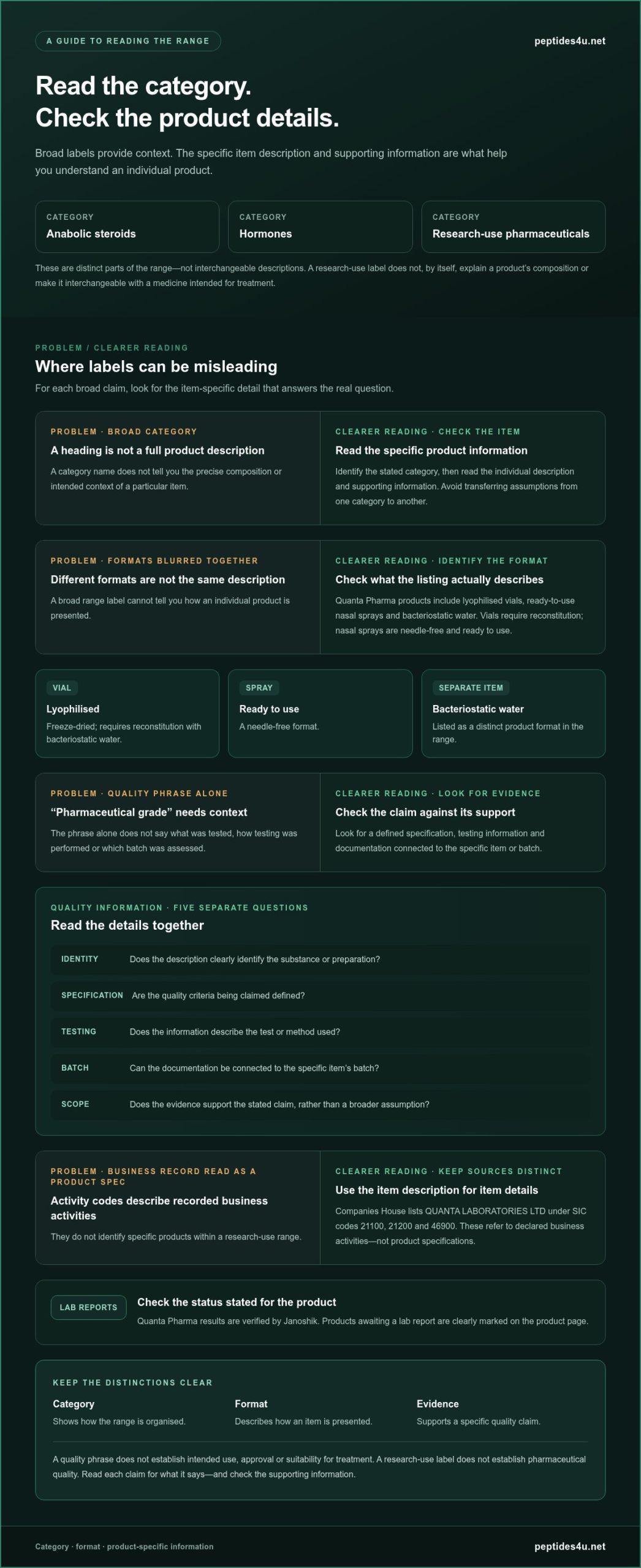
A research-peptide range is easiest to understand when you distinguish its product formats from their stated context. Quanta Pharma products include lyophilised vials, ready-to-use nasal sprays and bacteriostatic water. Vials require reconstitution, while nasal sprays are needle-free. Start by identifying the format and reading the specific product information, rather than assuming that one category explains everything about another. For more detail on peptide vial products, capacities and packaging quantities, compare the presentation options alongside the item information.
“Quanta Pharma” is a supplier brand name; it does not, by itself, explain a product’s composition or intended context. For each item, read its product description and supporting information. Quanta Pharma results are verified by Janoshik, and products awaiting a lab report are clearly marked on the product page.
To understand how pharmaceutical categories are discussed, watch this video from SHL Medical:
For the UK company record, three SIC codes describe declared business activities. According to Companies House, QUANTA LABORATORIES LTD lists manufacture of basic pharmaceutical products under SIC code 21100. It lists manufacture of pharmaceutical preparations under SIC code 21200. It also lists non-specialised wholesale trade under SIC code 46900. These entries describe recorded activities; they do not identify specific products within a research-use range.
Broad business or product-category descriptions do not identify a particular peptide or explain its composition. To understand a Quanta Pharma item, read its product description and check the information provided for that specific product. For vials, note that they are lyophilised and require reconstitution with bacteriostatic water; nasal sprays are ready to use.
Separate categories from intended use
Quanta Pharma products come in distinct formats: lyophilised vials, ready-to-use nasal sprays and bacteriostatic water. Vials are freeze-dried and require reconstitution; nasal sprays offer a needle-free format. These are not interchangeable descriptions. Read the wording attached to each product instead of transferring assumptions from one format to another.
A research-use label is not a substitute for product-specific information. It does not tell you the precise composition or manufacturing process. Two products in the same broad category may differ in form or documentation. A useful sequence is simple: identify the format, read the stated context, then review the information for that specific item. Keep those details distinct.
Company records also need a date-aware reading. QUANTA LABORATORIES LTD was incorporated in the United Kingdom on 11 March 2025 and dissolved on 22 September 2026. Those dates describe the company record, not the history or availability of any individual product. A business-activity entry should therefore not be used alone to infer that a specific product is currently supplied or suitable for a particular purpose.
A practical way to read the range
Use these steps when reviewing a research-use category:
- Identify whether the entry is described as an anabolic steroid, hormone or research-use pharmaceutical.
- Keep the stated category distinct from the product’s specific composition and intended context.
- Read the individual item details rather than relying on a broad catalogue heading.
- Treat SIC codes 21100, 21200 and 46900 as business-activity descriptions, not product specifications.
This approach keeps the categories clear without reading more into a label than it says. A steroid heading does not explain a hormone entry; a research-use heading does not define the product’s composition. For UK readers, the Companies House codes provide business-record context, while the item’s own description is the relevant place to understand its category. Separate those sources of information before drawing conclusions about the range.
Pharmaceutical grade
“Pharmaceutical grade” sounds precise, but the phrase needs context. It should point to a defined quality standard or set of specifications. Used alone, it doesn’t tell you what was tested, how testing was performed, or which batch was assessed. Treat the words as a prompt to look for supporting product information, not as proof of suitability for a particular purpose.
Keep quality claims separate from intended use. A product described as pharmaceutical grade is not automatically an approved medicine, a suitable treatment or safe for human use. Likewise, a research-use label does not establish pharmaceutical quality. These terms address different questions: one concerns quality criteria, while the other describes the stated context. Don’t use either label to infer the other.
For a practical review, start with the exact product description. Identify the named substance and format, then look for its specification and related evidence. For example, “high purity” is less informative than a defined test result linked to the product. Traceability matters: the claim should relate to a specific item and its supporting documentation.
What to look for in quality information
Review the details together rather than relying on one impressive-sounding term. A specification explains what the product is expected to meet. Testing information shows which characteristics were examined. Batch identification links those details to a particular production lot. Each element answers a different question.
- Identity: Does the description identify the substance or preparation clearly?
- Specification: Does it define the quality criteria being claimed?
- Testing: Does the information describe the test or method used?
- Batch: Can the documentation be connected to the specific item’s batch?
- Scope: Does the evidence support the claim being made, rather than a broader assumption?
Consider a certificate of analysis. Its title alone does not show whether it supports a quality claim. Read the substance name, batch identifier, listed tests and results together. A document for one batch should not be treated as evidence about every batch. A result for one measured property also does not establish every aspect of quality or suitability.
Words such as “pure”, “laboratory” and “pharmaceutical” can describe different things in product information. Purity concerns the proportion of a stated substance under a given measurement. A laboratory description may indicate context, but it does not define a product specification by itself. Read “pharmaceutical grade” alongside a standard, test details or other evidence explaining the claim.
Use a simple sequence when comparing two product descriptions. First, match the substance name and format. Next, compare the quality criteria, not just the headline wording. Then check whether the evidence relates to the same batch and stated context. This helps prevent a broad category label from being mistaken for a direct comparison. More detailed information can make a claim easier to interpret, but it does not establish suitability for use.
In the UK, product-quality wording should not be confused with an individual medical assessment or prescription. It cannot determine whether a substance is appropriate for a person. The same applies to a research-use product: its category does not make it a medicine for treatment. Keep quality claims, intended context and clinical decisions separate.
Use these checks to read descriptions carefully, then view the research-use vial range in that context. Focus on the item wording and any product-specific information, rather than treating “pharmaceutical grade” as a complete answer. That gives you a more grounded basis for understanding what a description does and does not communicate.
Peptides4u: Plumas SereneQ
Peptides4u’s Plumas SereneQ is the natural next step if you want to explore this specific offering after comparing pharmaceutical categories. It gives you a clear product name to focus on, rather than relying on broad labels such as “pharmaceutical grade”. Use the product information to understand how it is described and whether it matches what you are looking for. Keep product descriptions separate from medical advice or assumptions about suitability.
If your interest is specifically in Plumas SereneQ, visit Peptides4u online to explore the offering. For other questions, contact Peptides4u directly.
Choose your next step with confidence
Focus on the information relevant to your decision: the product’s format, stated context and details for that specific item. A familiar label alone cannot answer every question. When comparing Quanta Pharma products, use the product information rather than assumptions based on a category name.
Peptides4u offers Plumas SereneQ and Viales Quanta Pharma. These are the relevant options to explore when either matches what you’re looking for. Keep your questions specific to the product or its description, so you can make your next step with a clearer understanding of what you want to know.
Contact Peptides4u with your questions. Take the time you need, then move forward with clarity.
1 comment