Peptide pen products, reusable pens and separate packs
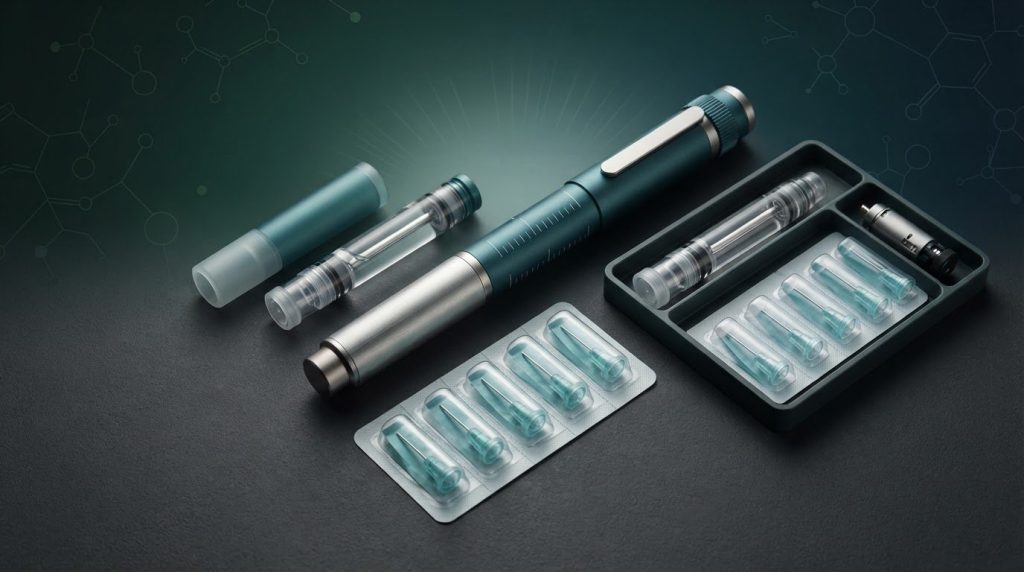
The pen isn’t always included with a peptide product. Peptide pen products include reusable pens, needles and cartridges, with listings that differ in what comes in the pack. One reusable pen listing has an 80 IU scale; a separate 80 Unit injector listing specifies 3 ml cartridge compatibility.
It’s easy to mistake a complete product for a pen or accessory sold separately. Check the listing carefully to see what is included, which parts are sold separately and how the price differs by product type.
This guide lays out peptide product listings and their prices, including products listed with a reusable pen. It also covers separate pen, needle and cartridge options, so you can compare pack contents before choosing. You’ll see how reusable pens work, what to look for in cartridge specifications and how UK guidance applies to medicines such as GLP-1 receptor agonists. The aim is simple: make the options easier to understand, without treating every listing as the same kind of product.
Key Takeaways
- Compare product listings by price and pack contents, not by name alone.
- Check whether a reusable pen is included with the product or sold separately.
- Separate needle packs and pen accessories are distinct options; the pen listing may be hardware only.
- Match cartridge size and measurements to the pen’s stated compatibility before choosing a pack.
- For GLP-1 receptor agonists, NHS guidance says prescribing should be for licensed indications and by brand.
Listed peptide products and prices
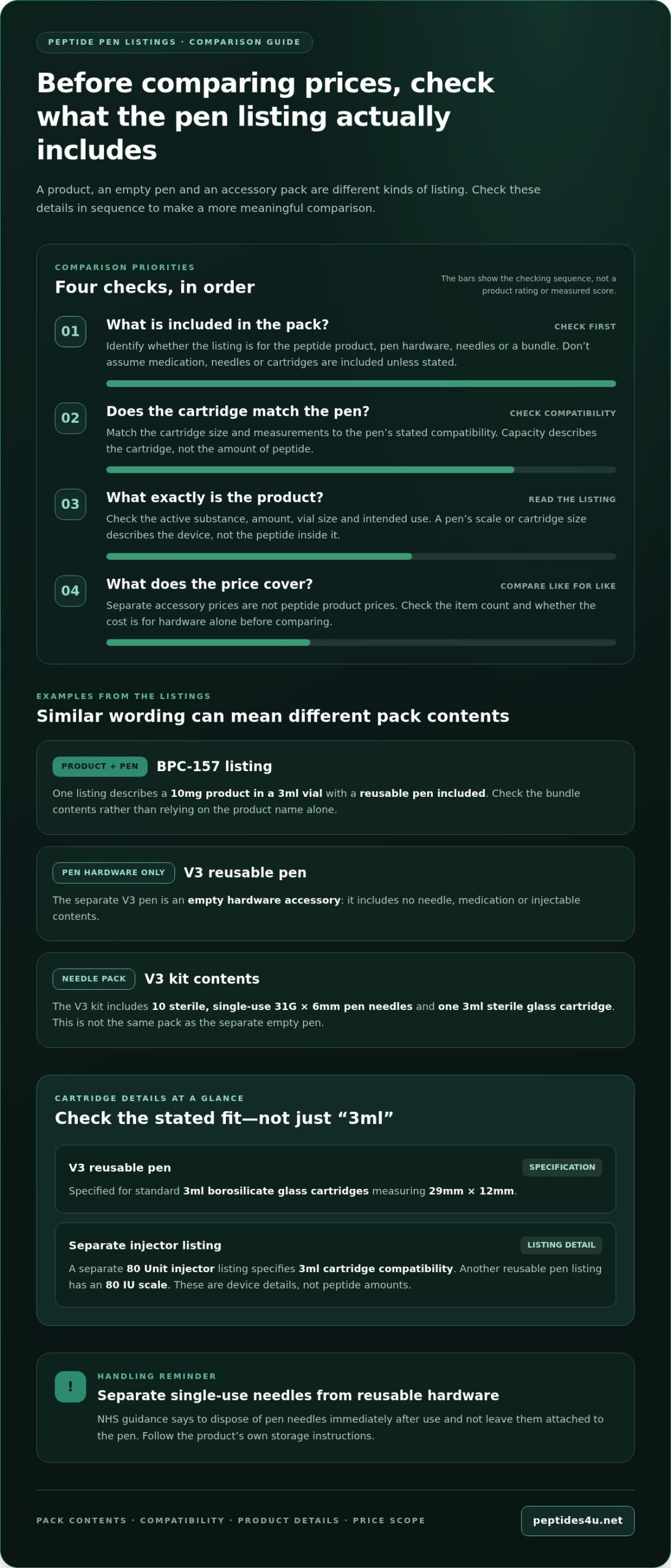
Peptide pen products can refer to the peptide itself, the device used to administer it, or a pack containing accessories. Check the exact product and pack contents before comparing prices. A pen’s scale or cartridge size describes the device, not the peptide inside it.
Listings include Retatrutide, GHK-Cu, BPC-157, TB-500, Tirzepatide, MOTS-C and Ipamorelin. Other examples include CJC-1295 (No DAC), Tesamorelin and a BPC-157 and TB-500 blend. These names identify different substances or combinations. They are not interchangeable product descriptions. Check the listing’s active substance, amount, vial size and intended use. For example, a 3 ml cartridge specification refers to cartridge capacity, not the peptide amount.
Accessory prices make a clearer like-for-like comparison. These are accessory listings, not prices for peptide products. Check whether a pack contains one item or several, and whether the price covers hardware alone. For broader context on buying peptides online in the UK, product formats and prices, compare the exact product and pack contents rather than price alone.
How can I check whether a peptide pen is genuine and MHRA-approved? Compare the exact medicine name, active substance, strength and authorised indication with MHRA medicines information. A pen’s appearance or a seller’s claim alone does not establish that the medicine is authorised.
Can peptide pen products be bought legally online in the UK? Legality depends on the specific product and how it is supplied. An online listing alone does not establish that a product is authorised or lawfully supplied.
What UK rules apply to prescribing, importing and selling peptide pen products? Requirements depend on the product’s regulatory status, its intended use and the supply route. For GLP-1 receptor agonists, NHS guidance says prescribing should be only for licensed indications and by brand.
What are the health risks and side effects of peptide pen products? Risks and side effects depend on the specific substance and product; one general list cannot accurately cover Retatrutide, GHK-Cu and every other listing. Read the product information for the exact medicine, and distinguish hardware specifications from medical guidance.
For a practical safety step, NHS guidance says to dispose of pen needles immediately after use and not leave them attached to the pen. That applies whether a listing describes a 31G × 6mm needle pack or a complete pen set.
Reusable peptide pen inclusion with products
A reusable pen may be included with a peptide product or sold separately. Check each listing’s contents to distinguish the substance, pen and replaceable parts.
Reusable and disposable options
A reusable pen keeps the injector hardware for use with compatible cartridges. Some product listings include a pen with the peptide, whilst others list the pen as a separate accessory. For example, a BPC-157 listing describes a 10mg product in a 3ml vial with a reusable pen included. A listing’s bundle contents matter as much as its product name.
A disposable format is a different device option, not evidence that the medicine itself is licensed. Check what the listing says is included, and whether the pen is reusable or intended for single use. Don’t assume needles, cartridges or medication are included unless the listing says so.
How do peptide pens compare with licensed injectable treatments such as GLP-1 medicines? A pen is a delivery device; it doesn’t establish that the substance it contains is a licensed medicine. NHS guidance says GLP-1 receptor agonists should be prescribed only for licensed indications and by brand.
How the reusable metal mechanism works
The V3 reusable pen has an anodised aluminium barrel and cap, with a plastic clip and dial knob. Turning the dial advances a threaded rod against the cartridge plunger. That mechanism dispenses repeatable volumes in fixed steps as the dial advances. The pen’s construction and mechanism describe hardware, not the contents or authorisation of a product.
Check compatibility before pairing a pen with a cartridge. The V3 is specified for standard 3ml borosilicate glass cartridges measuring 29mm × 12mm. Its kit includes one 3ml sterile glass cartridge. These details help distinguish an included component from a separate replacement purchase.
Storage, handling and disposal
How should peptide pens be stored, handled and disposed of safely? Follow the product’s peptide product storage instructions, keep the pen and cartridge in their specified conditions, and handle needles carefully. NHS guidance says to dispose of pen needles immediately after use and not leave them attached to the pen.
For a reusable device, keep the pen, cartridge and needle details together when checking instructions. A pen’s metal barrel doesn’t determine how its contents should be stored, and plain packaging doesn’t replace product-specific storage directions. After use, separate single-use needles from reusable hardware and use the appropriate sharps disposal arrangements.
Before choosing, compare three details: whether the pen is included, which cartridge it accepts, and what the product’s instructions say about use and storage. A bundle that includes a pen differs from an empty hardware accessory, even if both listings use similar pen terminology. For a pen-led option, review current peptide product information alongside the listing’s stated contents.
Pen and needle packs sold separately
A separate listing can cover the pen hardware alone, a needle pack, or both. Read the pack contents before comparing options. The V3 reusable pen is sold as an empty hardware accessory. It includes no needle, medication or injectable contents. A pen-only purchase therefore differs from a kit listing that includes those components.
Its listed count and dimensions help identify the accessory. The V3 kit, by contrast, includes 10 sterile, single-use 31G × 6mm pen needles. The matching size does not mean the separate pack and kit have identical contents. Compare the listing wording, not just the needle measurements.
Fit needles to the pen for use, then remove them. NHS guidance says to dispose of pen needles immediately after use and not leave them attached to the pen. This instruction applies to the needle, not the reusable pen. Keep the two parts distinct when reading product descriptions and handling instructions.
Check these details in each separate listing:
- Item type: decide whether it describes a reusable pen, needles or a kit.
- Pack count: the separate Peptide Needles listing contains 10 needles.
- Dimensions: compare 31G × 6mm with the compatible needle details given for the pen or kit.
- Included components: the V3 pen alone has no needle, medication or injectable contents.
A reusable pen and a needle pack serve different purposes. The pen is the device; the needle is a separate, single-use component. A listing that says “pen” does not automatically include needles, and a needle pack is not a complete pen kit. Check the stated pack contents to see what each option supplies.
The V3 kit’s included needles are described as 31G × 6mm, with a 0.25mm diameter. Its dial advances in increments of 1 unit per click. These are kit specifications, not a reason to assume every separate needle or pen listing has the same details. Match the exact needle dimensions and device information shown for the item you are considering.
For a practical comparison, note the pen model, needle size and pack count side by side. Then compare the hardware and needle-pack costs using each listing’s stated price and contents. This helps identify whether an option is an empty pen, a needle refill or a set with accessories, without treating these formats as interchangeable.
This listing covers the hardware accessory only: it includes no needle, medication or injectable contents. Keep that distinction in mind when deciding what the item covers, and read other product descriptions separately. The pen listing alone does not mean those items are included.
Peptide pen cartridges
Cartridges hold the product used with a compatible pen. Listings can differ in capacity, material and pack size, so match those details before choosing a replacement. Similar appearance alone does not establish compatibility between a cartridge and a pen.
The V3 pen kit includes one 3ml sterile glass cartridge. Its stated compatibility is with standard 3ml borosilicate glass cartridges measuring 29mm × 12mm. Use these specifications as a practical comparison point. Check both the cartridge capacity and its measurements against the pen information, rather than relying on the phrase “fits a peptide pen”.
Separate listings use different pack formats. One listing offers 20 individually sealed 3ml glass vials. The listing showed one unit left in stock at the time recorded. A larger pack count describes how many containers are offered, not how much product each container holds. Here, the stated capacity is 3ml per vial.
Check each listing for these details:
- Capacity: compare the stated volume, such as 3ml, with the pen’s requirements.
- Material: note whether the cartridge is glass and whether it specifies borosilicate glass.
- Measurements: compare the stated dimensions with the pen specifications.
- Pack format: distinguish one cartridge from a multi-piece pack of individually sealed containers.
- Contents: identify whether the listing is for empty hardware or a product-filled container.
These points prevent a common mix-up: a cartridge’s volume and the substance amount are different details. A 3ml capacity describes the container, not the quantity or concentration of its contents. Read the product description for both, and don’t infer one from the other. Likewise, a pack of 20 containers doesn’t mean each container has a 20-unit capacity.
Use a simple comparison before choosing a pack. First, note the pen model and its stated cartridge format. Then compare the cartridge’s capacity, material and dimensions. Check how many containers the listing includes and whether they are individually sealed. If a specification differs, don’t assume the items are equivalent just because both are called “cartridges”.
For example, the 20-piece listing specifies 3ml glass vials, whilst the V3 kit’s cartridge specification gives both capacity and measurements. Those details serve different comparison needs: pack quantity helps you understand the offer, whilst dimensions help you assess device compatibility. Keep the product description with the cartridge details so you can distinguish the container from the pen, needle and product contents.
A cartridge listing is most useful when its specifications answer a specific fit question. Match the named pen format first, then compare volume, material and dimensions. That method keeps a 3ml container, a 20-piece pack and the pen itself clearly separate in your decision.
Are peptide pens licensed medicines in the UK?
A peptide pen is a delivery device, not a medicine name. Licensing depends on the substance and product, so “peptide pen” alone cannot establish whether its contents are authorised. A reusable injector, an empty cartridge and a medicine listing are different things. Assess the medicine separately from its pen, packaging and sales description.
For GLP-1 receptor agonists, NHS guidance says prescribing should be only for licensed indications and by brand. That rule makes the exact medicine name and brand important. A description using only a peptide name or a device feature doesn’t answer whether a product matches a licensed treatment. Don’t treat a pen’s unit scale, cartridge size or metal construction as evidence of medicine licensing.
When assessing a listing, identify the stated active substance and brand first. Then compare the product’s stated purpose with the relevant UK medicine information. Distinguish the listing’s claims from official product information. A seller’s use of words such as “pen”, “injectable” or “peptide” does not by itself establish authorisation.
Online availability also isn’t proof of licensing. A webpage can describe an item, but the description alone does not establish its regulatory status or whether it is appropriate for a particular use. Distinguish an empty injector accessory from a medicine supplied in or alongside a pen. Look for the medicine’s identity and status rather than relying on its packaging format.
Separate these questions when comparing products:
- What is the medicine? Record its active substance and brand as written.
- What is the pen? Identify whether it is reusable hardware or part of a medicine presentation.
- What is the intended indication? For GLP-1 receptor agonists, NHS guidance ties prescribing to licensed indications and brand.
- What does the listing establish? Treat marketing wording as a description, not proof of authorisation.
These distinctions matter for products such as Retatrutide and Tirzepatide, whose names may appear in peptide listings. A product name alone doesn’t show the status of a specific medicine or its intended use. Nor does a compatible 3ml cartridge convert an unlicensed product into a licensed medicine. The pen’s mechanics and the medicine’s regulatory status answer separate questions.
Keep the decision practical: identify the product, distinguish its contents from its device, then apply the relevant UK guidance. For GLP-1 receptor agonists, use the NHS rule on licensed indications and brand as the key prescribing point. To browse product descriptions, use peptide product listings, while keeping device details distinct from medicine licensing.
For GLP-1 receptor agonists, NHS guidance says prescribing should be only for licensed indications and by brand. A pen or sales description alone does not establish that the medicine is authorised; the medicine’s identity and status must be distinguished from the injector device. For broader context on Quanta Pharma product categories and research-use pharmaceuticals, keep category descriptions distinct from medicine licensing.
Peptides4u: Plumas SereneQ
Peptides4u offers Plumas SereneQ as a product option after you’ve compared reusable pens, separate needles and cartridge formats. Review its product information to understand the specific offering, and keep device details distinct from questions about medicine licensing or clinical suitability. Orders placed before 12pm, Monday to Friday, are dispatched the same day, and packaging is plain. These details help set practical expectations when considering an online order. If Plumas SereneQ is the option you’re looking into, visit Peptides4u’s product information to continue.
Choose your next step with care
Make your next decision around the product you’re considering, not just the pen format. Keep the medicine’s identity, the device and the intended use distinct. That gives you a clearer basis for deciding what information you need next. Peptides4u offers Plumas SereneQ and associated vials. If you’re exploring peptide pen products, focus your enquiry on the specific option and the details that matter to you.
A product listing can help you understand what is offered, but it doesn’t replace medicine guidance or clinical advice. For questions about the available product options, contact Peptides4u about peptide pens. Take the next step with the information that fits your decision, and keep your choices clear and considered.
Frequently Asked Questions
What are peptide pens and how do they work?
A peptide pen is a device that delivers a measured amount from a compatible pre-filled pen or cartridge. For example, a SereneQ pre-filled pen contains 300 units and includes four sealed pen tips. Its dial-and-dose window is used to set delivery. The barrel carries a batch number, expiry date and serial, while the pen and retail carton have QR codes for product identification.
What are peptide pen products used for, and what evidence supports them?
These products deliver a substance in pen format; intended use depends on the specific substance and product. Evidence of a health effect must relate to that substance and its intended use, not simply the pen mechanism. Batch testing can assess product quality, but it does not by itself prove a treatment benefit or medicine authorisation. Test results and clinical evidence answer different questions.
How much do peptide pen products cost in the UK?
The price of peptide pen products varies by substance, format and pack contents. A pre-filled pen, a vial and separate pen accessories are different purchases, so compare like with like. Check the stated amount and whether items such as pen tips are included. For an accurate comparison, use the current listing price for the exact product and pack you’re considering.
What UK rules apply to prescribing, importing and selling peptide pen products?
Requirements depend on the product’s regulatory status, intended use and supply route. For GLP-1 receptor agonists, UK guidance says prescribing should be only for licensed indications and by brand.
What are the health risks and side effects of peptide pen products?
Risks and side effects depend on the specific substance and product, so read the product information for the exact medicine. Dispose of pen needles immediately after use and do not leave them attached to the pen.
1 comment