Buy Peptides Online in the UK: Prices and Product Range

Research peptides can be purchased, possessed and studied in the UK only for laboratory research. If you want to buy peptides online in the UK, keep in mind that research status does not make a peptide suitable for human use. Legality is the first filter, not the whole sourcing decision.
Price alone tells you little. Product format, batch documentation and a certificate of analysis (CoA) help you understand what is offered and what evidence accompanies it. The useful question is not simply what appears in a catalogue, but whether the product information lets you compare like with like.
This guide covers UK research-use boundaries, how to read a CoA, available peptide formats and why listed prices vary by product and presentation. It also explains which product details to assess, while making clear that a certificate is not a substitute for appropriate research practices. Use these points to narrow your options and make a considered sourcing decision.
Key Takeaways
- Understand the research-only boundary behind UK peptide legality, and why intended use matters.
- Compare product formats and catalogue details to identify what fits your sourcing needs.
- Learn what a certificate of analysis can tell you about a batch, and how to read its key details.
- See how dispatch terms and product information can shape a practical online buying decision.
- Explore Plumas SereneQ as a product option when considering Peptides4u.
Legal & Compliance – Are Peptides Legal?
The legal status of research peptides can be complex, so descriptions and claims about human use should be treated cautiously. This boundary matters when assessing compound descriptions, research guides and any claims about human use.
Research-Only Status and UK Legality
Research-only status describes a product’s stated purpose. It does not make laboratory materials medicines or establish that they are suitable for people. Read the product description alongside its compound documentation, including any certificate of analysis, and check that the stated research purpose is consistent throughout.
Scientific guides can explain a compound’s research context, but they are not instructions for personal treatment. GLP-1 receptor agonist research peptides also sit within this research-only boundary. A product’s name or claimed research application does not change its intended-use status.
Import Rules, Customs and Prescriptions
The UK research-only boundary covers purchasing, possession and study for laboratory research. It does not, by itself, settle customs handling or prescription requirements for every overseas shipment. Those questions depend on the compound, its declared purpose and how it is supplied.
Before interpreting an import claim, distinguish laboratory research from supply for human use. Product descriptions and accompanying paperwork help clarify a shipment’s contents and stated purpose. A research label alone does not answer every customs or prescription question.
Risks of Online Peptide Purchases
Online listings can leave important details unclear, including compound identity, batch documentation and intended use. Treat missing or inconsistent product information as a reason to pause. Do not use a research-only product as a medicine or substitute it for clinical advice.
If a product appears unsafe or unlawfully marketed, keep the listing, seller details, packaging and batch paperwork. Report suspected medicines-related concerns to the MHRA, or raise consumer-trading concerns with local Trading Standards. If use has caused a suspected adverse reaction, seek appropriate medical help and include the product details when reporting it.
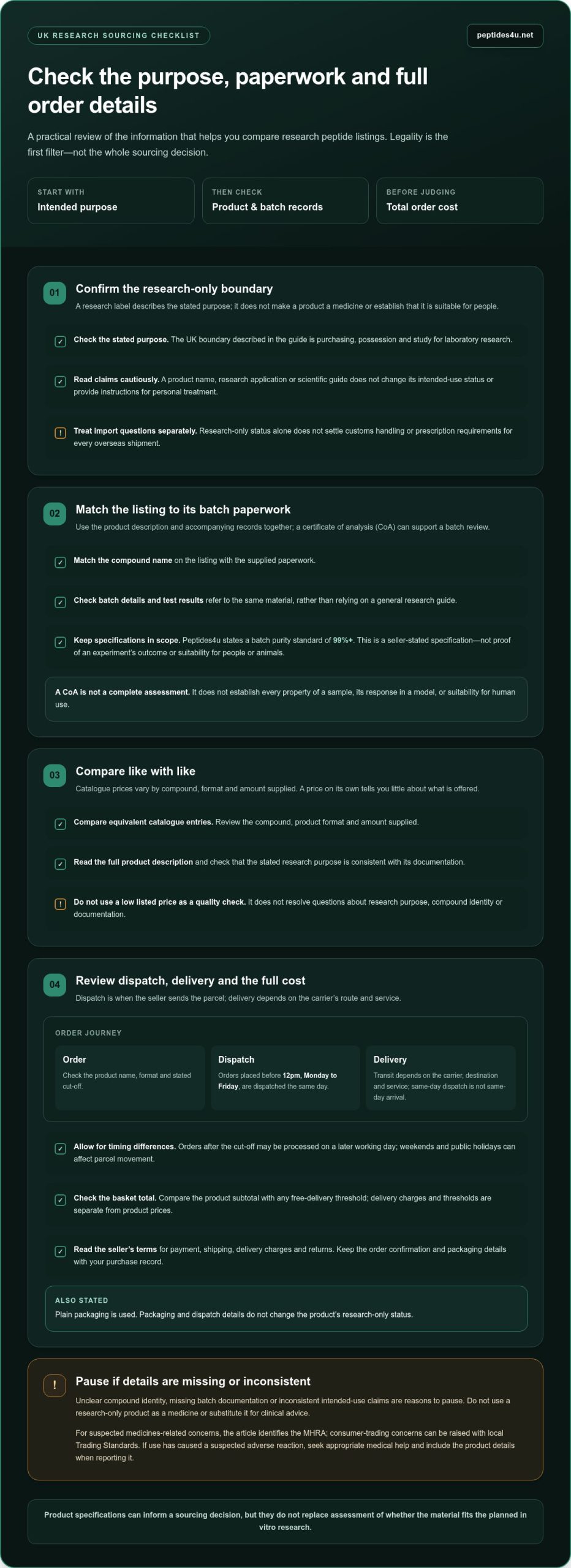
Check the documentation systematically. Match the compound name on the listing to the supplied paperwork. Confirm that batch details and test results refer to the same material, rather than relying on a general research guide. A certificate of analysis can support a batch review, but it does not establish suitability for human use.
Product prices vary by compound, format and amount supplied. Compare equivalent catalogue entries and read each full product description before judging value. A low listed price does not resolve questions about research purpose or documentation. Focus on the intended laboratory work, compound identity and records supplied.
What are research peptides?
Research peptides are compounds studied for their structure and activity in controlled scientific settings. Laboratory work may examine how a peptide behaves in vitro, meaning outside a living organism. This context differs from human or veterinary use. A product described strictly for research is not thereby a medicine or treatment.
For online orders, dispatch and delivery are separate stages. Dispatch means the seller has sent the parcel; delivery depends on the carrier’s route and service. Orders placed before 12pm, Monday to Friday, are dispatched the same day. Plain packaging is used. These details help set expectations, but same-day dispatch does not mean same-day arrival.
Delivery timing can depend on the dispatch cut-off, selected service, destination and carrier handling. An order placed after the daily cut-off may be processed on a later working day. Weekends and public holidays can also affect parcel movement. Read delivery terms as a sequence: order processing, dispatch and then estimated transit.
A free-delivery threshold is the basket value at which the delivery charge is removed. Compare your product subtotal with that threshold before adding items. Basket value affects the total paid, so assess the full checkout cost rather than the product price alone. Delivery charges and thresholds are separate from product prices.
Payment, shipping and returns policies vary between sellers. The terms should explain accepted payment methods, including cryptocurrency payments, dispatch arrangements, delivery charges and how returns are handled. Returns may depend on the product’s condition and the seller’s process. Keep the order confirmation and packaging details together so you can refer to the purchase record easily if an issue arises.
Review your order before checkout. Match the product name and format to the intended in vitro research, then check the stated dispatch cut-off and delivery charge. Confirm the total, including any delivery fee, and keep the order confirmation after payment. These steps help distinguish a dispatch estimate from an arrival estimate.
For a straightforward product browse, view the peptide product range and compare the product details with your research requirements.
When reviewing a research peptide, a stated purity figure is one part of the product information, not a complete description of its identity, handling, or suitability for a particular experiment. Peptides4u states that its research peptide batches have a purity standard of 99%+. This is the seller’s stated batch standard; it should be read as a specification rather than a conclusion about what an experiment will show.
Researchers can assess product details in light of the question being examined and the conditions of the work. A purity standard alone does not establish every property of a sample, its response in a model or its suitability for use in people or animals. The research-only context remains important: product specifications can inform a purchasing decision, but they do not replace the researcher’s assessment of whether the material fits the planned in vitro work. Keeping claims within their stated scope distinguishes product specifications from claims about outcomes or treatment.
Certificates of analysis
A certificate of analysis (CoA) records test results for a product or batch. For research peptides, its value depends on whether the document identifies the material being offered and presents results clearly. Treat it as evidence to assess, not proof that a compound is suitable for human or veterinary use.
UK suppliers differ in how they describe purity testing, provide certificates and link documents to individual batches. Compare the details: a batch-specific certificate is more useful for traceability than a general document without a matching batch identifier. Check that the product label, certificate and batch paperwork refer to the same compound.
High-performance liquid chromatography, or HPLC, is a method for separating components in a sample. A test report may use an HPLC result to describe purity. Read the stated method and result together. A purity figure alone does not explain the full test scope, identify every possible contaminant or establish how a peptide should be used.
Review the certificate in a consistent order:
- Match the compound name to the product description.
- Match the batch identifier to the vial or accompanying paperwork.
- Read the reported test method and purity result in context.
- Check the document date and whether its results concern the supplied batch.
- Keep the certificate with the order record for later reference.
Batch traceability connects a supplied item to its production and testing record. A certificate that names a batch makes it easier to compare the document with the product label. If a document describes a different compound or has no matching identifier, it cannot establish that the tested sample and supplied item belong to the same batch.
Look for legible results, clear compound identification and a direct link to the relevant batch. A document labelled “certificate” is not automatically batch-specific. Similarly, a testing claim on a product page is not the same as reviewing the associated report. These distinctions help separate documented evidence from general marketing language.
Bacteriostatic water is a separate product, not a peptide purity result. Its documentation should identify the water rather than be treated as evidence for a peptide batch. Keep each certificate linked to the correct item, especially when an order contains multiple compounds or supporting products.
Use the CoA to assess documentation quality and traceability, not to make a treatment decision. Research peptides are supplied exclusively for research purposes under their stated research-use status. HPLC testing and batch certificates can inform sourcing, but they do not change a product’s intended use or establish safety for people.
UK peptide catalogue and product prices
A useful catalogue clearly states the compound, format and amount supplied. Compare these details before judging listed prices or availability.
Product Concentrations and Sizes
Start with the label’s stated quantity and format. The related-products range includes Semaglutide 30mg and bacteriostatic water in a 10ml bottle. These are different product types, so compare each listing on its own terms. Check whether the stated amount refers to the full vial, pen or bottle, rather than assuming formats are interchangeable.
Some research peptides are supplied as lyophilised, or freeze-dried, material in sealed vials. This describes the format, not its concentration or suitability for human consumption. Keep the product’s stated research purpose in view. Products supplied strictly for laboratory research are not medicines for personal use.
Prices and Delivery Fees
There is no single UK-wide price for peptides or delivery. Product prices depend on the compound, format and amount; delivery fees depend on the seller’s shipping terms and order value. The checkout total combines the selected items with any applicable delivery charge.
For a fair comparison, start with the same compound and format. Then compare the stated amount supplied and the final checkout total. A larger quantity can affect the price without making two products equivalent. Check whether the listed price is per vial, pen or bottle before comparing baskets.
Product Availability
Catalogue availability can change by compound and format. A product page may show a specific item, such as Semaglutide 30mg, whilst a different format may not appear in the same range. Read the current listing and its product details together; a catalogue category alone does not establish that every format is available.
UK suppliers sell research products through online catalogues, but a listing alone does not establish legitimacy. Assess the seller’s product information, batch-linked documentation and stated research-use terms. Compare those records with the label and the exact item offered. Clear, consistent details make it easier to understand what is being supplied.
Concentration, total quantity and format answer different questions. Concentration describes the amount relative to a stated volume or presentation; total quantity describes the product amount. For example, a 30mg listing identifies a stated amount, while a 10ml bottle identifies a volume. Don’t treat these units as directly comparable.
Availability also affects price comparisons. If one catalogue lists a peptide in a sealed vial and another offers a different format, the products may not be comparable. Check the compound name, presentation and stated amount before comparing. Record those details alongside the delivery charge so the checkout totals reflect equivalent baskets.
Research products have a stated purpose. A catalogue description or price does not establish suitability for human consumption. Keep the distinction clear: assess the listing for research purposes, then use compound documentation to understand the item supplied. This keeps price comparisons separate from claims about personal use or treatment.
Peptide product range
A catalogue is easier to assess when products are grouped by compound, format and stated amount. For UK research, these details help distinguish peptide products from supporting items. Keep each entry’s research-use-only wording in view. A product’s place in a catalogue does not establish suitability for human use.
One related-products list includes Semaglutide 30mg and bacteriostatic water in a 10ml bottle. These entries describe different product categories: one names a peptide and amount, whilst the other names a liquid and volume. Don’t compare them as equivalent options. Start with the compound or material relevant to the research question.
Format affects how a product is described and packaged. Peptides may be supplied as lyophilised material in sealed vials. When you buy peptides online in the UK, check that the listing clearly identifies the compound and stated amount. Don’t infer these details from the vial alone. Match the label and accompanying batch documents to the catalogue entry.
Storage information also varies by product state. Unopened lyophilised vials are described as remaining stable for years when stored frozen. Reconstituted peptides are recommended for refrigeration at 2-8°C. These temperature details concern different states of the product, so read the storage guidance alongside the format and packaging information.
Review a catalogue entry in a set order:
- Identify the compound name and research-use wording.
- Separate the stated quantity from the container volume.
- Note whether the product is lyophilised or a supporting item.
- Match packaging and batch paperwork to the specific entry.
- Read storage information for the product’s stated condition.
That comparison prevents a 30mg peptide listing being confused with a 10ml liquid listing. It also makes product descriptions easier to compare across UK research peptide catalogues without assuming that similar packaging means equivalent contents. Record the exact name, format and quantity for each item under consideration.
Orders may contain more than one product type, so keep their records separate. For example, file the peptide’s batch document with its product details and keep the bacteriostatic water listing distinct. This makes it easier to trace which packaging and storage instructions apply to each item.
If you’re deciding where to buy peptides online in the UK, narrow your options by compound and format, then review each listing’s supporting details. Explore the available peptide product options when comparing products for research purposes.
Peptides4u: Plumas SereneQ
Peptides4u offers Plumas SereneQ as an option to consider after comparing product formats and documentation. Use the checks in this guide to assess whether its listing fits your sourcing criteria. Review the product information, intended purpose and supporting details before making a decision.
Keep research-use boundaries clear. A product listing does not replace scientific documentation or establish suitability for human use. To compare a specific offering, start with its product details and assess them against your requirements. Apply the same measured approach you would use for any catalogue entry.
Visit Peptides4u online to view Plumas SereneQ.
Make your next sourcing decision with care
Before you buy peptides online in the UK, decide what product information you need. Keep your research purpose clear, and make sure the description and supporting documents answer the questions that matter for your work. A considered choice starts with a clear requirement, not a rushed checkout.
Peptides4u offers Plumas SereneQ and Viales specialised formulations. If either offering is relevant to your sourcing decision, review its product information alongside the criteria you have established. Keep the intended purpose in view and avoid treating a product listing as medical guidance.
For questions about these offerings or the information presented, contact Peptides4u with your questions. Take the next step when you are ready, with your requirements clear and your decision grounded in the details that matter.
Frequently Asked Questions
Are peptides legal to buy online in the UK, and which rules apply?
Research peptides can be purchased, possessed and studied in the UK only for laboratory research. That does not make them suitable for human use or turn them into medicines. Before ordering, distinguish a product’s stated research purpose from any claims suggesting personal use. Overseas shipping can raise separate customs and prescription questions, depending on the product and circumstances. The research-only boundary remains central to the sourcing decision.
What are research peptides, and are they approved for human use in the UK?
Research peptides are compounds supplied for scientific investigation, such as laboratory studies of their properties. They are not presented as products for human use. Peptides4u states that its products are supplied strictly as laboratory research chemicals and are not for human or veterinary use. A product name, catalogue category or research description does not establish that a peptide is suitable for people. Keep research findings separate from personal health decisions.
How can buyers spot counterfeit, contaminated, or misleadingly marketed peptides?
Compare the product name and batch number on the packaging with the matching certificate, then use any stated verification feature to check that record. For example, Peptides4u describes independent HPLC identity and purity testing by Analiza Białek, with certificates published on product pages and QR verification for pens. Treat mismatched identifiers, unclear test records or claims of human-use benefits as warning signs. Keep the listing and packaging details with your purchase records.
1 comment