What to Check Before Buying Peptides for Purity and Price

“Pharmaceutical grade” is a claim, not proof of quality or suitability. Knowing what to check before buying peptides means looking beyond the label: assess the certificate of analysis, supplier details, product specifications, cost per milligram and shipping conditions. A grade label alone cannot answer those questions.
It’s reasonable to expect clear evidence behind purity claims and a price that makes sense for the quantity supplied. A certificate needs to identify what was tested, while the supplier should give enough detail to understand the product and its handling. If those basics are hard to establish, a low price or confident label won’t fill the gap.
This guide sets out the checks to make before you decide. You’ll learn how to read grade claims and certificates, compare cost per milligram fairly, and assess the information about the supplier and transit conditions. Use the points together, not as a substitute for considering whether a product is appropriate for you.
Key Takeaways
- Treat “pharmaceutical grade” as a claim to examine, not proof of quality or suitability.
- Read certificates of analysis for the test results and product details they actually show.
- Look for clear supplier identity, manufacturing information and product specifications.
- Compare price per milligram using the amount of peptide stated, not the pack price alone.
- Check how the product is packed and handled in transit, especially if temperature or light could affect it.
1. Does “pharmaceutical grade” mean anything?
“Pharmaceutical grade” is a claim to assess, not proof of quality or suitability. A practical approach to what to check before buying peptides starts by asking what the grade refers to, who assessed the product and whether the evidence applies to its specific batch. A label stating “99% pure”, for example, needs supporting evidence, not just prominent packaging.
Research-grade and pharmaceutical-grade describe claims, but neither label answers every question about a product. A research-use-only label means the product is presented for research, not personal use. It does not establish that the product has been tested for human use or is suitable for it. If a seller pairs that label with wellness promises, scrutinise the mismatch.
Are peptides legal to buy and use in the UK? There isn’t one blanket answer for every peptide; the position depends on the substance, how it’s supplied and its intended use. Buying a product and using it as a treatment are separate questions, so a research label alone doesn’t settle either one.
Which UK regulations apply to buying peptides for research or personal use? The applicable rules depend on the product and how it is presented or used. Check the stated purpose and status rather than treating a research-use-only label as permission for personal use. The label alone does not explain the legal position for every peptide.
How can I tell whether a peptide is approved for medical use in the UK? Look for product-specific evidence of medical authorisation, rather than relying on “pharmaceutical grade” or a seller’s badge. Match the exact product and intended use; a claim about a peptide category doesn’t establish approval for a particular product.
Evidence matters. Research on a peptide may involve animals, small groups or anecdotal reports, leaving uncertainty about benefits and risks for people. Evidence for one research purpose does not establish effectiveness for a broader wellness claim. When considering what to check before buying peptides, compare any claims with the evidence described and note where the claims go beyond it.
What are the health risks and side effects of unapproved peptides? Their effects and risks may be uncertain, and product quality can affect what a person receives. Possible concerns include unwanted effects, interactions with medicines and reactions to ingredients. The substance, product contents and person’s health all matter.
What questions should I ask a doctor or pharmacist before using a peptide? Give them the product name, label and intended use, then discuss your health conditions, medicines, supplements, allergies and past reactions. Ask what evidence supports the proposed use, which side effects to watch for and what to do if a reaction occurs. Those details make the discussion specific.
2. Interpreting purity claims and certificates of analysis
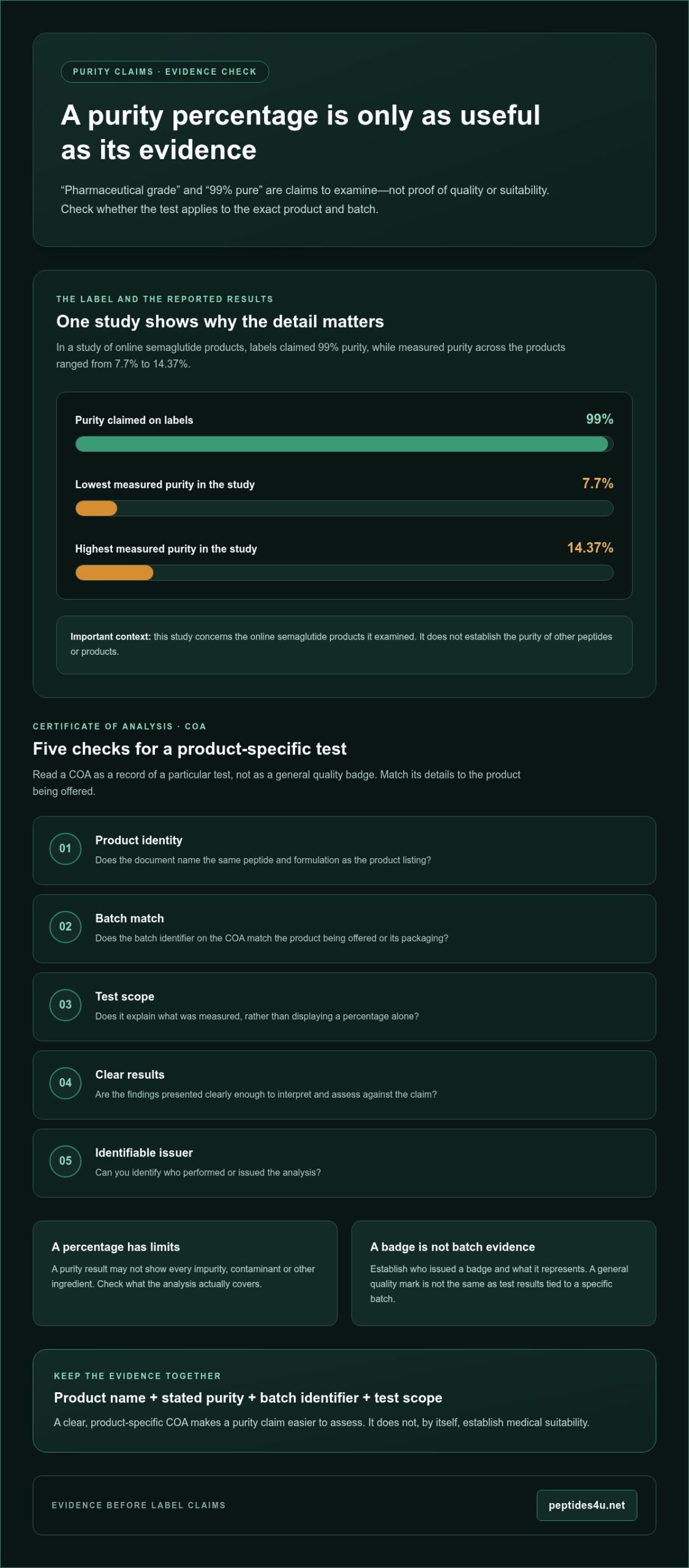
A purity percentage needs context. It may describe the measured amount of the named peptide, but does not by itself show what else is present or whether the figure applies to the product you will receive. Check that the claim relates to the exact peptide, formulation and batch, rather than a general product description. A certificate of analysis (COA) can help assess the evidence.
The difference between a label and a test result matters. In a study of online semaglutide products, measured purity ranged from 7.7% to 14.37%, despite labels claiming 99% purity, according to The study authors. The example shows why a bold percentage should prompt a closer look. It does not establish the purity of other peptides or products.
Read a COA as a record of a particular test, not as a badge. Match the product name and batch identifier on the document to the listing or packaging, then check what the analysis measures. A stated purity result may not cover every impurity, contaminant or other ingredient. Look for the test method and results that support the specific claim.
- Product identity: Does the document name the same peptide and formulation?
- Batch match: Does its batch identifier match the product being offered?
- Test scope: Does it say what was measured, rather than only displaying a percentage?
- Results: Are the findings presented clearly enough to interpret?
- Issuer: Can you identify who performed or issued the analysis?
A logo or certification badge needs the same scrutiny. Establish who issued it, what standards it reflects and whether it has medical or regulatory meaning. A badge without those details cannot show that a specific batch passed a relevant test. A general quality mark, for example, is not the same as test results tied to the peptide in your basket.
Apply the same checks to purity claims shown on selected products. One product’s COA doesn’t demonstrate the purity of another product, even if both appear in the same catalogue. Look for evidence that matches the precise item and batch. For a practical comparison of product presentation, view the peptide product range alongside any available batch-specific analysis.
Keep each claim beside its evidence. Note the product name, stated purity, batch identifier and test scope before comparing options. If a certificate lacks those details, its headline percentage gives little basis for judging purity. A clear, product-specific COA makes a claim easier to assess, but does not establish medical suitability.
3. Checking supplier identity and specifications
A clear product page should identify the supplier and the peptide. Start with the trading name, product name and a working contact route. Compare those details across the listing, order confirmation and packaging. If the names differ, clarify which business is responsible for the product. Consistent details make it easier to know where to direct product questions.
Read the specification as if you were matching a label to an order. Check the peptide name, amount, formulation and listed ingredients. A vial and a pre-filled pen, for example, are different formats; the description should make clear which is being sold. Do not infer contents from a product photo or short headline. The specification should describe the exact item you intend to buy.
Look for information about where the peptide was made or prepared. Broad phrases such as “high quality” do not explain its origin or preparation. Specific details help distinguish a product description from a general promise. If a supplier says a product is compounded, check who prepared it and what process is described. The word “compounded” alone does not explain who made it or how.
Check whether the listing gives a batch identifier and product-specific documentation. These details can connect the item in your order with its paperwork. Keep the listing and order details together, then compare the name, formulation and batch information on the packaging. This can reveal a mismatch, such as paperwork for a different formulation or product.
- Identity: Record the supplier’s trading name and the contact route for product questions.
- Specification: Match the peptide name, amount, formulation and ingredients to the listing.
- Origin: Look for specific information about where it was made or prepared.
- Preparation: For a compounded product, identify the pharmacy and how it was prepared.
- Support: Establish who to contact about side effects, questions or a reaction.
Support matters after delivery, too. A responsible supplier should explain who handles questions, side effects or a reaction. Find that contact route before purchase, and note whether it directs you to someone who can address product queries. A generic form with no clear purpose gives less practical guidance than a named support channel and a stated reason to use it.
Use these checks together. A detailed listing cannot replace clear supplier details, and a contact route cannot establish product contents. If the listing names one formulation but the packaging names another, pause and resolve the discrepancy before relying on either description. Clear identity, specific product information and a defined contact route make the purchase easier to assess.
4. Calculating cost per milligram
Peptide prices in the UK vary with the stated amount, format, formulation and what the price includes. An unusually low price may reflect a smaller quantity or a different presentation, so compare like with like before judging the cost.
For a basic comparison, divide the listed price in pounds by the total milligrams stated for that product. The result is the cost per milligram. Use the price and total amount shown for the same item, rather than comparing a vial with a pen or another formulation.
Read the quantity carefully. A product title may show the amount in the container, while the listing describes a different measure or formulation. Use the total peptide amount stated for the exact item. Do not treat the liquid volume as the peptide quantity: millilitres and milligrams measure different things.
Before comparing listings, note the peptide name, amount, form and price. Check whether both products contain the same peptide and state the same quantity. A lower pack price is not automatically better value if the pack contains less. Cost per milligram clarifies the quantity comparison, but cannot establish product quality.
- Price: Use the listed amount in pounds for the exact item.
- Quantity: Take the total peptide amount stated for that product.
- Calculation: Divide price by milligrams to get cost per milligram.
- Comparison: Match peptide, amount and format before comparing results.
Check what the price includes. A listing may describe a pen, vial or another format, and these are not directly interchangeable. Compare the price and stated peptide quantity for the same type of item. If a product page gives several amounts, use the amount for the option you selected, not another size shown nearby.
Consider what an unusually low price could mean. It may reflect a smaller amount, a different formulation or product details that make comparison difficult. If the quantity and format appear equivalent, a striking price difference is a reason to examine the specification and supporting information closely. Price alone does not show purity, batch identity or suitability.
Keep a short comparison record: product name, format, stated milligrams, listed price and calculated cost per milligram. This makes the source of each figure clear and helps prevent mix-ups between similarly named items. Use the calculation to compare quantities, then assess product evidence and handling separately. The lowest cost per milligram does not, by itself, prove the best choice.
5. Checking cold-chain packing and transit time
Temperature and light matter during peptide transport. The stated handling advice is to keep peptides refrigerated and in a dark container during transit, because heat and light can degrade them. For peptides in solution, the stated storage range is 2-8 °C. Use the product’s specific storage instructions when assessing how it should be packed and handled after arrival.
Look for a clear explanation of the packaging method. Insulation and a cold source can help limit temperature changes during transit, but packaging details alone do not show the conditions inside a parcel. Check whether the supplier explains how the product is protected from heat and light, and whether those instructions match its storage requirements.
Transit time is part of the same assessment. A parcel may pass through several stages, including collection, sorting and final delivery. Consider the peptide order dispatch and delivery arrangements alongside the storage instructions. A short journey does not replace suitable packaging, and protective packaging cannot make unclear handling guidance useful.
Before ordering, look for practical details about moving the product from delivery into storage. Check whether it needs refrigeration on arrival and how it should be kept away from light. Plan to store it as directed promptly, rather than leaving a temperature-sensitive parcel in a warm place or direct sunlight.
- Packaging: Look for details on insulation, temperature protection and light protection.
- Transit: Consider the stated dispatch and delivery window, not just the order date.
- Storage: Match the product’s instructions to the conditions available at home.
- Arrival: Know where the parcel will be received and how quickly you can store it correctly.
A product supplied in solution has a specific reference point: the stated storage range is 2-8 °C. Keep that figure distinct from general advice about refrigeration. Check the label and accompanying instructions for the exact product, then make sure the transit and arrival plan supports them. Don’t assume every peptide has identical storage needs.
Keep a record of the product instructions and delivery details. If the parcel arrives with damaged packaging or the product appears inconsistent with its storage guidance, retain the packaging and product information. These details will help when raising a delivery or product-handling question.
Review the peptide product details and storage information before placing an order. Match those instructions to your delivery plans, then arrange suitable storage before the parcel arrives.
Peptides4u: Plumas SereneQ
Peptides4u offers Plumas SereneQ as an option to consider after reviewing the checks in this guide. Use the same careful approach: read the product information, compare its stated details with your requirements, and consider whether the product’s intended purpose is appropriate for you.
Purity documents, supplier details, cost comparisons and handling conditions each answer different questions. No single label or price can replace reviewing the information relevant to the product. If you’re considering Plumas SereneQ, use those checks to make an informed decision about whether to proceed.
For information about Plumas SereneQ, visit peptides4u.net.
Make your next decision with confidence
Knowing what to check before buying peptides gives you a practical way to decide what matters next. Set your requirements first: identify the product you are considering, the evidence you need and the information that would leave you uncertain. This keeps the decision focused on your priorities, not a persuasive label or rushed comparison.
Peptides4u offers high-grade research compounds, including Plumas SereneQ. If you’re considering any option, use the same careful approach and review the details relevant to your choice. A clear question is a useful starting point, whether it’s about a product or the information available for it.
Contact Peptides4u with your questions. Take your next step at a pace that feels informed and considered.
Frequently Asked Questions
Does “pharmaceutical grade” mean anything?
It isn’t enough to establish what a product is or how it may be used. Treat the phrase as a seller’s description, then look for product-specific evidence and a clearly stated intended purpose. For products sold by Peptides4u, the boundary is explicit: they are supplied strictly as a laboratory research chemical and are not for human or veterinary use. A quality claim does not change that restriction.
How can I tell whether a supplier holds UK stock?
A UK-facing website does not, by itself, show where a particular parcel will be dispatched from. Look for clear dispatch information, delivery terms and tracking details that apply to your order. Compare these with the order confirmation. A UK-based retailer can make domestic ordering straightforward, but dispatch origin and delivery arrangements are the practical details that explain how the parcel will reach you.
What should I check before buying research peptides in the UK?
First, check that the product is clearly presented for research and not as something for personal use. Then match its name, form and stated contents across the product description and supplied paperwork. Keep a copy of the listing with your order details. This gives you a record of what you selected and helps distinguish a research product from claims about a human-use purpose or outcome.
Why is cost per milligram better than unit price?
Cost per milligram accounts for the amount stated in each product, making differently sized packs easier to compare. A lower unit price may simply reflect a smaller quantity. Match the peptide and product form first, then divide each price by its stated milligrams. This gives a quantity-based comparison, not a measure of purity, suitability or overall product quality.
How can I verify a peptide supplier’s legitimacy and reputation?
Look for a consistent trading identity, clear product information and a usable route for order or product enquiries. Separate customer feedback about delivery from evidence about product contents; one doesn’t prove the other. Peptides4u publishes batch test certificates for its SereneQ products, with testing by Analiza Białek using HPLC. For any supplier, consider what the documents actually establish, rather than relying on ratings or promotional wording alone.
What certificates of analysis and independent lab tests should peptide products have?
Look for product-specific documentation that identifies the peptide, the batch tested, the test method and the reported results. A certificate should be relevant to the product being offered, not simply a general quality statement. Peptides4u states that SereneQ batches receive independent HPLC testing by Analiza Białek, with certificates published on product pages. Read the stated scope carefully; a purity result does not automatically answer every question about a product.
How can I check peptide purity, identity, and contamination risks?
Check whether the supporting report addresses identity as well as purity, and whether it applies to the batch in question. Read the test scope and results together. A purity figure alone does not identify every possible contaminant or prove none are present. Keep the distinction clear: laboratory results describe what was tested, while a product label describes what the seller says is supplied.
What storage, shipping, and expiry details should I check before buying peptides?
Read the product’s own storage instructions, expiry information and transit guidance as a set. Check whether the stated conditions apply to the product before opening or after preparation, since those are different stages. For SereneQ pens, Peptides4u states: “Store refrigerated at 2 °C-8 °C. Do not freeze.” Its stated expiry is “12/2027 on sealed, correctly stored stock.” Follow the exact product instructions and packaging.
1 comment